Kitchen Trolley Shelves for Commercial Foodservice Operations
Kitchen trolley shelves help commercial kitchens move ingredients, trays, cookware, tableware, and cleaning supplies between busy work zones without slowing down service. In restaurants, hotels, central kitchens, cafeterias, and catering facilities, fixed storage alone is rarely enough because staff need equipment that can move safely from dry storage to prep, from washing to service, and from cold rooms to production lines. For B2B buyers, the real question is not simply which trolley looks suitable, but which shelf structure, caster system, material grade, and size can support daily foodservice use.
Use Cases for Kitchen Trolley Shelves
A commercial kitchen trolley is most useful when items need to move repeatedly across different areas during the working day. Unlike a fixed rack, it supports short-distance transport, temporary sorting, and fast access during peak service. This makes it valuable not only in restaurant kitchens, but also in hotel banquet areas, staff canteens, institutional kitchens, and food production spaces.
In daily operations, a foodservice trolley may carry prep containers from storage to the production line, while a restaurant service cart may move clean plates, trays, or serving items closer to the dining area. In larger kitchens, a kitchen storage trolley can help teams reduce unnecessary walking, especially when supplies are shared between multiple workstations.
Common applications include:
- Moving ingredients from dry storage or cold rooms to prep areas.
- Transporting cookware, trays, and utensils between washing and cooking zones.
- Holding sauces, condiments, packaging materials, or small tools during service.
- Supporting banquet, buffet, or catering preparation before food is served.
- Organizing cleaning supplies in wet kitchen or dishwashing areas.
For buyers comparing stainless steel trolley shelves, the most important point is to define the trolley’s route and workload before confirming the model. A stainless steel trolley with wheels used in a narrow restaurant aisle may need a different design from one used in a hotel kitchen corridor or central kitchen production area.
Where Mobility Adds Value
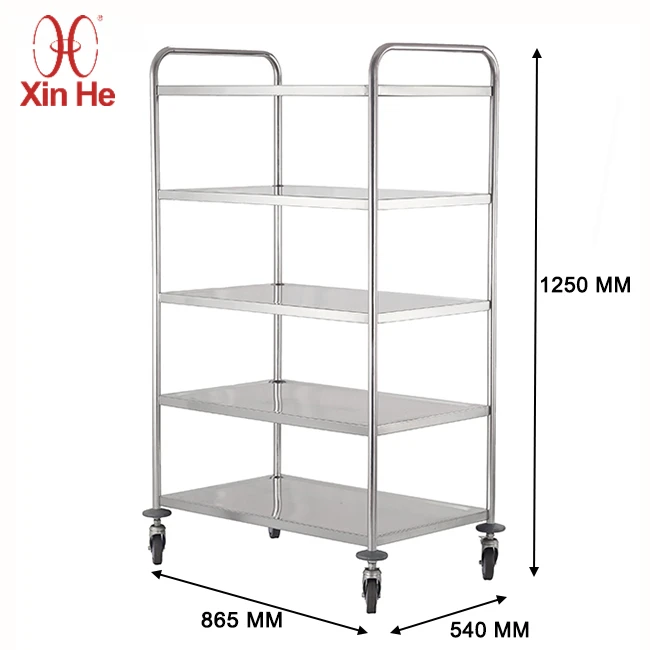
The value of a mobile unit is most visible when teams need to bridge gaps between fixed work zones. A shelf may store items well, and a table may support preparation well, but a trolley connects the workflow. In a high-volume kitchen, that connection can reduce handling time, lower the risk of dropped items, and keep fast-moving supplies closer to where staff actually need them.
Why Stainless Steel Works
Foodservice environments expose equipment to moisture, oil, heat, cleaning chemicals, and constant handling. This is why the stainless steel kitchen trolley remains a preferred option for many commercial projects. Compared with painted steel, wood, or plastic alternatives, stainless steel is easier to wipe down, less likely to retain stains, and better suited to repeated cleaning routines.
For higher hygiene requirements, buyers often ask about a 304 stainless steel trolley, especially for hotel kitchens, central kitchens, school cafeterias, and food processing areas. However, material grade should always be confirmed with the supplier based on the intended use, cleaning routine, and budget. A good purchasing decision should consider not only the grade of steel, but also shelf thickness, surface finish, welding quality, and edge treatment.
A stainless steel utility cart for commercial kitchen use should be evaluated as part of the broader kitchen system. If the same project also includes sinks, cabinets, floor drains, hand wash stations, and preparation equipment, buyers may find it more efficient to coordinate specifications through one source for commercial kitchen equipment solutions.
What Buyers Should Inspect
Surface quality matters because it affects daily cleaning. Smooth, easy-clean shelves are faster to sanitize and less likely to trap food residue. Welded corners, reinforced undersides, and polished edges also influence long-term durability. For heavy daily use, these details can matter more than small price differences.
Choosing Shelf Tiers
The number of shelves should match the items being moved, not simply the desire for more storage. A kitchen trolley with shelves can be configured in different ways, but more tiers are not always better if the trolley becomes difficult to clean, unstable when loaded, or inconvenient for staff to access.
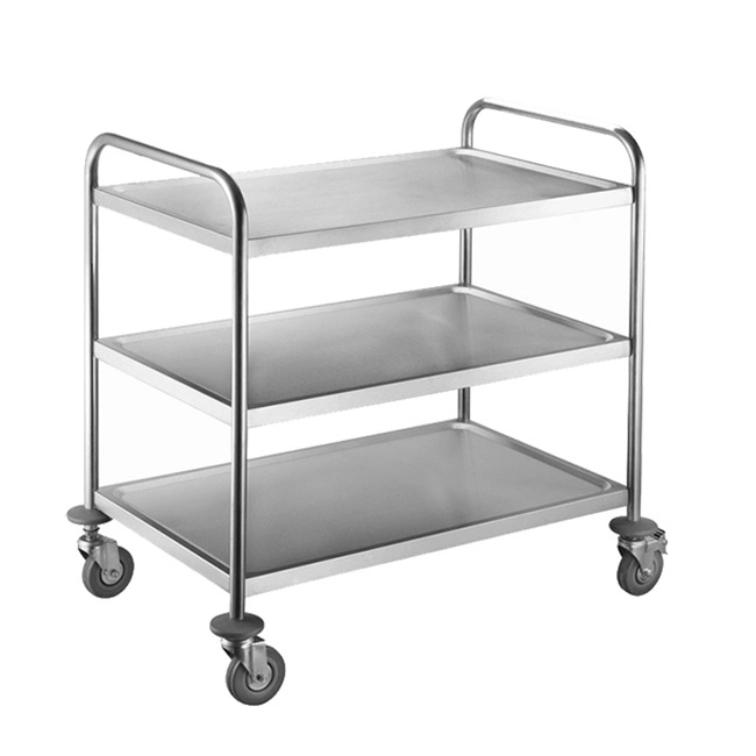
A 2-tier trolley is often suitable for taller items, bulk containers, or heavier cookware that needs more vertical clearance. A 3 tier kitchen trolley is practical when staff need to separate plates, trays, ingredients, or light tools during service. In some cases, more tiers may be useful for lightweight goods, but buyers should consider visibility, turning stability, and ease of unloading before choosing a taller design.
| Shelf Configuration | Best Fit | Buying Consideration |
|---|---|---|
| 2-tier trolley | Tall containers, cookware, bulk ingredients | More vertical space, easier loading for larger items |
| 3-tier trolley | Plates, trays, condiments, small tools | Better separation for daily foodservice tasks |
| Multi-tier trolley | Lightweight items on fixed routes | Check stability, access height, and cleaning convenience |
For buyers searching for a 3 tier stainless steel trolley, the shelf spacing is just as important as the number of levels. If trays, pans, or containers do not fit comfortably, the trolley may create more handling problems than it solves.
Matching Tiers to Workflow
A commercial foodservice cart used during meal service may benefit from three levels because different items can be separated by function. A cart used for bulk ingredient movement may perform better with fewer, stronger shelves. The right choice depends on what the team carries most often, how far the trolley moves, and how quickly staff need to load or unload items.
Load and Structure
For commercial use, buyers should not choose a trolley only by price, size, or appearance. Load capacity affects safety, durability, and daily handling. A heavy duty kitchen trolley used for cookware, packed food, ingredient bins, or trays must have a shelf structure strong enough to support repeated loading, not just occasional light use.
A heavy duty stainless steel trolley should be checked for:
- Load capacity per shelf and total load capacity.
- Shelf thickness and underside reinforcement.
- Welding quality at joints and corners.
- Smooth edges to reduce injury risk during handling.
- Raised edges or guard rails where items may slide.
- Handle position and grip comfort for frequent movement.
A stainless steel trolley shelf may look simple, but small structural differences can affect long-term performance. Thin shelves may flex under repeated loads, rough edges may create handling risks, and weak welds may fail faster in high-traffic kitchens. Buyers should confirm load requirements with the supplier before ordering, especially for hotel, central kitchen, institutional, or food production projects.
Questions to Ask Before Ordering
Before approving a model, procurement teams should ask what the trolley will carry, how often it will move, and whether staff will load it from one side or multiple sides. They should also confirm whether the product will be pushed over wet floors, floor drains, thresholds, or elevator gaps. These practical details often reveal whether a standard model is enough or a reinforced option is required.
Caster Quality
The caster system often determines whether a trolley feels safe and efficient in daily use. In a busy foodservice facility, a trolley may pass through narrow aisles, wet floors, storage rooms, dishwashing zones, and service corridors. Poor wheels can make movement noisy, unstable, or physically tiring for staff.
A stainless steel trolley with wheels should be checked for wheel diameter, swivel performance, brake reliability, and floor compatibility. Swivel casters make turning easier in tight layouts, while lockable casters help keep the trolley stable when loading or unloading. For kitchens with wet floors, buyers should also consider wheel grip and corrosion resistance.
A restaurant service cart stainless steel design may prioritize smooth movement between kitchen and service areas, while a catering trolley for hotel kitchen use may need stronger casters for banquet trays, longer corridors, and repeated movement during event preparation.
Locking and Turning
A kitchen trolley with lockable casters is especially useful when the trolley is used as a temporary holding station. Staff can lock it in place during unloading, plating, or sorting, then release the brakes when the trolley needs to move again. This small feature can improve both safety and workflow control in high-pressure service periods.
Sizing by Project
The right size depends on the kitchen layout, not just the product catalog. A hotel kitchen may need a larger catering trolley for banquet trays and event preparation, while a compact restaurant may require a narrower model that can pass through tight back-of-house aisles. Central kitchens may need larger units for batch movement, but they also need enough turning space around production lines and washing areas.
Before confirming dimensions, buyers should check:
- Aisle width in prep, cooking, washing, and storage areas.
- Door width, elevator access, and corridor turning radius.
- Height clearance under shelves, counters, or pass-through areas.
- Size of trays, containers, cookware, or packaging materials.
- Staff operating height for safe loading and unloading.
- Storage space when the trolley is not in use.
A custom stainless steel kitchen trolley may be more practical when standard dimensions do not match the workflow. This is common in hotel kitchens, central kitchens, school canteens, airport kitchens, and food production facilities where equipment must fit fixed routes and repeated handling patterns.
Avoiding Oversized Trolleys
Larger is not always better. An oversized trolley may carry more items, but it can also block aisles, slow staff movement, and create safety issues during peak hours. For project buyers, the best size is usually the one that moves smoothly through the real kitchen route while carrying the required load.
Trolley Shelves vs Tables vs Racks
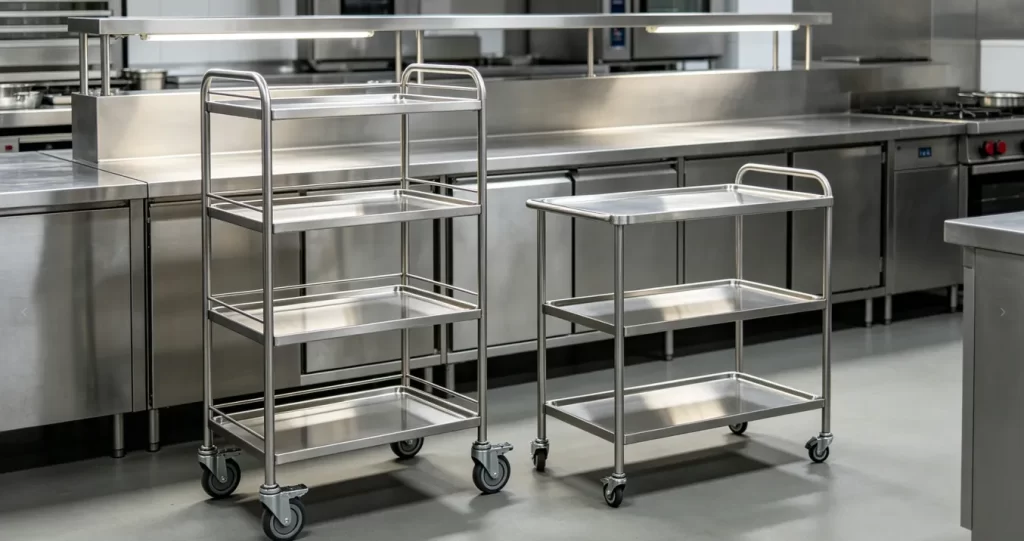
Kitchen trolley shelves should not be treated as a replacement for every table or fixed rack. Each product type serves a different role in a commercial kitchen. A stainless steel work table supports stable food preparation, a fixed shelf supports long-term storage, and a trolley supports movement between work zones.
This distinction matters because many buyers compare these products during a kitchen project. For chopping, mixing, or food assembly, a stainless steel work table for prep areas provides the stable surface staff need. Long-term storage of dry goods, cookware, or equipment is usually better handled by fixed shelving. When the job involves moving trays, ingredients, tools, or supplies between work zones, a trolley becomes the more practical choice.
| Equipment Type | Main Function | Best Use Case |
|---|---|---|
| Work table | Stable preparation surface | Cutting, sorting, assembly, plating preparation |
| Fixed shelving | Long-term storage | Dry goods, cookware, containers, inventory |
| Trolley shelves | Mobile transport and temporary organization | Moving items between storage, prep, washing, and service |
Working Together
In many commercial kitchens, these products are not competitors. They work together. The work table supports production, the fixed shelf keeps supplies organized, and the trolley keeps materials moving. This combined setup is especially useful in high-volume kitchens where staff need both stable work surfaces and flexible transport.
Custom Options
Standard trolley models may be suitable for simple restaurant use, but project buyers often need more precise configurations. Custom options become important when the trolley must fit a specific route, carry a defined tray size, support heavier loads, or meet the operating habits of a particular kitchen team.
A commercial kitchen trolley supplier should be able to discuss practical options such as shelf spacing, shelf quantity, handles, raised edges, caster type, brake configuration, and overall dimensions. A stainless steel foodservice trolley used in a central kitchen may need stronger shelf reinforcement, while a hotel banquet trolley may need dimensions based on standard tray sizes.
Custom requirements may include:
- Special length, width, or height for narrow aisles.
- Adjusted shelf spacing for trays, pans, or ingredient bins.
- Raised edges to reduce sliding during movement.
- Side handles or push handles for easier control.
- Lockable casters for stable loading and unloading.
- Reinforced shelves for heavier daily loads.
- Surface finish options based on cleaning requirements.
For project buyers, working with a kitchen trolley manufacturer can help align the trolley with real operating conditions instead of forcing staff to adapt to unsuitable standard equipment. Buyers reviewing custom trolley shelf options should prepare basic information about layout, load, route, and intended use before requesting a quotation.
When Customization Is Worth It
Customization is most valuable when the trolley affects daily productivity. If staff use the equipment many times per shift, small improvements in caster quality, shelf spacing, handle design, or size can save time and reduce handling strain over the life of the project.
Procurement Checklist
Before placing a bulk order, buyers should review both product construction and operational fit. This is especially important for wholesalers, importers, contractors, and commercial kitchen equipment distributors who need products that can serve different project types.
| Buying Factor | What to Confirm | Why It Matters |
|---|---|---|
| Material | Stainless steel grade, finish, and thickness | Affects hygiene, corrosion resistance, and service life |
| Shelf design | Tier count, spacing, raised edges, reinforcement | Determines usability and load performance |
| Casters | Swivel, brake, wheel material, floor suitability | Controls movement, safety, and handling comfort |
| Size | Length, width, height, aisle and door fit | Prevents workflow obstruction |
| Custom support | Load, dimensions, handles, casters, packaging | Helps match project requirements |
A careful checklist helps buyers avoid common mistakes, such as choosing too many shelves, ignoring caster quality, or selecting a size that cannot move smoothly through the kitchen. It also helps distributors and contractors communicate more clearly with end users before confirming specifications.
FAQ
What are kitchen trolley shelves used for?
They are used to move and temporarily organize ingredients, trays, cookware, tableware, cleaning supplies, and service items in restaurants, hotels, cafeterias, central kitchens, and other commercial kitchen environments. Their main value is supporting transport, storage flexibility, and service preparation between different work zones.
Is stainless steel better for commercial kitchen trolleys?
Stainless steel is commonly preferred because it is easy to clean, resists corrosion better than many coated materials, and suits high-frequency foodservice environments. Buyers should still confirm material grade, surface finish, welding quality, and load requirements based on the actual project.
Should I choose a 2-tier or 3-tier model?
A 2-tier model is often better for taller containers or heavier items that need more vertical clearance. A 3-tier model is useful when staff need to separate plates, trays, tools, or light ingredients. The decision should be based on item height, weight, access needs, and kitchen space.
What caster type is suitable for foodservice trolleys?
Swivel casters are useful for turning in narrow spaces, while lockable casters help keep the trolley stable during loading and unloading. For wet kitchen floors, buyers should also check wheel grip, brake reliability, movement noise, and corrosion resistance.
Can trolley shelves be customized?
Yes. Buyers can often request custom dimensions, shelf spacing, load capacity, caster types, handles, raised edges, and other details based on project requirements. Customization is especially useful for hotels, central kitchens, catering operations, and commercial kitchen renovation projects.
Final Buying Advice
Choosing the right kitchen trolley shelves can make daily foodservice work safer, cleaner, and more efficient. For restaurants, hotels, central kitchens, cafeterias, and catering facilities, the best trolley is not simply the lowest-cost option. It is the one that fits the real workflow, load requirement, aisle space, cleaning routine, and movement pattern of the kitchen.
Buyers should compare stainless steel material, shelf structure, caster quality, size, and customization options before placing an order. Looking for kitchen trolley with stainless steel shelves for a commercial foodservice project? Contact Xinhe to discuss trolley sizes, shelf structures, caster options, and custom manufacturing support for bulk orders or project procurement.