Home > Blog > Public Products >
Wudu Foot Washer Design Guide for Public and Commercial Facilities
Most people don’t think much about foot washers until they’re standing in a finished washroom watching water pool around someone’s ankles. By then, the spec sheet is already a problem.
If you’re sourcing a wudu foot washer for a school, an airport, a community center, or any kind of high-traffic public building, the brief is rarely as simple as “a sink, but lower.” The unit has to handle dozens — sometimes hundreds — of uses a day. It has to stay clean without exhausting the cleaning crew. It has to drain properly even when several people are using it at once. And it has to keep doing all of that five, ten years in. This guide walks through the parts of that decision that tend to trip projects up, plus what to actually ask a supplier before you commit.
Why a Generic Basin Doesn’t Cut It
A hand basin and a wudu foot washer might look related on paper. In practice, they fail in very different ways when you use one as the other.
Hand basins sit too high. Their bowls are too shallow. The drains aren’t sized for the volume of water that comes off a quick foot rinse, let alone several rinses happening in the same minute. You also can’t really lean on the edge of a wash basin without worrying about the bracket — but people will absolutely sit on the edge of whatever you install in a wudu area, whether the spec said to or not.
The damage usually shows up in three places:
- Water ending up on the floor instead of in the drain
- Slip incidents that the facility manager has to write up
- Cleaning staff fighting limescale and soap residue in corners that were never meant to be scrubbed twice a day
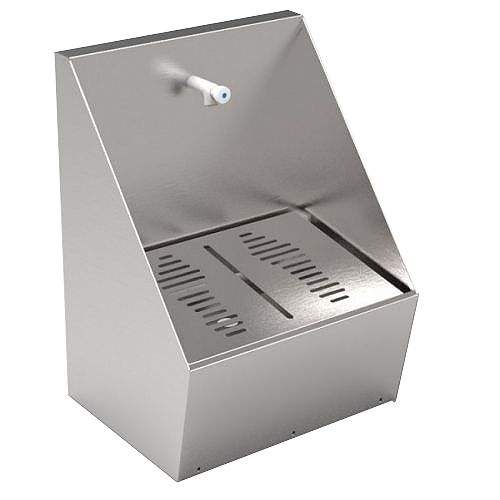
A purpose-built commercial wudu wash station is a different fixture entirely — lower, deeper, with drainage sized for the actual use case and edges that handle weight.
What to Sort Out Before You Spec
There are four things that matter most in this category: how people move through the space, how the water leaves the unit, what the unit is made of, and how easily someone can clean it. The order matters, and the first one gets skipped the most often.
Flow and Space First
Walk the site before you look at any catalog. It sounds basic, but plenty of projects buy units that won’t fit the way the room actually works.
A few things to figure out:
- Is this a one-person unit, or does peak demand need a row of four or six?
- Does the unit sit along a wall, in a corner, or down the middle of the room?
- Are seats or grab bars needed? Older users and accessibility-driven projects often require them.
- Does the route from the entry door to the unit cross a wet zone? If yes, you’ll need to plan slip protection.
The wudu sink isn’t a standalone fixture. It’s part of how the whole wet area circulates, and the design only works if you treat it that way.
Getting Drainage Right
This is the single biggest variable, and the one that costs the most when it’s wrong.
| Drainage Factor | What It Affects |
|---|---|
| Drain outlet position | How fast water clears when multiple people use the unit at once |
| Bowl depth and slope | Whether water pools or splashes onto the floor |
| Splash guard / apron | How much water ends up on adjacent walls and floors |
| Floor drain alignment | Whether the room drains as a system or just relocates the puddle |
| Floor finish around the unit | Slip risk in the surrounding zone |
The unit and the floor drain need to be specified together. A great wudu foot washer paired with an undersized stainless steel floor drain is still a problem — just a more expensive one.
Material: 304 or 316, and Why It Matters
Stainless steel is the default for good reasons — it resists corrosion, takes cleaning chemicals without complaint, and survives years of daily punishment. But not all stainless is equal.
304 grade works for most indoor public installations. 316 makes more sense near coasts, in humid climates, or anywhere salt is in the air. Sheet thickness is the part buyers often miss: a 1.0 mm bowl and a 1.5 mm bowl will look identical on day one and behave very differently by year five. Ask for the thickness in writing, and ask about how the welds are finished — exposed weld seams in a wet zone trap residue and corrode faster.
A brushed finish hides the small scratches that everyday use creates. Rounded internal corners save the cleaning team real time.
Cleaning Is Where the Real Cost Lives
The purchase price is a one-time number. The cleaning hours are forever.
Smooth interiors with no exposed seams. Strainers that actually come out for rinsing. Enough clearance underneath or behind to reach the plumbing when something needs servicing. Surfaces that respond to ordinary commercial cleaners — nothing exotic.
A unit that takes an extra fifteen minutes a day to clean costs the facility more over its lifespan than almost any specification upgrade you could make upfront.
Installation Formats That Actually Get Used
There’s no universal “right” configuration. The format follows the room.
Single-user units suit smaller washrooms — boutique hospitality, mid-size offices, smaller community spaces. Easy to integrate, easy to retrofit.
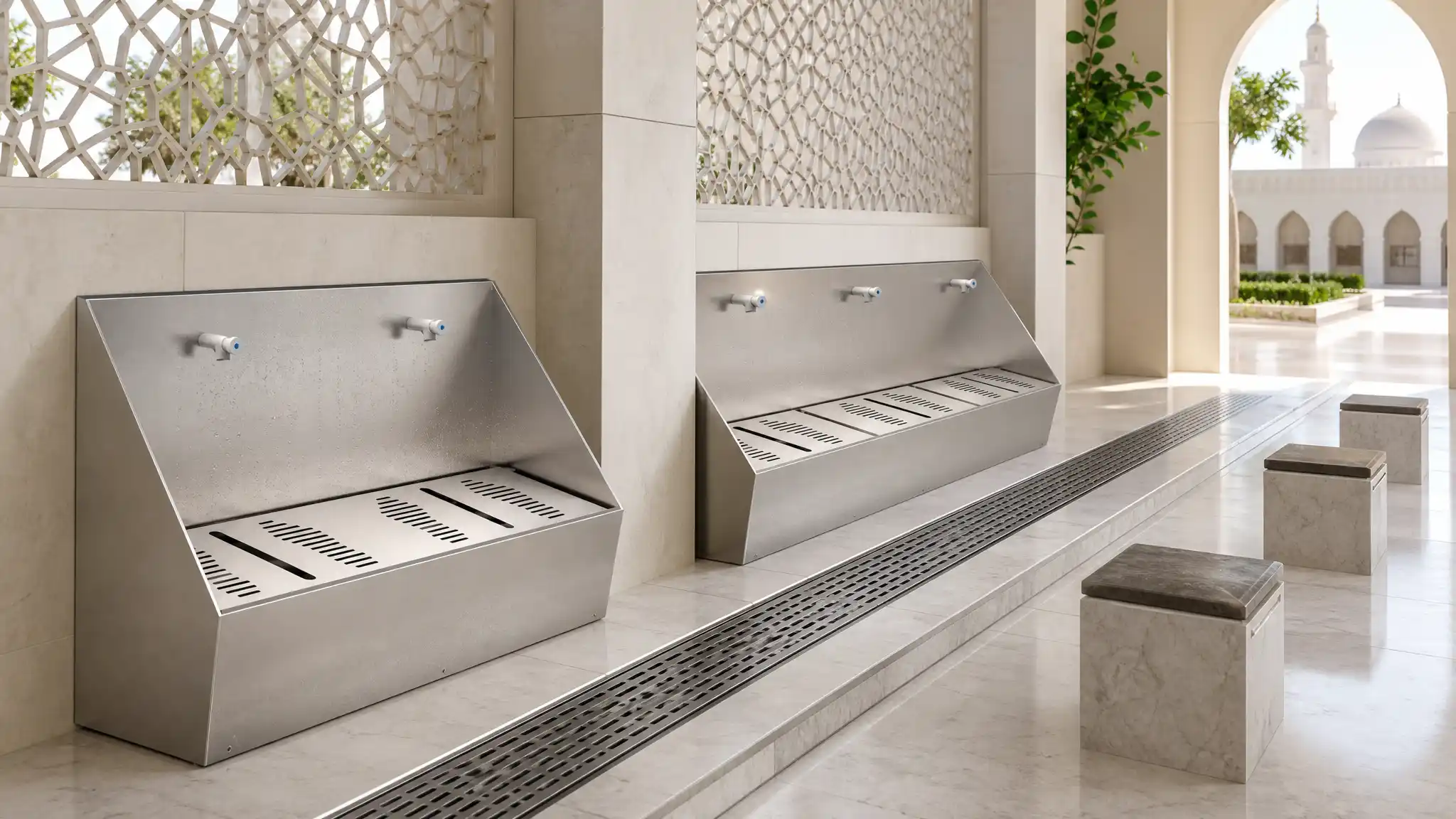
Multi-user bench layouts show up in airports, university campuses, large mosques, and transport hubs where four to ten people might be washing at the same moment. These usually run along a wall with continuous drainage.
Wall-hung vs. floor-mounted is a structural call. Wall-hung makes the floor easier to clean but demands the wall can carry the load. Floor-mounted is more forgiving of wall conditions but routes the drain differently. A custom floor-mounted wudu foot washer with an integrated seat, for instance, suits prayer rooms and mosque ablution areas where users wash one at a time but throughout the day.
Custom stainless steel fabrications become necessary when standard sizes don’t fit — odd room dimensions, integrated seating, specific drain positions, or coordination with the rest of the washroom finish package. Lock the wall position, water supply, drainage outlet, floor slope, and cleaning access before the custom drawings get signed off. Changes after fabrication get expensive fast.
Where These Units End Up
Different settings stress different parts of the spec.
Schools care about durability and rounded edges, since the users are young and the use is constant. Airports prioritize throughput — water needs to clear between waves of travelers, and the wudu area often sits alongside other public fixtures like outdoor drinking fountains that face the same high-frequency conditions. Office and commercial buildings care about visual fit and space efficiency more than raw capacity. Community centers and public buildings often go through tender processes where documented certifications carry real weight; a verified set of stainless steel fixtures for public facilities tends to clear those reviews more easily. Hospitality projects want the unit to read as architecture, not as plant equipment, so finish quality and visible welds become part of the conversation.
Picking a Supplier Who Won’t Disappear
Choosing a wudu sink supplier on unit price alone is the kind of decision people regret around the time the second shipment arrives damaged.
A supplier worth working with should be able to:
- Talk about your installation in technical terms, not just send a catalog
- Show real stainless steel fabrication capability beyond simple sheet bending
- Provide CAD or shop drawings when you ask
- Quote custom dimensions and multi-user layouts without acting like it’s exotic work
- Pack and ship internationally with units that arrive intact
- Run repeat orders that match the first batch in specification and finish
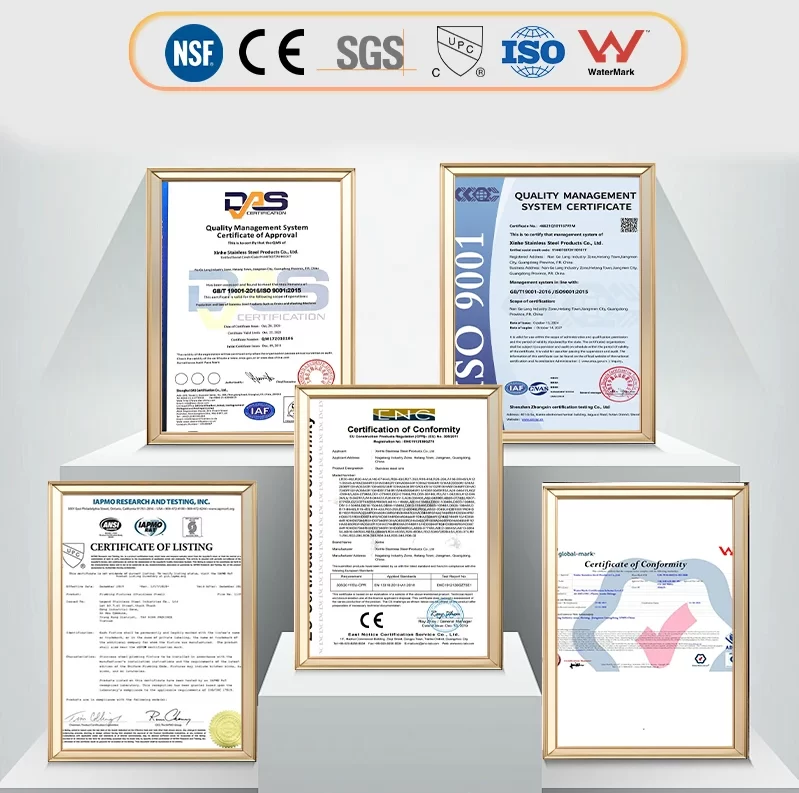
Certifications matter here — NSF, ISO 9001, CE, SGS, Watermark. They’re not decorative; in some markets they determine whether the unit can even be installed.
Working on a public washroom or commercial wash area? Reach out to Xinhe to talk through wudu foot washer dimensions, drainage details, and custom production for your project.
Foot Washer vs. Standard Basin
A quick side-by-side, since this question comes up in nearly every early project meeting:
| Feature | Standard Wash Basin | Wudu Foot Washer |
|---|---|---|
| Mounting height | Hand height (~800–850 mm) | Lower position, often with seat |
| Bowl depth | Shallow | Deeper, sized for feet |
| Splash control | Minimal | Apron, guard, or recessed design |
| Drainage capacity | Sized for handwashing | Sized for higher-volume rinsing |
| Load-bearing | Light point load | Built to take partial body weight |
| Typical thickness | Standard gauge | Heavier gauge for commercial use |
Using a hand basin as a foot washer creates problems that cost more to fix than the right unit cost in the first place. A dedicated foot washing fixture is the simpler call.
Five Things People Get Wrong
After enough project conversations, the same mistakes show up:
- Specifying the unit without specifying the drain. Always coordinate both from the start.
- Forgetting to ask the cleaning team anything. They know things the spec sheet doesn’t.
- Skipping the anti-slip flooring. A perfect unit on a slippery floor is still a liability.
- Sizing for average use, not peak. Queues form fast in public spaces.
- Leaving custom dimensions and lead times for the last minute. Custom stainless work needs weeks, sometimes more.
None of these are dramatic on their own. Together, they’re behind most of the post-installation complaints in this category.
Why Stainless Steel Wins Long Term
Pulling the threads together: a stainless steel wudu foot washer earns its place because it absorbs everything a public facility throws at it. Constant use without surface fatigue. Cleaning that doesn’t slow staff down. Custom sizes when the room demands them. And — this part gets undervalued — it coordinates with the rest of the washroom package. When the urinals, toilets, hand wash troughs, and floor drains come from a single manufacturing platform, installation goes faster, finishes match, and replacement parts stay sourceable years later.
FAQ
1. What is a wudu foot washer used for in public facilities?
It’s a dedicated foot-washing fixture built for high-frequency, multi-user public and commercial washrooms. The focus is on safe access, controlled drainage, easy cleaning, and durability — not aesthetic flourish.
2. Is stainless steel a good material for a commercial wudu sink?
For most public projects, yes. 304 grade works indoors; 316 is the call for coastal or harsh environments. It resists corrosion, handles frequent cleaning, and fabricates well into project-specific custom sizes.
3. Can a wudu foot washer be customized?
Most commercial-grade units can be customized — length, number of positions, drainage outlet, seating, handrails, overall dimensions. Confirm what’s possible and the lead time with the supplier early, before drawings get locked.
4. What should buyers check before ordering?
Overall dimensions, material grade and sheet thickness, drainage configuration, installation method, expected peak user volume, cleaning access, supplier production capacity, international packaging quality, and certifications required for the destination market.
Before You Sign the PO
Most wudu foot washer projects don’t fail at the catalog stage. They fail at the handover, when the floor’s wet, the drain’s in the wrong spot, and the cleaning team is already complaining. Getting it right is less about finding the perfect unit and more about pairing the right unit with the right room.
If you’ve got a project on the table and need someone who can actually read your drawings, Xinhe is open to that conversation. Send the layout, the user volume, the climate — and we’ll come back with sizing, material, and lead time.