OEM Stainless Steel Manufacturing: How to Partner with a Factory for Custom Sanitary Projects
Sourcing custom stainless steel sanitary products for a commercial or institutional project differs fundamentally from buying off a catalog. A procurement director at a North American healthcare company or a European kitchen equipment brand searches for a manufacturing partner, not a SKU. They need a factory that owns a problem from blueprint to shipping container. Selecting the right stainless steel sink manufacturer directly affects your margin, project timelines, and legal standing in regulated industries.
This guide explains what separates a capable OEM partner from a commodity vendor, how the engineering process works for custom sanitary projects, and what to evaluate before signing a supply agreement.
1. Why OEM Partnership Goes Beyond Unit Price
Most procurement teams discover the gap between a factory and a manufacturing partner during a crisis. A custom dimension fails to fit the installation space. The surface finish fails a hospital’s infection control audit. Or a container clears customs in Rotterdam but gets flagged in Chicago. Choosing the right stainless steel sink manufacturer prevents those scenarios before they start.
Supply Chain Stability as a Selection Criterion
A factory that stamps out standard product faces the same risks as its buyers: raw material price swings, port congestion, labor shortages. A manufacturer with genuine engineering depth absorbs those shocks differently.
Xinhe operates four production bases across China’s Pearl River Delta region and Vietnam, running over 500 skilled staff including 20 engineers and 45 QC specialists. That distribution is a deliberate hedge. If a single facility faces a production constraint, the manufacturing pipeline keeps moving. For buyers running commercial construction projects with fixed completion dates, that redundancy matters more than a price difference of a few percentage points per unit.
Buyer Tip: Ask any prospective manufacturer to show you their production distribution. A single-facility supplier with no backup site is a concentration risk. Request their contingency protocol for production disruption before you finalize terms.
Vetting R&D and Mold Library Depth
A manufacturer’s R&D capability tells you how far beyond standard catalog items they can go. Two signals matter most: the engineering team’s pedigree and the proprietary mold library.
| Indicator | What to Ask | Why It Matters |
|---|---|---|
| Engineering pedigree | Where did the lead engineers work previously? | Brand-level R&D experience shapes tolerance and finishing standards |
| Mold library size | How many existing proprietary molds do you maintain? | Larger libraries cut lead times and lower MOQ for custom configs |
| Tooling cost transparency | What is the tooling cost for a new dimension? | Vague answers signal they lack the library |
Xinhe maintains proprietary molds. For most commercial dimensions, a buyer does not pay for mold development from scratch. That library compresses lead times and reduces the minimum viable order quantity for custom configurations. For a detailed look at how custom sink fabrication works in practice, see our guide to custom three compartment sink fabrication.
2. The OEM Engineering Workflow: Concept to Prototype
For buyers new to OEM procurement, the process between “we need this product” and “this product is on a boat” feels opaque. Understanding the actual engineering workflow removes that uncertainty.
Four-Hour Design Drawings
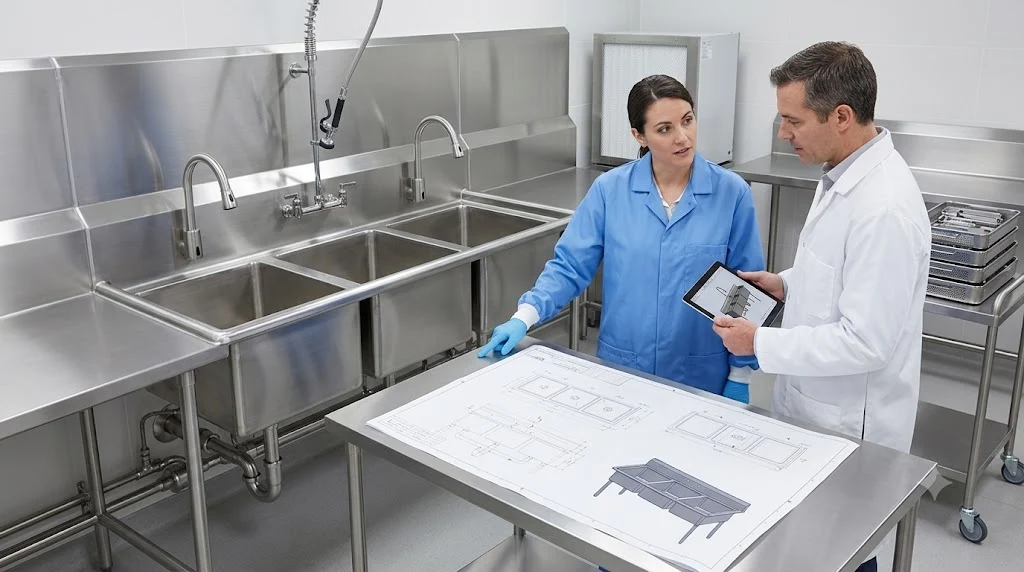
A qualified stainless steel sink manufacturer starts the conversation with drawings, not with a price. Once a buyer submits a project brief (intended installation environment, regulatory certification requirements, approximate volume), the engineering team returns a set of design drawings within a business day. Xinhe’s standard is four hours for free design drawings.
That turnaround tells you whether the engineering team is staffed to service your project in real time, or whether your questions will queue behind a backlog. The technical evaluation that follows (assessing dimension viability, appropriate gauge, and manufacturing method) happens within 24 hours.
Expert Recommendation: Use the design drawing stage to test communication quality, not just technical output. How precisely does the engineering team interpret your requirements? Do they identify potential compliance conflicts before you do? A factory that catches a regulatory mismatch at the drawing stage saves you a costly prototype revision later.

The 72-Hour Prototype Milestone
Prototype delivery speed reflects how well a factory organizes its production workflow. A 72-hour prototype turnaround requires the engineering team, mold shop, and production line to coordinate without scheduling friction.
For buyers managing a construction timeline, this matters concretely. A three-day prototype cycle instead of a three-week one lets you iterate on fit, finish, and function without delaying your installation team. On a large project with multiple custom sink configurations, each iteration cycle adds up.
Before approving any prototype:
- Test it physically against installation conditions, not just visually
- Verify the outlet position and bracket mounting points under load
- Confirm the surface finish under the installation environment’s lighting
- Check dimensional tolerances with calibrated tools
Factories that push back on prototype testing requirements reveal something important about how they handle problems after the bulk order ships.
3. Manufacturing Methods: Deep-Drawn vs. Welded
Not every custom sanitary project should be manufactured the same way. The choice between deep-drawn and welded construction affects hygiene performance, structural integrity, per-unit cost, and lead time. Understanding the tradeoffs helps you specify correctly and evaluate quotes accurately.
Deep-Drawn Construction: Volume and Hygiene
Deep-drawing uses hydraulic presses to form a bowl from a single sheet of stainless steel in one operation. No seams. No weld lines. The finished bowl carries an NSF compliance advantage for food-contact and healthcare environments because bacteria have nowhere to accumulate at a joint.
The tradeoff is that each unique dimension requires a dedicated mold, and the economics only make sense above roughly 500 units. For a restaurant chain rolling out a new kitchen layout across 300 locations, deep-drawn construction at scale is the correct choice.
Welded Fabrication: Flexibility and Precision
Welded fabrication uses laser cutting, press brake folding, and TIG welding to build bowls without mold investment. The geometry flexibility is much greater: extra-deep bowls, non-standard widths, custom mounting configurations. The per-unit labor cost is higher, but for projects under 500 units or with genuinely unusual dimensional requirements, welded construction is typically more cost-effective.
| Method | Best For | MOQ Threshold | Key Advantage |
|---|---|---|---|
| Deep-Drawn | High-volume standard dimensions | 500+ units | Joint-free, NSF-friendly |
| Welded | Custom geometry, low volume | Flexible | No mold investment |
Engineering Insight: Deep-drawing stretches the stainless steel during forming, which means the original sheet gauge thins at the corners and lower sidewalls. A 16-gauge sheet may finish at approximately 19-gauge in the highest-stress zones. Reputable manufacturers compensate by starting with heavier-gauge raw stock and applying stress-relief treatment after drawing. Ask for production documentation showing the post-draw gauge measurement at the bowl radius.
4. Custom Sanitary Products Across Project Types
A capable stainless steel sink manufacturer serves multiple regulated industries. The mold library and engineering team must handle diverse dimensional requirements across healthcare, correctional, and commercial food service environments.
Commercial Kitchen Sinks
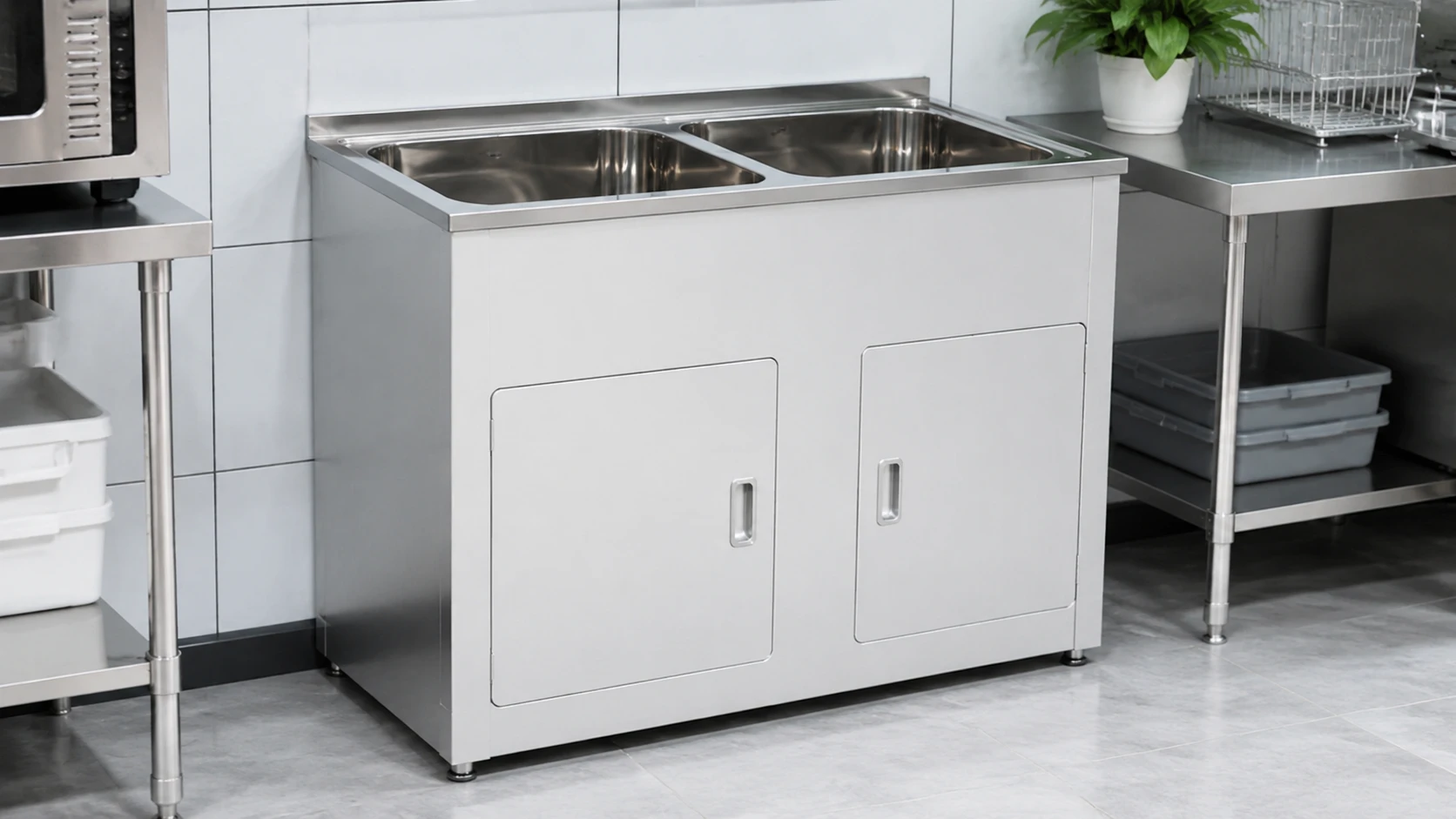
Commercial kitchens require NSF-compliant washing and prep stations. A custom three compartment commercial sink built to project-specific dimensions ensures compliance with local health codes while fitting the available floor space. Buyers specify bowl depth, drainboard length, and backsplash height to match the kitchen’s workflow.
Medical and Sanitary Fixtures
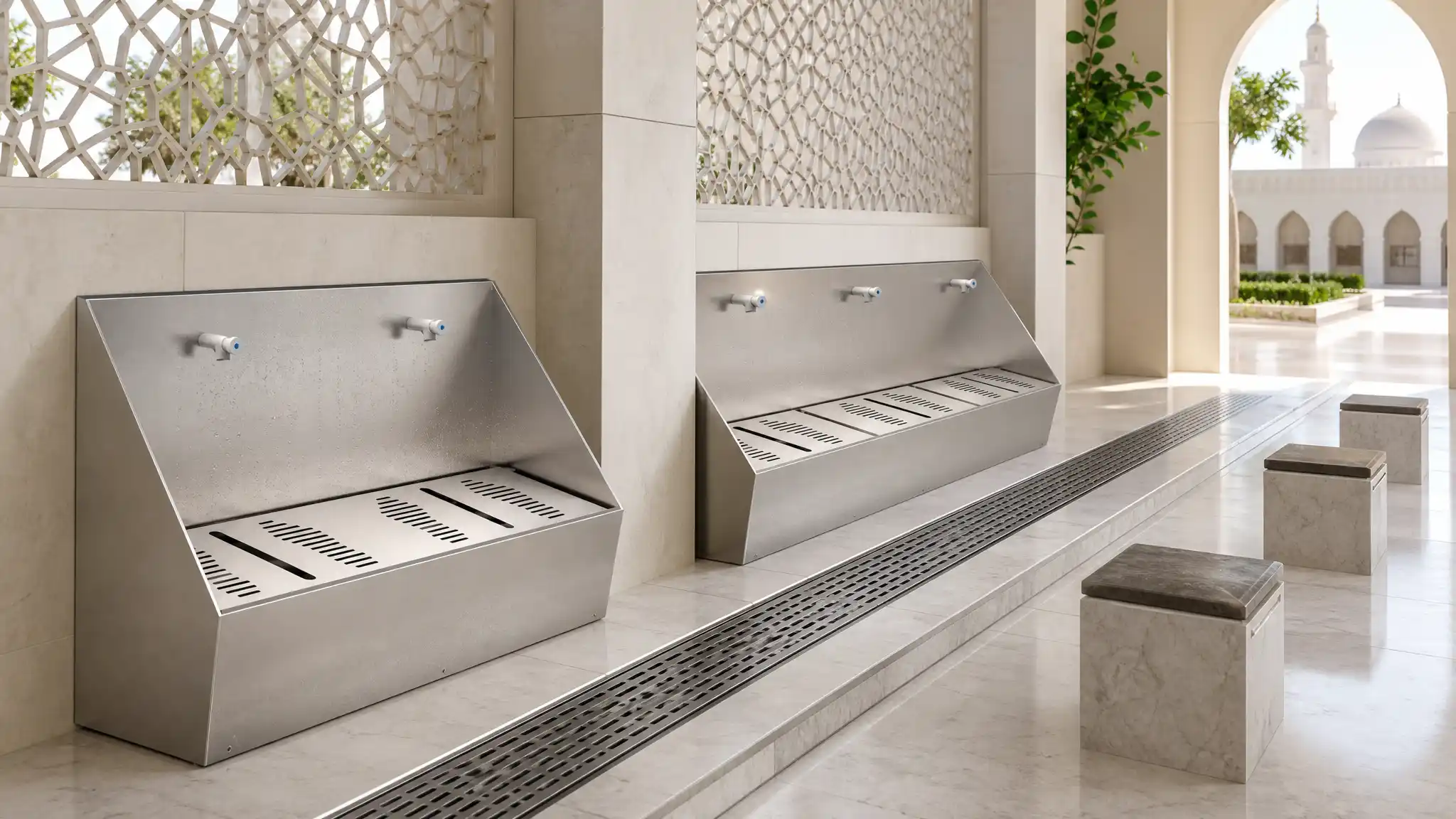
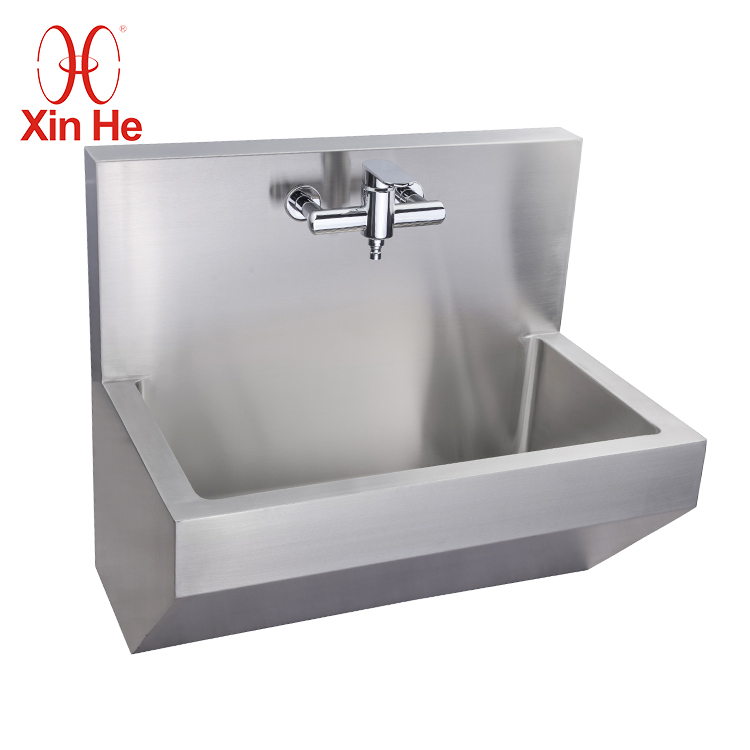
Healthcare projects demand stricter surface standards and material grades. A modular hospital scrub sink in Grade 304 or 316 steel meets infection control requirements while allowing layout reconfiguration as clinical needs change. Manufacturers with medical project experience understand the certification reviews and documentation that clinical environments require.
Correctional and Public Facility Equipment
Correctional facilities need vandal-resistant plumbing fixtures. The same OEM factory that produces commercial sinks also manufactures anti-ligature toilets and integrated sink-toilet units for secure facilities. Specifying these products from a single manufacturer simplifies compliance documentation and logistics coordination.
5. Global Logistics and the Dual-Base Advantage
A manufacturer’s production capability is only part of the equation. For international buyers, the logistics chain from factory to job site carries its own complexity: tariff classification, freight routing, customs documentation, and last-mile coordination.
China and Vietnam: Tariff Optimization
The current US tariff environment creates a meaningful cost distinction between Chinese-manufactured goods and goods produced in Vietnam. For buyers sourcing commercial kitchen and sanitary equipment for North American projects, a manufacturer with production capacity in Vietnam offers a concrete tariff advantage that compounds across large orders.
Xinhe’s Vietnam facility operates within the same supply chain network as the China plants, sharing engineering resources and quality systems while shipping directly to North American ports under more favorable tariff classifications. For a procurement team running the landed cost calculation on a 1,000-unit order, the difference is not marginal.
Buyer Tip: Always request a landed cost breakdown, not a factory gate price. Include ocean freight, port handling, import duties specific to your HTS classification, and local delivery to site. A cheaper factory gate price from China can be outweighed by tariff exposure, particularly on equipment categories subject to Section 301 increases.
Export Documentation and Certification
Xinhe works with a vetted network of 10 to 15 freight forwarders to manage international shipping, customs clearance, and delivery across North America, Europe, and Australia. For buyers without a dedicated logistics team, this network removes the burden of managing freight coordination independently.
The critical detail is documentation quality. Customs delays on commercial equipment orders typically trace back to incorrect or incomplete shipping documentation, not freight capacity issues. A manufacturer whose export team has processed thousands of international shipments builds the documentation correctly the first time.
Xinhe holds CE certification and full export qualifications, and supports buyers across NSF, CE, and Watermark certified projects. Working with a single manufacturing partner who understands all three certification frameworks reduces the compliance coordination burden.
Engineering Insight: When specifying NSF-certified products for US commercial kitchen projects, confirm that the NSF certification applies to the specific model and configuration you purchase, not just the manufacturer’s production line in general. NSF certifications are issued to specific product models. A custom dimension, even from a certified factory, requires its own certification review. Build that review timeline into your project schedule.
6. Why Xinhe: Three Decades of Engineering at Scale
Xinhe was founded in 1990 and has grown into a recognized national high-tech enterprise and the Guangdong Provincial Engineering Research Center for Stainless Steel Products. Those designations reflect a specific capability: the ability to conduct stainless steel product R&D at an institutional level, not just manufacture to a buyer’s spec.
The company serves long-term OEM relationships with internationally recognized brands including Elkay, Franke, and Loggere. Those relationships provide a reference point that a certification document alone cannot. A brand like Franke does not maintain a multi-year OEM supply relationship with a factory that delivers inconsistent quality.
Production Capabilities at a Glance
| Metric | Value |
|---|---|
| Founded | 1990 |
| Production bases | 4 (China Pearl River Delta + Vietnam) |
| Total staff | 500+ (20 engineers, 45 QC specialists) |
| Proprietary molds | 6,000+ |
| Design drawings | 4 hours (free) |
| Prototype delivery | 72 hours |
| Bulk production | 15 days (standard configs) |
| Certifications supported | NSF, CE, Watermark, cUPC, ISO 9001 |
The 15-day bulk production turnaround on standard configurations compresses project timelines in a meaningful way. For a commercial construction project with a fixed opening date, three weeks of recovered schedule time is a legitimate business value.
7. FAQ
What is the minimum order quantity for custom stainless steel sanitary products?
There is no universal answer because it depends on whether an existing mold covers your required dimensions. For configurations within the existing 6,000+ mold library, minimum quantities can be considerably lower than for genuinely new tooling development. Request a tooling assessment before you calculate order economics.
How do I verify a stainless steel sink manufacturer can meet my regulatory requirements?
Ask for the specific product certifications (NSF, CE, or Watermark) tied to the models you specify, not blanket factory certifications. Then ask whether your custom dimensions require a separate certification review. A knowledgeable manufacturer answers this without hesitation. One that deflects is signaling a gap.
Does the Vietnam production facility maintain the same quality as the China plants?
The engineering, QC systems, and sourcing networks are shared across all four production bases. Vietnam facility operations use the same material standards, the same QC documentation processes, and the same production engineering oversight as the Pearl River Delta plants. That tariff advantage does not come with a quality tradeoff.
What documentation does Xinhe provide for customs clearance?
Standard export documentation includes commercial invoice, packing list, bill of lading, certificate of origin, and product-specific compliance certificates. For US-bound shipments from Vietnam, the certificate of origin is critical for tariff classification. Xinhe’s export team prepares this documentation as part of standard order processing.
How should I structure the prototype approval stage?
Treat prototype approval as a binding technical specification document, not just a visual confirmation. Have the engineering team sign off on gauge measurements, surface finish specification, dimensional tolerances, and mounting configuration before bulk production starts. Any deviation in bulk production then becomes a contractual issue, not a subjective dispute.
Ready to partner with a stainless steel sink manufacturer for your next custom sanitary project? Contact Xinhe’s engineering team to request free design drawings within four hours, prototype delivery within 72 hours, and full certification documentation for NSF, CE, and Watermark compliant projects.