
Home > Blog > Home Kitchen Products >
Commercial Stainless Steel Laundry Sink Cabinet: Waterproofing and Material Specs for Hotel Utility Rooms
2026-07-31
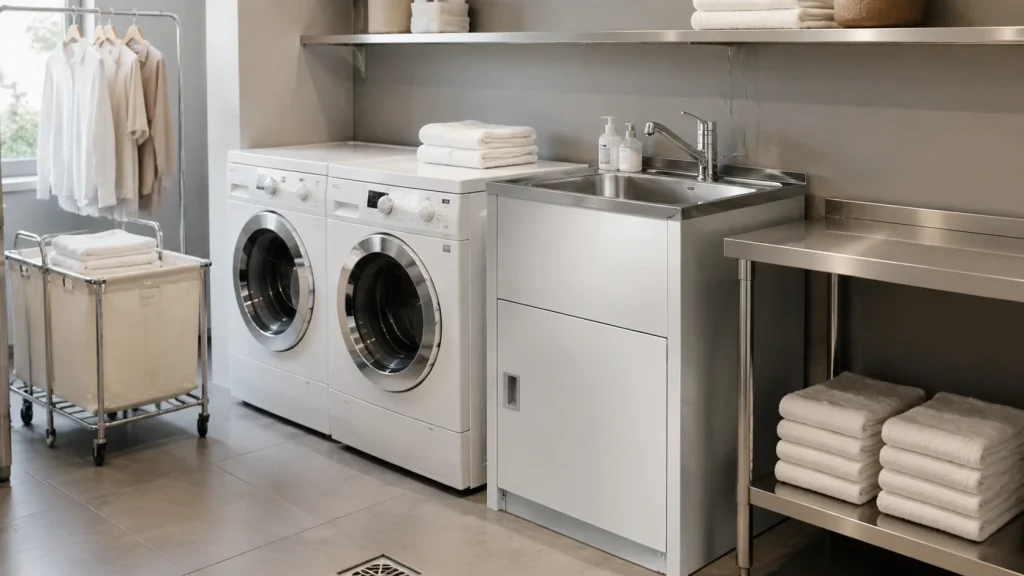
Back-of-house laundry rooms in hotels, hospitals, and senior-care buildings punish furniture. Washers vent steam, staff mop the floor twice a shift, and splash never stops. Standard wooden cabinetry cannot hold that line. Particleboard bases swell, laminate lifts at the edges, and mold settles behind the kick plate where nobody looks. The bill arrives twice: once as a replacement purchase order, again as a sanitation finding during inspection.
So specifiers now write a commercial stainless steel laundry sink cabinet into the base spec instead of treating it as an upgrade. Steel does not absorb water, holds its shape in humidity, and takes the same sanitizer the rest of the room gets. Any facility manager who has pulled the same rotted cabinet three times already knows the answer.
Why Wood and Laminate Fail in Wet Utility Rooms
What Humidity Does to Particleboard
Spec meetings throw around humidity control in laundry rooms as if it were a settings problem. It is a materials problem. A busy hotel laundry runs washers and dryers through most of the working day, and every spin cycle pushes moisture into the air. Add a mop pass at shift change and the base of nearby cabinetry sits in a thin film of water for hours.
Interior-grade particleboard and plywood are bonded with adhesives rated for dry service, not for standing water. Exterior and marine plywood use phenolic resins that hold up far better, but almost nobody specifies those for a utility cabinet at that price point. Once a scratch or a lifted edge breaches the surface laminate, water wicks into the core. The board expands, the laminate separates, and the swollen base no longer meets the floor. That gap turns into a dark, damp cavity where bacteria and mold grow out of sight.
By the time a housekeeping supervisor smells something musty, the damage usually runs past repair. The cabinet comes out, someone checks the floor underneath for staining, and the whole unit gets replaced on an emergency PO. Spread that across a property with several linen closets and utility rooms, and the real cost of “cheap” cabinetry stops looking cheap.
Wood vs. Stainless: A Side-by-Side View
Putting the two material paths next to each other clears up most of the argument.
| Factor | Wood / Laminate | Stainless Steel |
|---|---|---|
| Water resistance | Absorbs spills and steam through any breach in the laminate; core swells | Non-porous surface; water sits on top and wipes off |
| Typical service life in a wet utility room | Often replaced within a few years | Commonly a decade or more with routine cleaning |
| Maintenance effort | Sanding, resealing, partial rebuilds | Wipe down; no resealing |
| Hygiene | Core harbors mold and bacteria once breached | Specifiable to NSF food-equipment criteria; takes commercial sanitizers |
Those service-life figures reflect what maintenance teams report in the field rather than a certified accelerated-aging test. Ventilation, water quality, and cleaning chemistry all shift the number. The pattern holds anyway: a stainless unit costs more on day one, and the total cost of ownership flips in its favor before the first wood unit finishes its second replacement cycle.
What a Wood Failure Actually Costs
Run the arithmetic with your own supplier quote. If a wood cabinet lasts two years in a hotel utility room, a ten-year horizon means the original purchase plus four replacements. Each swap carries plumbing disconnection, disposal, labor, and the nuisance of pulling a failed unit during peak occupancy. The stainless alternative gets specified once and then drops off the maintenance calendar. Crossover usually lands somewhere in the third or fourth year, and everything after that is money the property keeps.
Facility managers who have lived that cycle rarely go back. The next spec names a commercial stainless steel laundry sink cabinet by default, because the alternative already proved its cost the expensive way.
If you want to see how basin geometry affects the decision before locking a spec, our breakdown of commercial stainless steel laundry sinks walks through bowl shapes, drain placement, and the trade-offs between top-mount and under-mount installs.
Waterproofing Specs That Matter
Four specs separate a purpose-built commercial stainless steel laundry sink cabinet from a kitchen cabinet with a sink dropped into the top. Knowing what to ask changes the conversation from “which one is cheapest” to “which one still works in year eight.”
Welded Seam Sealing
Cheaper cabinets go together with mechanical fasteners: screws, rivets, clip joints. Every fastener passes through the metal and leaves a micro-gap around the shank. Under daily splash and mop contact, water follows those gaps straight into the cabinet interior.
Better units rely on continuous welded seam sealing. The fabricator joins basin, side panels, and base with an unbroken weld bead, then grinds and polishes it flush. The weld becomes part of the panel, so no mechanical joint exists for water to travel through. That gives you a continuous barrier between the wet side and the dry storage cavity, with no fastener holes anywhere along the splash line.
Confirm three points with any supplier:
- Ask whether the basin-to-cabinet joint runs fully welded rather than spot-welded at the corners.
- Check that interior corners are ground and sealed, since water pools in corners first.
- Require faucet and drain penetrations to be sealed with weld or gasket instead of left as raw cut holes.
A cabinet that clears those three questions will not show the internal rust streaks that appear on bolt-together imports after a year of service.
Material Gauge and Weld Method
Gauge matters more than most buyers expect. A 16-gauge panel, roughly 1.6 mm, shrugs off dents from dropped detergent jugs and mop handles better than 18-gauge, and the thicker wall gives the welder more material to fuse cleanly. Most welded cabinet bodies use TIG (tungsten inert gas) welding, which lays a clean, contaminant-free bead suited to hygiene-grade work.
When a supplier cites NSF/ANSI 2 (food equipment) or NSF/ANSI 51 (food equipment materials) as a design reference, treat it as a build standard to verify rather than a badge. A design reference is not a listing. Ask for the NSF listing number and check it in the public database at nsf.org, then request mill test reports for the steel itself. Serious manufacturers expect those questions.
Rust-Proof Legs and Base Clearance
Standing water finishes off any floor-level cabinet. Even a stainless body fails if the legs corrode and the unit settles into a puddle. Rust-proof cabinet legs carry as much weight in the spec as the body.
Call out adjustable stainless steel bullet feet. They level the cabinet on the uneven floors you find in older utility rooms, and they lift the base clear of routine mopping so water never sits against the bottom panel. Some designs add a sloped or open base shelf that lets air circulate and drains stray splash instead of trapping it.
Clearance has a number attached. NSF/ANSI 2 and the FDA Food Code call for a minimum 6 in (150 mm) of unobstructed clearance under floor-mounted equipment that is not sealed to the floor, so cleaning crews and inspectors can reach and see the slab underneath. Anything less gets flagged. If the layout will not allow 6 in, the alternative is sealing the base to the floor or to a coved masonry curb with a continuous watertight seal.
Get that detail right and the commercial laundry sink with base storage stays usable. Base storage is the reason anyone buys a sink-cabinet combo in the first place. Let the lower compartment rust from the bottom up and you lose the square footage that justified the purchase.
Grade and Finish Selection
Finish is the last line of defense, and stainless holds a structural advantage over painted wood. A moisture-resistant utility cabinet in brushed 304 or 316 needs no chemical sealant to stay waterproof, because the corrosion resistance lives in the alloy rather than in a coating that chips.
Grade selection follows the chemistry of the room:
- 304 stainless handles general laundry humidity and most neutral cleaning agents without trouble.
- 316 stainless adds molybdenum for stronger resistance to chlorides and aggressive sanitizers, which earns its premium in healthcare, coastal properties, and any room where staff use chlorine bleach daily.
That bleach point deserves attention. Hypochlorite is standard issue in commercial laundries, and chloride exposure is exactly what pits 304 over time. If your housekeeping protocol leans on bleach, either move to 316 or write a rinse-and-dry step into the cleaning SOP so residue never dries on the steel.
Brushed finishes hide scuffs better than mirror polish and show water spotting less. In a high-traffic back-of-house room that counts as a practical advantage, not a styling one. Most reputable fabricators also passivate the finished steel in a citric-acid bath, which strips free iron from the surface and lets the chromium oxide layer that actually resists corrosion rebuild evenly.
Building a Durable Laundry Station for Hotels
Material selection is half the job. The other half is designing a station around the workflow of the people who use it every shift.
Standardizing Back-of-House Equipment
Standardize utility rooms around one proven platform and hospitality facility maintenance gets simpler everywhere. Spare parts interchange, cleaning crews learn one procedure, and capital planning turns predictable instead of reactive. A director running ten properties does not want ten different cabinet failures on the tracker. One specification that works everywhere beats ten that mostly work.
A durable commercial laundry station starts with a commercial stainless steel laundry sink cabinet sized to the room, then adds the faucet, drain, and shelving staff actually reach for during a shift. Emergency swaps disappear from the calendar. Audit prep gets lighter, since stainless surfaces meet the sanitization expectations of most health and safety inspections without special treatment. When a new property comes online, procurement copies a spec that already works.
Hospitals face the same math with sharper stakes, and the material comparison there runs deeper than cost. Our field notes on the stainless steel laundry tub sink against plastic in hospitals cover impact resistance, disinfectant compatibility, and why plastic tubs craze under repeated chemical exposure. A hospital that consolidates three scattered linen closets into one central hub and specifies the same welded cabinet across the build carries one spare-parts kit instead of three, and trains the environmental services crew once.
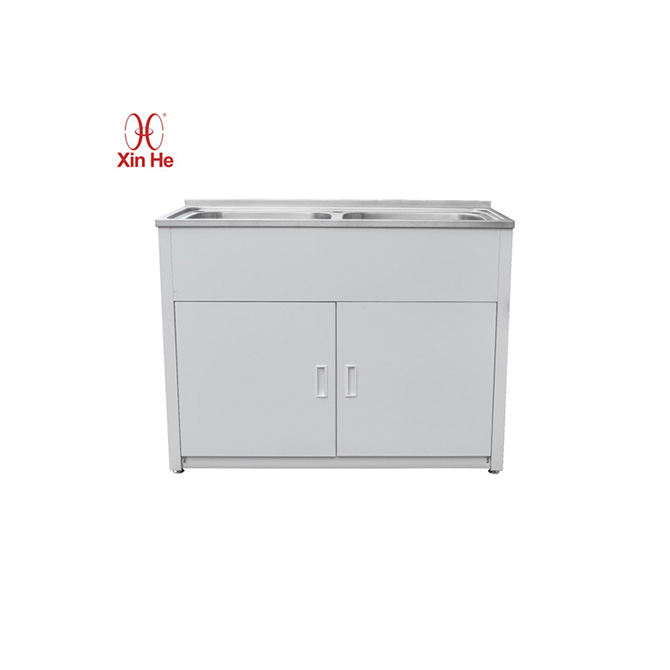
Sizing follows the room rather than the catalogue. For tight footprints, a 30L/35L stainless steel laundry sink cabinet delivers welded construction and base storage in a compact Watermark-certified body, which suits staff utility corners and light-duty floors. Where volume is the constraint, the 90L double sink laundry cabinet in 304/316 stainless gives two bowls for soak-and-rinse workflows in laundromats, multi-family housing, and hospitality projects.
Pre-Install Checklist for Specifiers
Before releasing the purchase order, walk these five points:
- Confirm the basin-to-cabinet joint is fully welded rather than screwed or riveted.
- Match grade to chemistry: 304 for general rooms, 316 wherever bleach, other chloride sanitizers, or salt air are in play.
- Verify adjustable stainless feet and 6 in of floor clearance, or a sealed and coved base if the layout blocks it.
- Request CAD drawings before production to confirm door swing, plumbing access, and rough-in centers.
- Agree on a sample-approval step so the bulk run matches the unit you signed off.
Teams planning a multi-property rollout should also read our notes on sourcing a commercial laundry sink for hotel utility projects, which cover specification sheets, sample approval, and the inspection points that protect a bulk order. Settling those details before production beats rejecting a container at the dock.
FAQ: Caring for Your Laundry Sink Cabinet Combo
How do you prevent water damage in a laundry sink cabinet?
Most water damage gets designed in at the spec stage rather than caused by an accident, so laundry room sink cabinet combo waterproofing starts on the drawing. Require fully welded seams instead of fastened joints, sealed faucet and drain penetrations, and adjustable non-corrosive feet that hold the base clear of mop water. After installation the job turns into routine: wipe the basin edge after heavy use, keep the base area clear so air moves, and inspect interior corners monthly for residue or discoloration. A correctly specified unit rarely asks for more than a weekly wipe-down.
Is stainless better than wood for hotel laundry cabinets?
For a wet utility room, yes. A commercial stainless steel laundry sink cabinet beats wood on service life, carries no risk of warping or hidden mold growth, and sanitizes with the agents already on the housekeeping cart. A hotel utility room stainless steel cabinet also lowers total cost of ownership, since it drops out of the replacement cycle instead of returning to it every couple of years. Wood can look right on installation day and fail inside a single season. Stainless does the same job, cleanly, for years, and the only decision left is what goes in the base.
Specify Once, Stop Replacing
Water-damaged back-of-house furniture is a recurring cost no operator needs to accept. A tighter cleaning schedule will not fix it, and neither will a better sealant. The fix is a fully welded stainless unit built for commercial duty from the first weld to the last foot.
Specify a commercial stainless steel laundry sink cabinet once and take replacement out of the capital plan. XinHe builds these cabinets to project specifications, with 304 and 316 grade options, adjustable rust-proof feet, and welded seams as standard rather than line-item upsells. Planning a property upgrade or a multi-site rollout? Contact our specification team for custom dimensions, CAD drawings, and a quote sized to your order.
NEXT:
Not NEXT