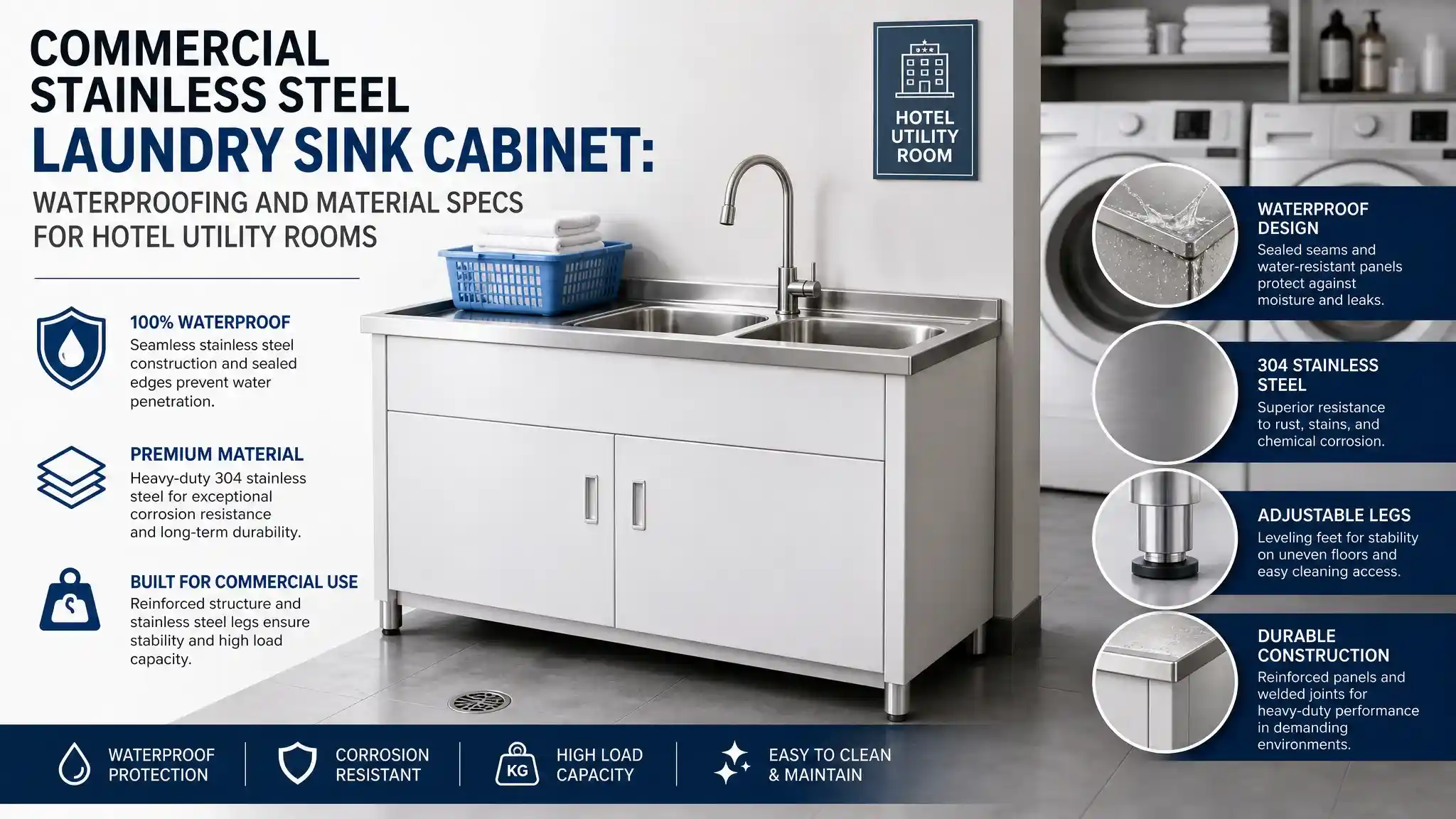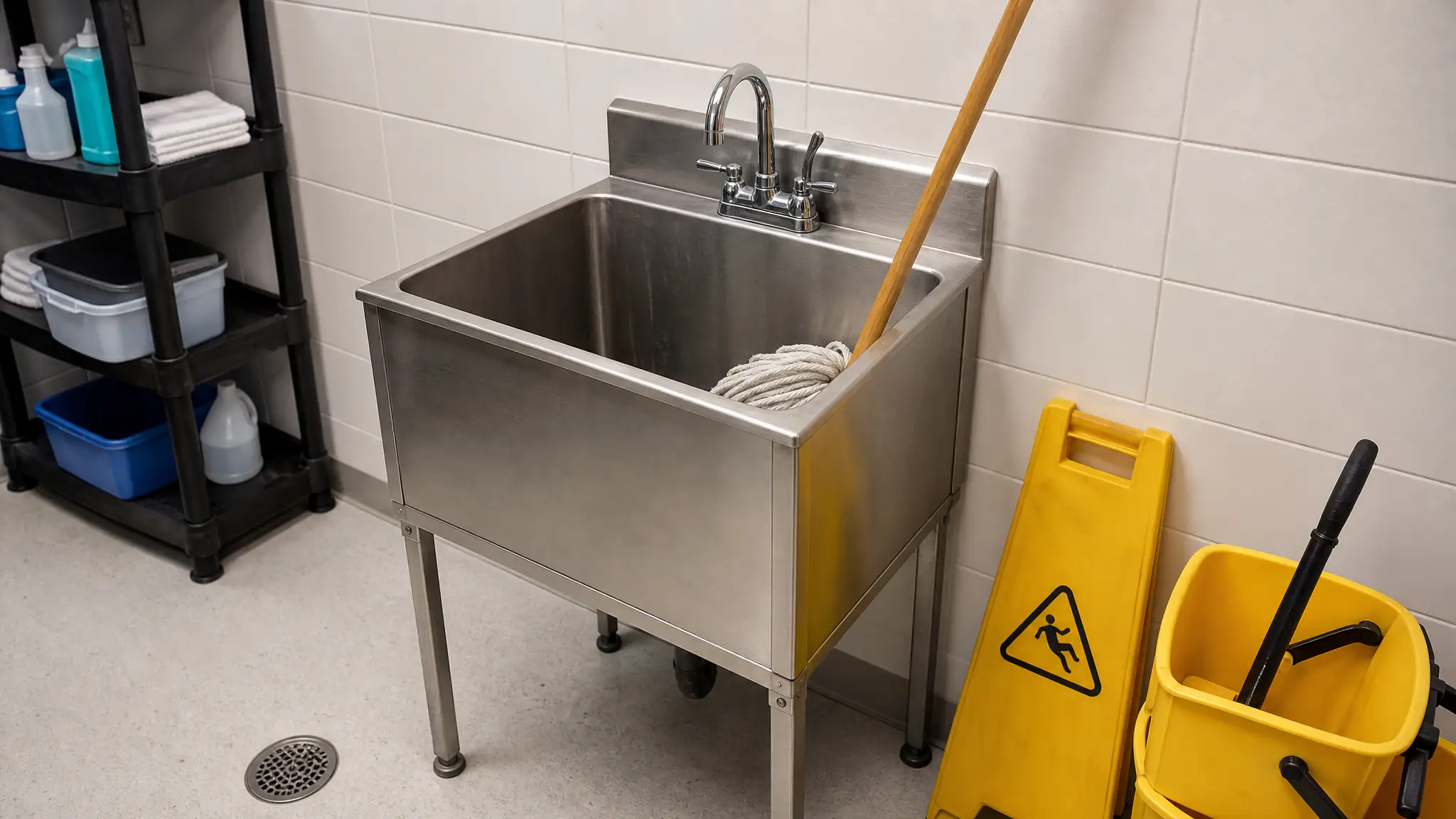

Commercial Stainless Steel Mop Sinks: Stop Odor and Clogs
2026-07-31
A foul-smelling janitor’s closet and a slow-draining basin are early warnings of standing wastewater, biofilm growth, and a possible health-code citation. For teams running hospitals, hotels, schools, and commercial kitchens, a neglected utility sink turns into an operational liability within weeks, and the repair bill lands on top of the disruption.
A service call to clear a blocked line takes a work area offline for hours, and a citation from an inspector closes it longer. Disciplined janitor closet sink maintenance costs almost nothing and prevents both. This guide gives facility managers and janitorial supervisors a practical SOP to prevent odor in commercial mop sink setups and protect the plumbing behind the wall. We focus on commercial stainless steel mop sinks because they dominate back-of-house and maintenance areas, and they reward a consistent cleaning routine.
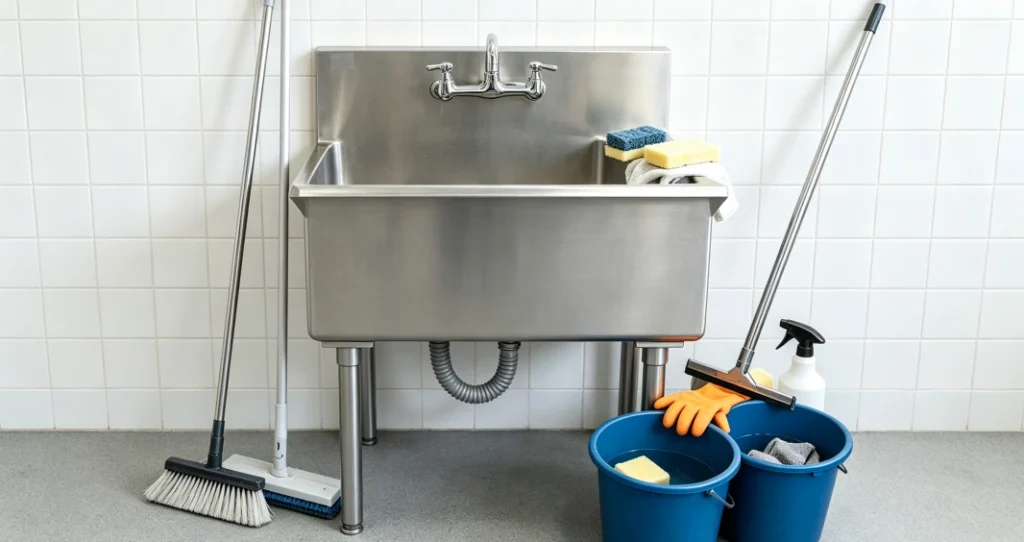
Why Mop Sinks Smell and Clog
Treat the mop sink as a throwaway fixture and you create the problem yourself. On commercial stainless steel mop sinks, the basin rarely fails first. The drain line and the trap underneath it do.
The load your mop water carries
Every pass across a floor lifts fine sediment, hair, food particles, grease film, and residue from the cleaners you use. That slurry runs into the basin, through the strainer, and down the trap. In a busy facility the volume adds up fast. A school hallway during flu season, a hotel lobby after a weekend, a kitchen at close of service, each one pushes a different mix of solids into the same line.
Chemical residue matters more than most teams expect. Quaternary ammonium disinfectants carry a positive charge, and when they meet the negatively charged anionic detergents in floor soaps, the two form an insoluble complex that drops out of solution as a waxy sludge. That sludge coats the pipe wall and catches whatever follows. Soil and organic residue from enzyme cleaners then give bacteria something to eat. The cleaner you use on the floor ends up in the drain, so the drain inherits the chemistry.
Blockages start in the trap
Clogs rarely form at the basin. They build in the P-trap and the first few feet of drain line, where solids settle and organic matter decays. A loose or missing strainer lets particles pass into the line and accumulate at the low point. The trap holds water by design, and once sludge fills the bend, drainage slows and the smell begins.
Biofilm and the rotten-egg smell
Trapped organic matter feeds bacteria, and those bacteria form a slimy layer called biofilm on the pipe walls. Biofilm holds moisture and releases hydrogen sulfide, the rotten-egg smell you notice walking into the closet. It also narrows the pipe, which slows drainage and leaves the next load of mop water sitting longer.
The trap seal most teams forget
Sewer gas prevention comes down to one detail. Plumbing codes require a water seal of two to four inches in the trap bend, and that column of water separates the room from the drainage system. Lose it and hydrogen sulfide, methane, and biological aerosols move up through an open pipe.
Evaporation is the usual culprit in low-traffic closets, and conditions decide how fast:
- A trap in a climate-controlled space with moderate humidity can hold its seal for six to eight weeks.
- The same trap in a heated utility room with forced-air circulation can run dry in under two weeks.
- Sludge in the bend or a poorly vented line can break the seal sooner through siphoning.
For a closet that sits idle over holidays or between seasons, a trap seal primer valve conforming to ASSE 1018 or a barrier-type device conforming to ASSE 1072 takes the problem off your checklist. Where a device is not practical, pour a quart of water into the drain on a set schedule and float a few tablespoons of mineral oil on top to slow evaporation. Scrubbing the basin will not fix a compromised trap, because the gas originates below the fixture.
Before specifying or replacing a basin, review how mop sink materials compare over a long service life. Wall thickness, joint construction, and basin geometry all decide how easy a unit is to keep clean, and the comparison puts those trade-offs in front of you before you spend on a replacement. Basin depth deserves the same attention, since choosing the right mop basin sink depth controls splash-out and how well a bucket empties without dumping solids over the rim.
The Mop Sink Maintenance SOP
A short, repeated routine beats an occasional deep scrub. The schedule below suits busy teams, and it holds up across a full quarter without demanding a perfect day.
The four-point cleaning schedule
| Frequency | Action Item | Expected Outcome |
|---|---|---|
| Daily | Empty and rinse the strainer basket; wipe the basin after the last mop run. | Stops debris from drying into the drain and prevents immediate buildup. |
| Weekly | Flush the drain with hot water and a mild, pH-neutral soap; scrub basin walls. | Maintains baseline hygiene and removes early film before it sets. |
| Monthly | Perform commercial utility sink P-trap cleaning to clear trapped sediment and confirm the water seal is intact. | Avoids sewer gas prevention failures and keeps drains flowing. |
| Quarterly | Apply a citric-acid or lactic-acid descaler to dissolve mineral scale without attacking the steel. | Restores flow and extends the life of the basin and fittings. |
One caution on the weekly flush: hot tap water is fine, but boiling water can soften PVC drain joints and loosen solvent-welded connections. Keep it below scalding and let volume do the work.
Each step needs a named owner. In a hospital that is often the environmental services lead. In a hotel it falls to the engineering team. Write the task into the shift handover so it survives busy days, and pair it with a five-minute strainer check to anchor the daily step.
Tools to keep at the sink
A small caddy by the basin covers most of the routine:
- A stiff-bristle handheld brush for the basin walls and strainer.
- A pH-neutral soap approved for food-contact surfaces.
- A drain auger or flexible snake for early clogs.
- Enzymatic cleaner for the monthly and quarterly treatments.
- A laminated facility management cleaning checklist for initials and dates.
Your team will use what sits within arm’s reach of the basin.
Build a facility management cleaning checklist
Turn the table above into a facility management cleaning checklist that your janitorial staff initial each shift. Once a task carries a signature and a date, you can verify it, and you hand an inspector a paper trail when they ask how the closet is maintained.
Keep the checklist at the sink rather than in an office folder. Note the date, the initials, and anything unusual, such as a drain that ran slow despite the weekly flush. That note is your early warning that the monthly trap step needs to come sooner.
Consistency beats the quarterly deep clean
Reactive drain clearing costs more than prevention. A blocked line means a plumber, a closed work area, and possibly a citation. Long-lasting care for commercial stainless steel mop sinks comes from small daily and weekly habits.
The schedule above is also the most reliable way to prevent odor in commercial mop sink systems without specialty chemicals. Most of the benefit sits in the monthly trap step. Quarterly descaling handles the slow buildup that heat and hard water leave behind, and it protects the polished surface that makes stainless easy to sanitize.
Stainless Steel Service Sink Clogging Solutions
Even with a good routine, a clog can still happen in commercial stainless steel mop sinks. A new tenant, a dropped rag, or a change in cleaning product can upset the balance. Your response in the first hour decides whether the fixture survives.
What not to pour down the drain
Acid-based drain openers built on sulfuric or hydrochloric acid promise a fast clear, and they attack stainless steel while they work. Hydrochloric acid strips the passive chromium oxide layer that protects the surface, and 304 stainless resists neither dilute sulfuric nor hydrochloric acid well. Once that layer is gone, the metal is open to pitting and rust.
Bleach is a softer risk and still worth caution. Chloride is the mechanism: 304 stainless can show signs of attack at free chlorine levels around 2 ppm, while 316 tolerates roughly twice that before pitting becomes a concern. Dilute it and rinse it off, and bleach stays manageable. Leave it sitting in a basin with organic buildup and chloride concentrates, then goes after the weld heat-affected zone, where chromium carbide precipitation during welding leaves the grain boundaries chromium-depleted. That zone is where a mop sink starts leaking.
A fabricator can polish and repassivate light surface pitting. Deep pitting through the wall ends the conversation, and you are buying a replacement instead of clearing a clog.
A simple snaking procedure
For most service sinks, a light-duty handheld auger reaches the trap and pulls out the rag, hair, or sediment plug. The steps are short enough for a trained janitor to run:
- Put on gloves and place a bucket under the trap to catch water.
- Feed the auger slowly into the drain until you feel resistance.
- Rotate the handle to hook the obstruction, then pull it back out.
- Flush with hot water and confirm the drain runs clear.
- Follow with an enzymatic treatment to break down what the auger left behind.
This mechanical-first approach clears the line without touching the steel. Call a plumber for the rare case where the blockage sits past the trap and into the building line.
Mechanical and enzymatic first
After the auger, use an enzymatic cleaner that digests organic buildup without harming the alloy. Enzymatic products work slower than acid, and they leave the steel intact while continuing to work after you walk away. These stainless steel service sink clogging solutions protect the asset first, because a cleared line buys you nothing if the basin is now pitted and weeping at the seam.
If the same closet backs up again and again, look past the fixture. A floor drain sized for the actual load takes overflow off the basin and gives the room a second path to the sewer line.
Choosing a replacement that lasts
If the unit is already pitted through, or the trap geometry catches solids instead of passing them, no cleaning routine will save it. When you spec a replacement, work with fabricators that document alloy grade and construction method.
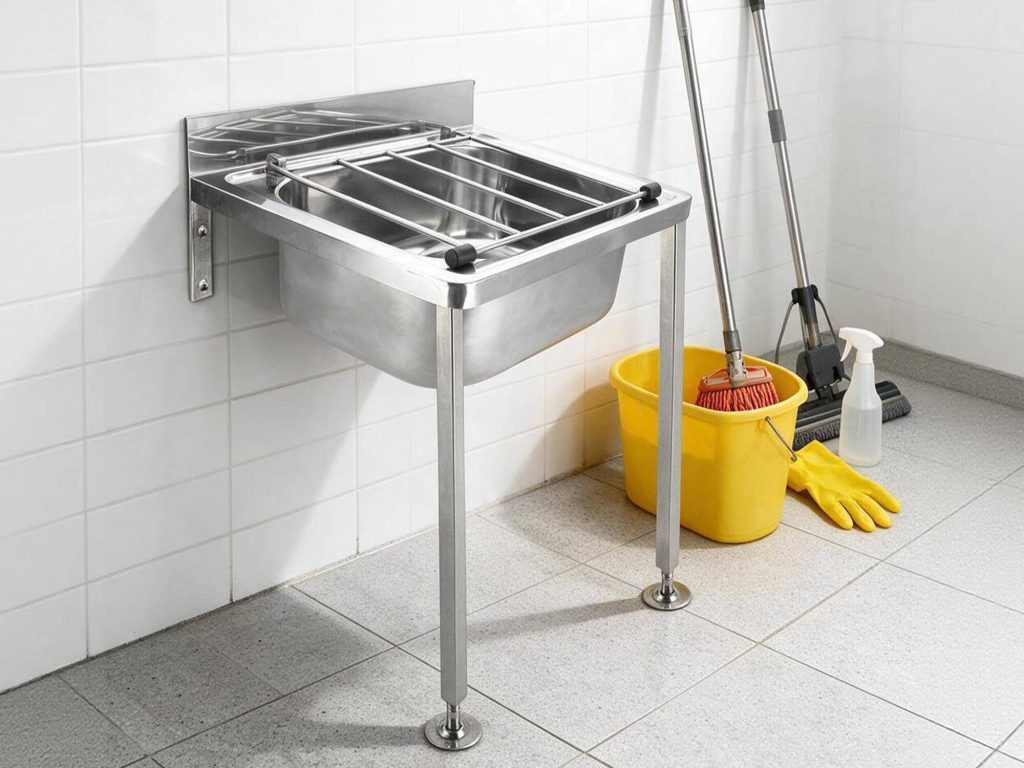
For closets with floor space, a freestanding stainless steel mop sink with support legs in 304 stainless keeps the basin off the floor and opens up the area underneath for cleaning. Xinhe builds these as NSF-ready one-bowl units and sizes each one to the closet it serves. Where floor space is tight, a wall mounted mop utility sink with a folding grate and splashback in 304 stainless gives you a central drain and a protected wall behind the bucket.
Whichever mounting style you pick, confirm the NSF and code requirements for janitor closets before you order, so the fixture passes inspection on the first visit. Signage helps too. A small note above the basin reading “mop water and rinse only, no solids” cuts the careless drops that start most clogs.
FAQ: Commercial Mop Sink Maintenance
1. Why does my commercial mop sink smell?
The smell usually comes from decomposing organic matter, mop fibers, dirt, and soap scum trapped in the drainpipe or the P-trap. Weak debris filtration lets this material build up and form biofilm, which releases hydrogen sulfide. If the odor persists after cleaning, check whether the trap seal has evaporated, since a dry trap opens a direct path from the sewer line into the room.
2. How often should the P-trap in a service sink be cleaned?
For high-traffic facilities, inspect and clean the P-trap at least once a month. This commercial utility sink P-trap cleaning step prevents severe blockages and keeps the water seal intact, which is the core of sewer gas prevention. Low-traffic closets can stretch to every six weeks, though monthly remains the safe standard for hospitals, hotels, and kitchens where the sink sees constant use.
3. What grade of stainless steel is best for a mop sink?
304 stainless is the standard for most indoor commercial settings. It resists corrosion from water and common cleaners and handles daily mop-water loads well. Choose 316 if the sink sits near salt, pool chemicals, or coastal air, since the molybdenum content raises pitting resistance in chloride environments. Wall thickness matters too. A 16- or 18-gauge basin resists denting far better than a thin 20-gauge unit under heavy use, and a continuously welded corner ground smooth is easier to sanitize than a bolted joint.
4. Can I use bleach to clean a stainless mop sink?
Yes, in moderation. Dilute it, apply it, and rinse it off with clean water. Do not let bleach sit in the basin with organic buildup, and never mix it with acidic or ammonia cleaners, which releases chlorine or chloramine gas. For routine odor control, enzymatic or pH-neutral products are safer on the steel over the long run and they leave the protective oxide layer alone.
5. Do commercial stainless steel mop sinks need a trap primer?
Only when the trap is subject to evaporation, which usually means a closet with infrequent use. If your janitorial team runs water through the basin several times a week, normal use keeps the seal topped off. For seasonal buildings, vacant tenant spaces, or closets in heated mechanical rooms with forced-air circulation, an ASSE 1018 primer valve or an ASSE 1072 barrier device is the reliable fix.
Keep the Closet Compliant
Reactive plumbing repairs are costly and disruptive. Run the maintenance SOP above and you clear the odors, keep the drains open, and extend the service life of your commercial stainless steel mop sinks without adding headcount or specialty chemicals. If your current fixtures are pitted through or failing hygiene standards, contact Xinhe’s specification team for durable, code-compliant replacements sized to your closets.