
How Basin Depth Decides Your Stainless Steel Wash Tub Choice
2026-07-24
A shallow basin saves wall space in a tight janitor closet. A deep basin fits a full mop bucket and keeps dirty water off the floor when you dump it. For cleaning stations, that difference matters more than brand or finish. Most buyers size a stainless steel wash tub by footprint or price, then fight the basin on every shift. A tub sized to your mop bucket and your dirtiest job cuts splash, speeds refill, and keeps wastewater where it belongs. This guide covers which cleaning tasks need a deep basin, which run better shallow, and the structural checks worth confirming before the order ships.
Why Basin Depth Is the First Spec to Lock Down
Depth settles three things before anyone turns a tap:
- Whether a mop bucket fits under the faucet and inside the basin.
- How high the splash climbs when you empty dirty water.
- How much grit-laden water the drain clears in a single pull.
A bucket that sits too tall for the basin forces the crew to tip it over the rim, and the dirty water sheets down the front of the tub onto the floor. A 10-inch basin throws splash back at an operator’s apron the moment a full pail hits the bottom; a 16-inch basin keeps that same pour below the rim. A deeper vessel also holds a heavier column of wastewater, so the drain line and trap must clear it without backing up.
Buyers file depth under “dimensions” and move on, and that ordering costs rework. A facility manager who locks basin depth first avoids re-running plumbing later, when a shallow tub cannot take a standard 26-quart mop bucket. The same decision protects the cleaning crew: splash height drops once the water sits 150 mm below the rim instead of 25 mm.
Retrofitting an under-spec’d tub means a new basin, a re-cut counter, and a re-run drain line. That package costs more than the correct tub would have on the first order. Settling depth at the spec stage costs nothing beyond a conversation.
Depth also signals purpose. A shallow unit reads as a rinse point; a deep one reads as a bucket-and-mop station. Buyers who blur the two get a fixture that does neither job well. Once you match the basin to your heaviest task instead of your lightest, the tub covers the full range of mop and service sink duties a cleaning room needs.
Tooling gives you one more reason to settle depth early. A deep-drawn basin needs a different press than a shallow one, so changing your mind after the mold is cut means paying for a new tool. Lock the depth, then let every other parameter follow it.
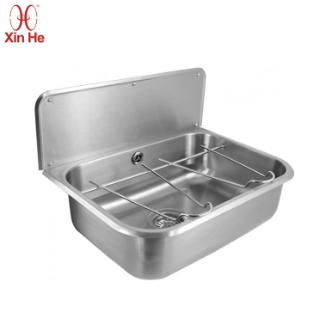
Deep Basin vs. Shallow Basin
The table frames the trade-offs buyers meet on site. Use it to screen options; the scenario section after it shows where each side wins.
| Specification | Deep Basin (14–18″+) | Shallow Basin (10–12″) |
|---|---|---|
| Primary Application | Mop bucket fill and dump, mop soaking, chemical mixing | Quick rag rinse, hand washing |
| Splash Control | High: walls contain the pour | Lower: higher splatter risk |
| Worker Ergonomics | More reach, but a full bucket lifts in and out | Easier for repeated short tasks |
| Drainage Demand | Larger drain plus strainer for grit and hair | Standard drain sufficient |
| Chemical Load | Dilutes concentrates and holds wastewater safely | Not ideal for heavy or prolonged chemical use |
| Typical Setting | Janitor closet, central cleaning station | Kitchen back-of-house, lab bench rinse |
Each depth wins different work. A deep basin handles bucket duty, mop soaking, and chemical dilution; a shallow basin suits quick-rinse points where staff return every few minutes. Match the stainless steel wash tub to the longest task on the floor, not the most common one.
Use this short rule when you brief the supplier:
- A full mop bucket goes in and out: go deep.
- Staff rinse a cloth and leave in seconds: go shallow.
- One tub must cover both: expect a compromise on splash or ergonomics.
A compromise shows up on the floor as splash, slow drainage, or a sore back. Buying one depth for both jobs is the error to avoid.
Matching Your Task to the Right Depth
Depth only means something once you attach it to a task. Many stainless steel wash tub orders stall because the buyer pictures the average shift instead of the worst one. The three scenarios below cover most cleaning stations; pick the one closest to your heaviest job.
Scenario A: Mop Bucket Fill, Dump, and Mop Soaking
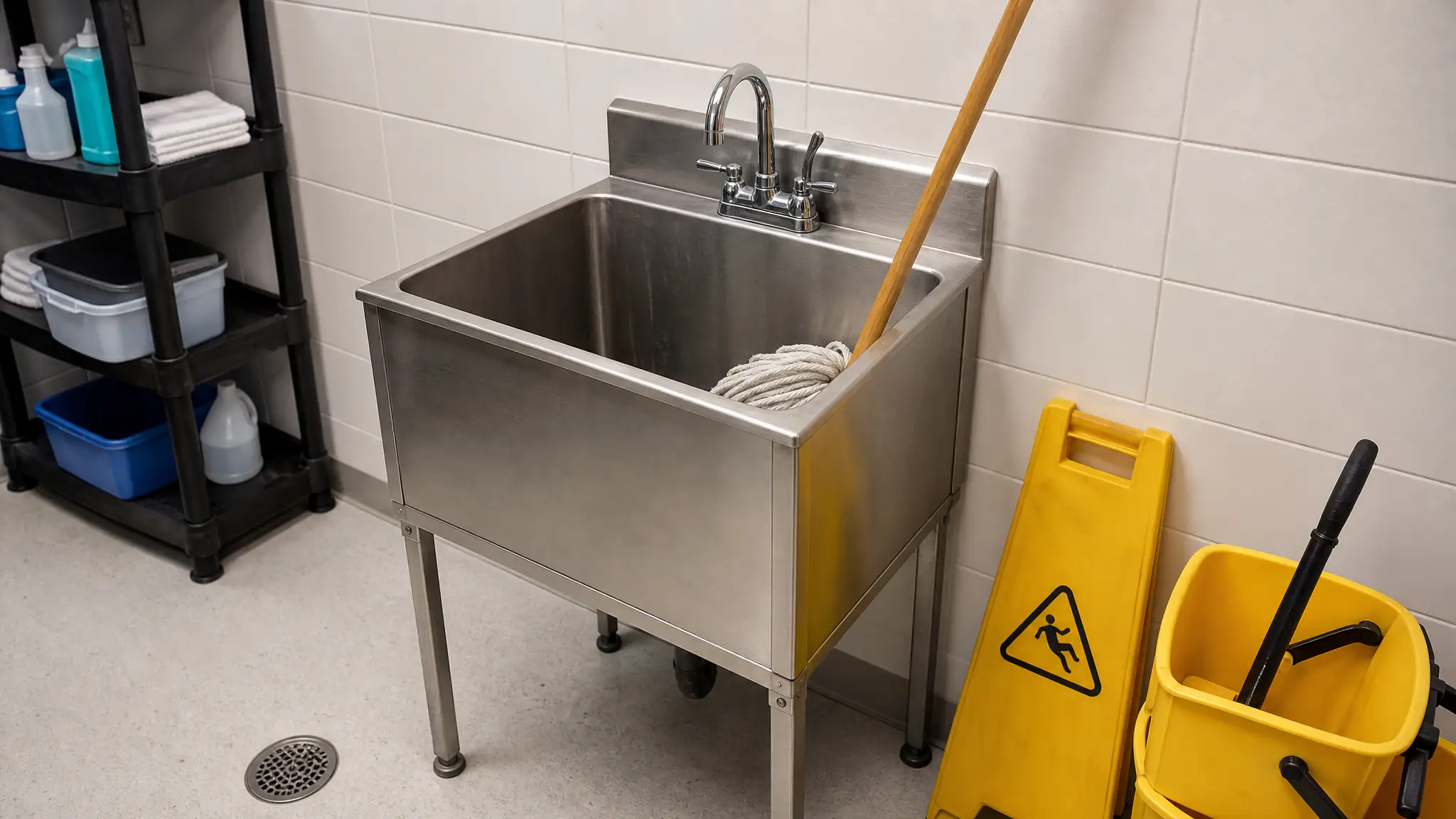
Janitor closets and central cleaning rooms run this cycle all day. A crew fills a bucket, cleans a zone, then comes back to dump gray water and rinse the mop head. The task looks simple until the bucket is taller than the basin. Then the pour clears the rim, and dirty water runs down the tub face onto the floor the crew just cleaned. A shallow basin fails here twice: the bucket cannot sit inside it, and the wastewater splashes on every dump.
A 400 mm basin clears a standard mop bucket with room to tip it inside the walls, so the pour stays below the rim. The crew stops mopping up their own spills, and the floor around the station stays dry between rounds. A deep tub also lets a mop head soak in a cleaning solution without a separate pail. A rounded-corner basin helps here, because grit and hair settle in one reachable spot instead of spreading across a flat floor.
Depth also puts the sidewall between the wastewater and the operator’s clothes. A tub with a high wall keeps the splash below waist level, which matters when the water carries floor stripper or a strong degreaser. Spec corrosion-resistant 304 stainless as the floor grade; the basin meets cleaning chemicals daily, so weld seams and corners face the harshest exposure. Where the room has open floor but no free wall, a floor-mounted deep tub gives the crew a full-service station without a plumbing rerun.
Picture a 26-quart bucket that stands taller than a 300 mm basin: the crew has to tip it over the rim, and half the pour catches the outside wall. In a 430 mm basin the same bucket drops inside the walls, and the water goes straight down the drain. The deeper corner traps sediment in one spot, so the next shift rinses it out in a single pass instead of chasing residue across the base.
Scenario B: Rag, Cloth, and Small-Tool Rinsing
Kitchen back-of-house, lab benches, and retail cleaning points flip the logic. A worker rinses a cloth, a squeegee, or a scrub brush every few minutes, and a deep basin becomes a back problem: every reach drops the shoulder an extra 150 mm, which adds up over a shift. A shallow tub at bench height keeps the rinse quick and the posture straight.
Speed beats volume in this task. Water leaves fast, so a standard 1.5-inch trap handles the drainage. Staff rinse, wring, and set the cloth down instead of soaking. A shallow rim also throws less splash-back onto the counter where clean supplies wait. Set the rim at roughly 900 mm and most operators keep a neutral wrist through a full shift; raise it and the splash climbs, lower it and the back bends. Rim height belongs inside the depth decision, not outside it.
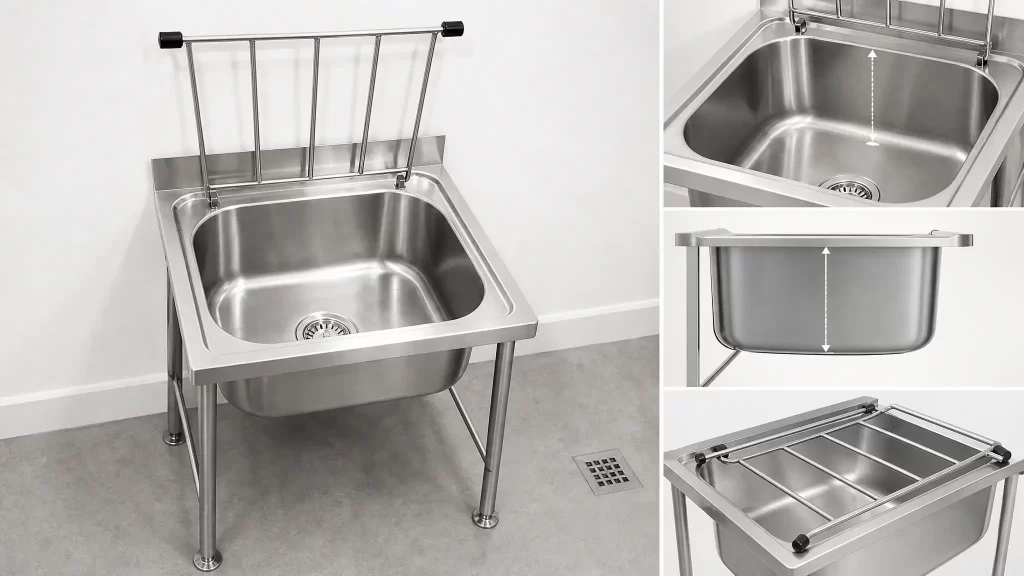
Where the bench has no wall to hang a fixture, a freestanding mop sink with legs solves placement without rerouting plumbing. Floor-standing legs turn an open corner into a rinse point, which is why cleaning stations often skip wall mounting. The same leg set survives a cart bump that would crack a wall-hung bracket.
Scenario C: Chemical Dilution and Wastewater Handling
Central cleaning rooms mix concentrates, dilute floor-care chemicals, and pour off dirty water before it enters the drain. A shallow basin makes this risky. Diluting a concentrate can foam and splash, and a low rim lets the mix reach a passer-by’s shin or a floor drain never rated for it.
Spec a deep basin with a high sidewall for this station. A tub rated for chemical work pairs that depth with a sealed wall, and the wall earns its place when a crew pours concentrate into water and the mix surges. Keep the body at 304 stainless for standard cleaning chemicals, and move to 316 if the room handles acidic descalers or strong sanitizer concentrates; the molybdenum in 316 resists the pitting that 304 develops under those agents over time.
A deep basin at 450 mm depth with a 200 mm backsplash gives the operator working room and a barrier if the mix kicks. If your facility keeps a safety data sheet on file for each product, match the basin grade to the harshest chemical on that list, not the mildest. Treat basin depth in this scenario as a safety parameter, not a convenience.
Structural Requirements Beyond Depth
Depth opens the spec conversation, and four more checks decide whether a stainless steel wash tub survives its first year on a busy floor. Skip any one and the failure shows up as a dent, a clog, a citation, or a leak behind the wall.
- Steel thickness. A cleaning station takes knocks from carts, buckets, and mop handles. Spec 16 gauge (1.5 mm) as the minimum for a working tub, and move to 14 gauge (2.0 mm) where buckets drop or a cart parks against the side. Thin-gauge basins dent, hold water in the dent, then corrode at the crease.
- Drain aperture. Mop water carries grit, hair, and lint that block a small drain. Pair a deep basin with a 50 mm or larger drain and a strainer basket that catches debris before it reaches the trap. A standard 1.5-inch drain under a deep basin lingers, and standing gray water breeds odor.
- Sidewall and backsplash. A high backsplash keeps splash and cleaning chemicals off the wall behind the tub. Inspectors and safety officers check that wall first; a clean surface behind a cleaning station signals a controlled process.
- Install method. Some rooms cannot take a wall-hung basin; drywall partitions, leased spaces, or conduit runs rule it out. A floor-standing leg set removes that dependency and lets the tub sit where the cleaning workflow needs it.
Depth and thickness together answer a question buyers ask late: how utility tubs differ from standard sinks in load-bearing performance. A standard sink hangs on a bracket rated for light use, while a tub loaded with a full bucket and a soaking mop needs reinforced legs or a wall sleeve rated for the filled weight. Spec the support for the filled tub, not the empty one.
Certification closes the checklist. Ask the supplier for the paperwork your market requires: cUPC for North America, CE for Europe, WaterMark for Australia, and NSF/ANSI 61 where the water touches a potable line. A tub that passes the basin test but lacks the certificate stalls at the customs desk or the inspection gate.
FAQ
Q: How deep should a stainless steel wash tub be for cleaning work?
For mop bucket work and chemical dilution, 14 to 18 inches (350–460 mm) is the working minimum, deep enough to hold a full bucket and contain the pour. Basins in the 10–12 inch range suit quick rag rinsing and hand washing, but avoid them where a full bucket goes in and out.
Q: What is a stainless steel wash tub used for in cleaning settings?
In facilities, kitchens, and janitor rooms, a stainless steel wash tub handles mop bucket filling and emptying, mop and cloth soaking, cleaning-chemical dilution, and gray-water disposal. It gives the cleaning crew one fixture rated for grit, chemicals, and daily knocks, which a light-duty household sink cannot take.
Quick Spec Checklist Before You Order
Run this list before you sign off on the order:
- Basin depth: bucket and soaking tasks need 14 inches or more; rag rinsing works at 10–12 inches
- Steel grade: 304 stainless for standard cleaning chemicals, 316 for acidic descalers or strong concentrates
- Drain size: confirm a 50 mm or larger aperture plus a strainer for grit and hair
- Install method: wall-mount where the wall carries the load; choose a freestanding mop sink where floor placement fits the workflow
Share your cleaning-room layout and workflow with Xinhe’s team to get an accurate spec and quote: Contact Us