Stainless Steel Mop Sink NSF & Code Requirements for Janitor Closets
Health inspectors walk into commercial janitor closets early, and a missing or non-compliant fixture stalls a build-out, fails an inspection, or forces an expensive retrofit. Improper mop water disposal and missing backflow devices create direct cross-contamination risks to the municipal water supply.
This guide covers the three code bodies that govern a stainless steel mop sink in the United States, the NSF/ANSI material standards that decide whether your fixture qualifies, and the physical installation rules your plumber must satisfy before final inspection.
To see how these fixtures fit into your facility’s cleaning station, read our overview of what a service sink is and how it functions before reviewing the code requirements below.
1. The Three Code Bodies That Govern Commercial Mop Sinks
Three regulatory frameworks control commercial service sink installations. Your facility must satisfy all three at the same time.
| Code / Standard | Governing Body | What It Controls |
|---|---|---|
| FDA Food Code § 5-203.13 | U.S. Food & Drug Administration | Requires at least one service sink or curbed cleaning facility in food establishments; prohibits mop waste disposal in food prep or hand-washing sinks |
| UPC § 418.0 / IPC § 410.0 | IAPMO / ICC | Controls drain pipe sizing, trap requirements, backflow prevention, and waste outlet dimensions |
| NSF/ANSI Standard 2 | NSF International | Sets material composition, surface finish, and seam construction standards for food-zone equipment |
The Formal Term: “Service Sink” and Why “Mop Sink” Stuck
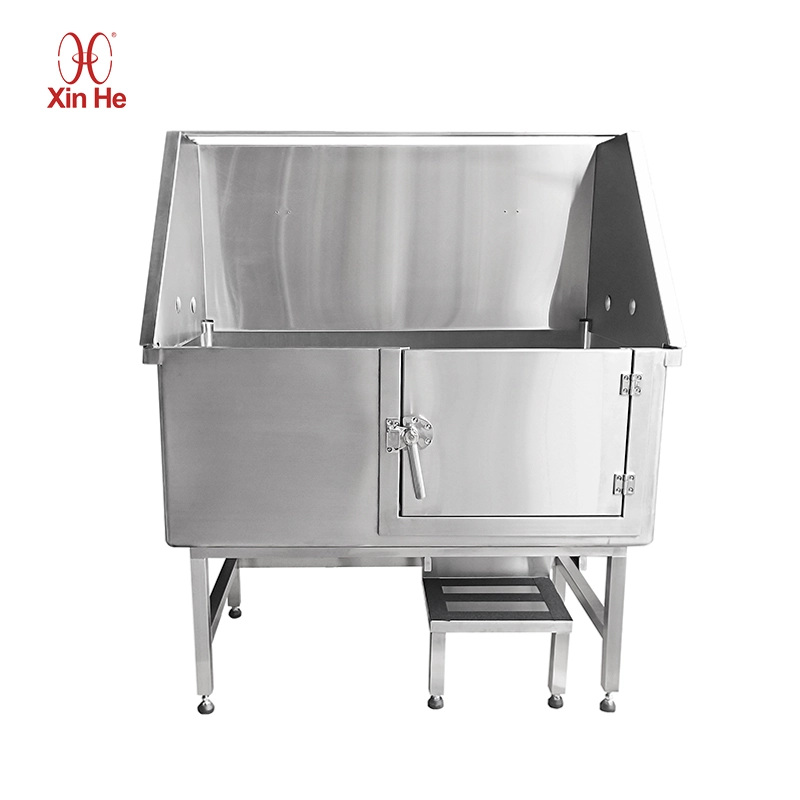
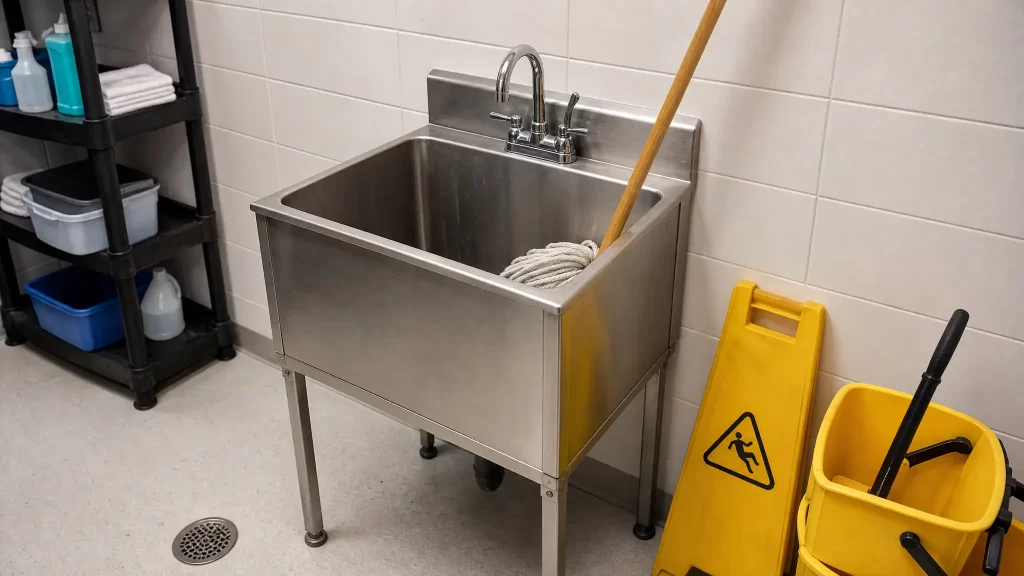
The plumbing and food codes name this fixture a service sink: a permanently installed basin used only for filling and emptying cleaning equipment and disposing of janitorial wastewater. On the jobsite and in product catalogs, the same fixture is almost always called a mop sink. That name grew out of the fixture’s primary job, filling and rinsing mop buckets, and it is now the term distributors, plumbers, and buyers use to search for and specify the equipment. Both words point to the same product. “Service sink” appears in the regulations; “mop sink” drives how you buy and install it.
FDA Food Code § 5-203.13 requires food establishments to provide at least one service sink. Employees who clean mops or rinse cloths in a three-compartment dishwashing sink or a food prep sink commit a critical violation, which inspectors cite for immediate corrective action.
2. NSF/ANSI Standard 2: Material and Construction Rules
NSF/ANSI Standard 2 (Food Equipment) defines the minimum material and fabrication standards for any equipment in a commercial food facility’s splash zone. A stainless steel mop sink that carries the NSF mark must meet every clause below.
Why Type 304 Stainless Is the Baseline
NSF/ANSI Standard 2 requires surfaces in splash zones to be smooth, non-porous, and corrosion-resistant. Painted steel, galvanized zinc, and thin-gauge plated metals all fail this requirement.
- Alloy: Specify Type 304 stainless steel (18% chromium, 8% nickel minimum). This composition resists pitting from alkaline detergents and chlorine-based sanitizers at standard dilution rates.
- Gauge: Specify 16-gauge (1.5 mm) or 14-gauge (2.0 mm). Anything thinner flexes under a filled basin load, opening micro-cracks at weld seams where organic residue accumulates. A stainless steel mop sink at 16-gauge shrugs off the daily impact of heavy buckets.
Physical Construction Requirements
- Coved corners: NSF/ANSI Standard 2 prohibits sharp 90-degree internal seam joints. All corners inside the basin must have a coved radius of R10 mm to R15 mm minimum. This eliminates debris traps that prevent effective sanitation.
- Continuous flush welds: All weld joints must be ground flush and polished to match the surrounding surface finish. Rough weld scale, visible pinholes, or incomplete fusion lines fail sanitation audits.
- Sloped basin floor: The basin bottom must slope uniformly toward the drain outlet. Standing water inside the basin indicates inadequate slope geometry and triggers a sanitation deficiency notice.
3. Backflow Prevention: Vacuum Breaker Codes
Backflow prevention receives the most scrutiny from plumbing inspectors on mop sink installations. Janitor closet faucets frequently attach to chemical dispensers or sit submerged in dirty mop buckets, creating a direct cross-connection risk to the building’s potable water supply. On a stainless steel mop sink, this risk concentrates at the hose spout.
Atmospheric Vacuum Breakers (AVB)
UPC § 603.5.7 and IPC § 608.15.4 both require a backflow preventer on any threaded hose connection. When a hose attaches to a mop sink faucet, a sudden drop in municipal water pressure creates a siphon capable of pulling contaminated water back into the clean supply line.
The code solution is an Atmospheric Vacuum Breaker (AVB) mounted on the discharge side of the faucet valve. The table below shows the correct sequence and the elevation rule.
| Step | Component | Code requirement |
|---|---|---|
| 1 | Faucet valve (water supply) | Upstream shutoff controls the supply |
| 2 | Atmospheric Vacuum Breaker (AVB) | Mount on the discharge side, at least 150 mm (6 in.) above the highest flood-level rim of the basin or the highest chemical dispenser inlet |
| 3 | Threaded hose spout | Connects to the mop bucket or chemical dispenser |
Critical AVB Rules
- Elevation: Mount the AVB at least 150 mm (6 inches) above the highest flood-level rim of the basin. If a chemical dispensing system connects downstream, measure from the highest inlet of that dispenser instead.
- No downstream shutoffs: You cannot install a shut-off valve downstream of an atmospheric vacuum breaker. If the chemical system has an internal valve, upgrade to a Pressure Vacuum Breaker (PVB) or a Reduced Pressure Zone (RPZ) assembly.
- Non-removable hose thread breaker: Faucets must use a hose-thread vacuum breaker secured with a non-removable set screw so users cannot bypass the device.
4. Physical Dimensions, Clearances, and Floor Drain Rules
Basin Depth for Code Compliance
Most municipal health authorities expect a stainless steel mop sink basin depth of at least 200 mm to 300 mm (8 to 12 inches). This prevents splashback from reaching surrounding porous wall finishes, which develops structural rot and mold growth behind the fixture. For a detailed breakdown of how depth requirements vary by facility type, our guide on mop basin sink depth for facility maintenance covers the key selection variables.
Clearance and Installation Requirements
- Floor drain proximity: Many local plumbing authorities expect the service sink to sit within 1,500 mm (5 feet) of the main floor drain stack to maintain correct venting and proper drain line velocity.
- Splash-zone wall protection: Protect all wall surfaces within 450 mm (18 inches) of the sink rim with a non-absorbent material. Stainless steel wall panels or FRP board satisfy this requirement.
- ADA-accessible janitor closets: Where an accessible janitor closet is required, install a floor-mounted curbed basin with a maximum curb height of 100 mm (4 inches) to allow a mop bucket to roll over the threshold.
5. Wall-Mounted vs. Freestanding: Which Configuration Meets Your Code
Both sink types achieve full code compliance when installed correctly. Configuration selection depends on your rough-in location, available floor space, and wall construction. A stainless steel mop sink performs to spec in either layout once the plumber follows the rough-in rules.
| Feature | Wall-Mounted | Freestanding |
|---|---|---|
| Best For | Compact janitor closets; floor must remain clear for mopping | Large utility rooms; floor-slab plumbing rough-ins |
| Wall Requirement | Heavy-duty backing plate anchored into studs | None |
| Drain Rough-In | Through the wet wall | Up through floor slab |
| ADA Clearance | Easier to achieve required knee clearance | Requires careful leg positioning |
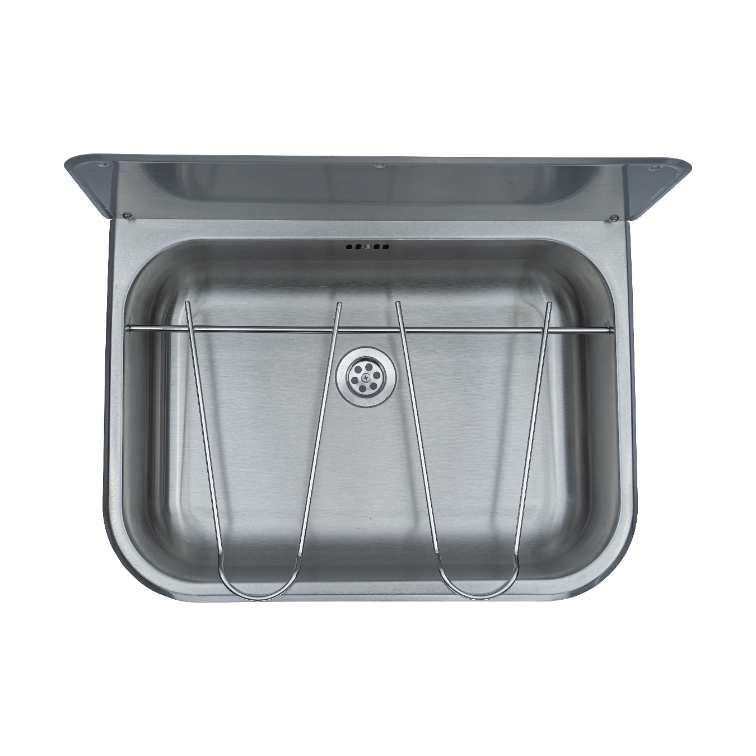
| Recommended Model | LA131 Wall-Mounted Utility Mop Sink | A15-4 commercial stainless mop sink |
Pre-Inspection Installation Checklist
- Basin carries a current NSF/ANSI Standard 2 certification mark
- Type 304 stainless steel at 16-gauge minimum
- All internal corners are coved to R10 mm radius or greater
- AVB installed on the faucet spout, positioned ≥ 150 mm above the highest flood rim
- Minimum 50 mm (2-inch) P-trap drain connection
- Surrounding walls protected with non-absorbent material up to 450 mm above the sink rim
- For wall-mounted units: mounting bracket anchored directly into wall studs
- For freestanding units: leveling feet adjusted; rear legs floor-anchored
FAQ
Is a mop sink required by code in a commercial restaurant?
Yes. FDA Food Code § 5-203.13 requires every food establishment to provide at least one service sink or curbed cleaning facility. Facilities that lack a dedicated service sink and allow employees to dispose of mop water in food prep or ware-washing sinks receive a critical violation during routine health inspections.
Does a mop sink need a vacuum breaker?
Yes, if the faucet has a threaded hose connection. UPC § 603.5.7 and IPC § 608.15.4 both mandate backflow prevention on threaded hose outlets. An atmospheric vacuum breaker satisfies this requirement in most standard installations. If any downstream shut-off valve exists, upgrade to a pressure vacuum breaker or an RPZ assembly instead.
Can a janitor closet floor drain substitute for a mop sink?
No. A floor drain handles incidental spills. It does not provide the dedicated sanitation space or backflow protection that FDA Food Code § 5-203.13 requires. A floor drain cannot replace a service sink; it supplements it.
What drain size does a commercial mop sink require?
UPC Table 702.1 sets the minimum at a 50 mm (2-inch) waste pipe. A residential 40 mm (1.5-inch) drain line is code-non-compliant for commercial service sinks because it cannot handle the volume of sediment and waste-water discharge these fixtures generate.
Closing
Three numbers define a compliant stainless steel mop sink installation: 200 mm minimum basin depth, 50 mm minimum drain pipe, and 150 mm AVB elevation above the flood rim. Pair those with NSF-certified Type 304 stainless steel at 16-gauge, coved internal corners, and wall protection within the splash zone, and your janitor closet passes inspection on the first visit.