Anti-Ligature Stainless Steel Fixtures for Behavioral Health & Correctional Restrooms
Restrooms in correctional settings and mental health facility wings demand fixtures that remove common self-harm anchor points. Standard commercial toilets, basins, and flush valves give individuals multiple ways to secure cords, laces, or bedding. Specifying high-security anti-ligature stainless steel fixtures gives facility engineers their strongest physical defense for maintaining patient safety, preventing self-harm, and meeting municipal and state regulations. Traditional materials crack under direct, high-impact force. The reasons correctional facilities prefer heavy-duty metal fixtures over traditional materials come down to how metallic properties resist both systematic vandalism and complex self-harm attempts.
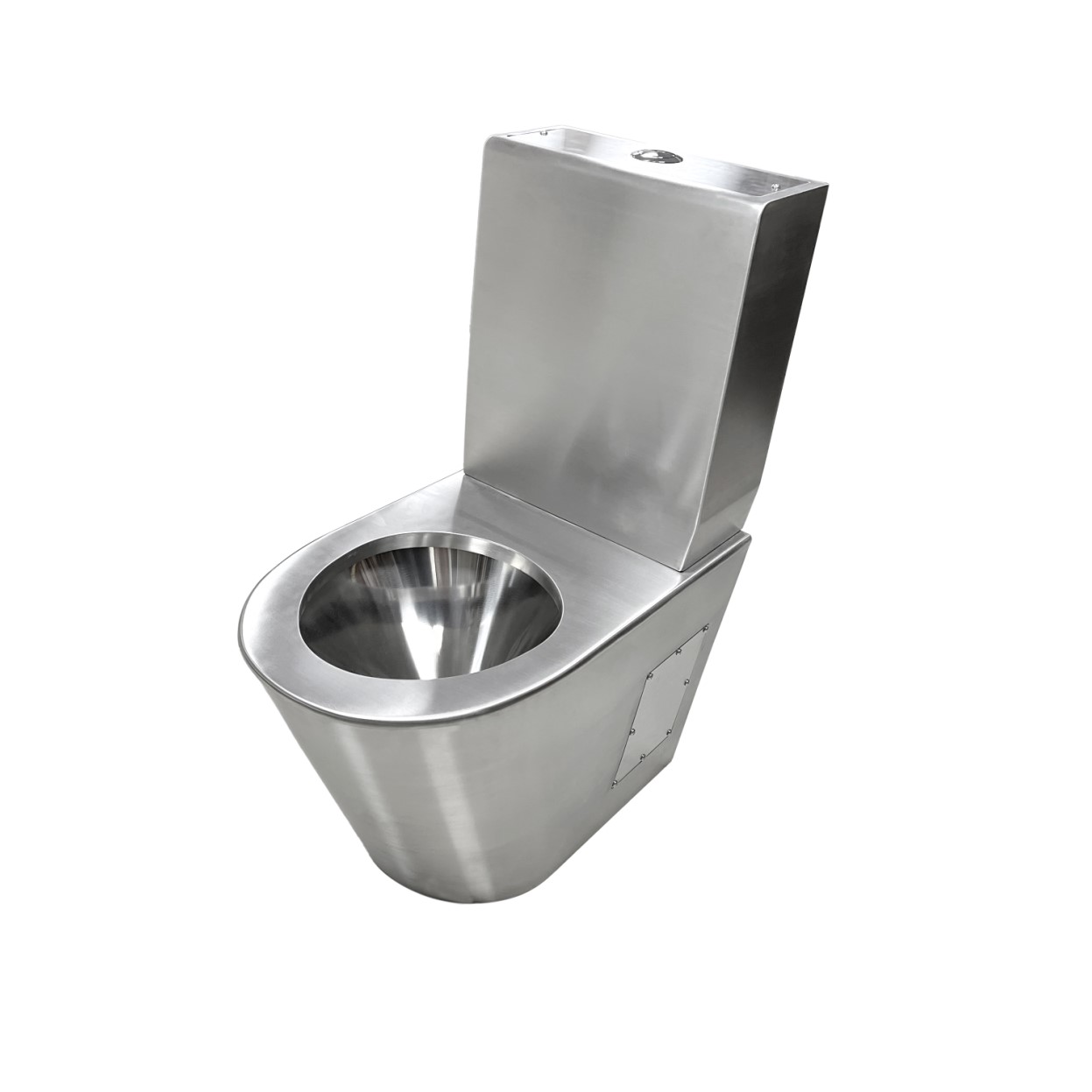
The Core Engineering of Suicide-Resistant Restrooms
Specifying products for suicide-resistant restrooms means eliminating what security personnel call “ligature points”: any loop, gap, joint, or hardware projection that can support a cord, bedsheet, or wire under tension. Engineers design specialized security ware to deny these purchase points entirely. Four critical physical principles drive the design:
1. Fully Radiused Edges & Beveled Contours
Suicide-resistant fixtures lack corners, sharp returns, or rectangular profiles. Surfaces carry a minimum 3mm rounded contour and continuous bevels. When a patient tries to loop a cord or sheet over a suicide-resistant toilet, the continuous slope and lack of physical friction cause the material to slide off instantly.
2. Seamless Welding & Gap Elimination
Fabricators use high-precision robotic and manual TIG welding to join raw 14-gauge stainless steel panels. The assembly undergoes continuous full-penetration welding, and workers grind the weld seams smooth to a uniform finish. This closes any physical gap between the fixture and the wall, blocking patients from inserting paperclips, razor blades, or strings into hidden joints.
3. Flush-Mounted Hemispherical Buttons
Lever-style flush handles and protruding push-buttons create high-risk anchor hazards. Anti-ligature systems replace these mechanisms with flush-mount, pneumatic, or electronic hemispherical buttons. These buttons project less than 3mm from the wall plate and carry a sloped profile, so loops cannot catch on the button body.
4. Anti-Ligature Drainage Systems
Typical sink and floor drains contain grates with slots large enough to feed a wire or plastic strip through to form a loop. Anti-ligature grates feature laser-cut micro-perforations with hole diameters strictly under 2mm. This sizing lets water drain efficiently under gravity while blocking the insertion of even paperclip wire.
Integrating these features into space-saving integrated cell combinations removes all exposed plumbing lines and hardware within the inmate’s or patient’s immediate reach.
Strict Compliance with Behavioral Health & Security Standards
Engineering departments must align facility hardware with established regulatory baselines rather than relying on standard commercial specifications. Two primary standards govern this sector:
NY OMH Patient Safety Standards
The New York State Office of Mental Health (OMH) Patient Safety Standards provide the standard reference for psychiatric ward and clinical design. Under these rules, high-risk patient bathrooms must deploy fixtures that leave no exposed gaps, carry no sharp points, and cannot sustain a downward vertical load greater than 22 pounds (10 kg) without collapsing or releasing the loop. Xinhe anti-ligature stainless steel fixtures meet these guidelines through sloped tops, flush buttons, and micro-perforated drains that withstand load tests.
ASPE Behavioral Health Plumbing Design Guidance
The American Society of Plumbing Engineers (ASPE) behavioral health plumbing design guidance dictates the mechanical layout of the utility chase. It calls for rear-access, chase-mounted installations where all supply, waste, and electrical lines sit behind a structural wall. In addition:
- Secure plumbing systems use tamper-resistant fasteners to lock front-access panel assemblies.
- Flush valves must use pneumatic actuators or piezoelectric switches wired to a secure solenoid box in the utility chase.
- Specifiers can request a specialized powder-coated finish over the stainless steel to soften the cold, institutional look of metal, matching therapeutic environments without sacrificing structural security.
Product Performance: Xinhe Specifications vs. Institutional Requirements
The table below shows how Xinhe’s physical engineering specifications meet and exceed standard safety codes for high-risk environments:
| Technical Parameter | Standard Requirement | Xinhe Compliance | Security Function |
|---|---|---|---|
| Steel Grade & Gauge | Min. 14-Gauge SS304 | Heavy-Duty 14-Gauge & 12-Gauge SS304 / SS316 | Resists extreme impacts; prevents cracking, chipping, or fracturing into sharp weapons. |
| Edge Radius | Fully radiused, no sharp returns | Minimum 3mm radius on all corners; seamless hand-ground welds | Eliminates friction catch-points, causing looped items to slide off immediately. |
| Fastener Access | Concealed, rear-chase mounted | Back-to-wall mounting with high-tensile security bolts | Prevents patients from dismantling the fixture or accessing internal valves. |
| Flush Control | Non-projecting, non-mechanical | Hemispherical pneumatic flush-mount button | Zero protrusion profile eliminates leverage points and prevents mechanical jamming. |
| Drainage Grate | Micro-perforated or solid-sloped | Laser-cut anti-ligature pattern (Max 2mm perforations) | Permits gravity drainage of waste water while blocking wire insertion. |
| Surface Finish | Impact-resistant, easy-clean | Brushed satin stainless steel or optional powder-coated finish | Withstands industrial chemical cleaning agents; softens the visual environment. |
When selecting toilet bowl configurations, planners can specify vandal-resistant prison toilet and sink combo systems or standalone secure toilet units depending on cell or ward dimensions.
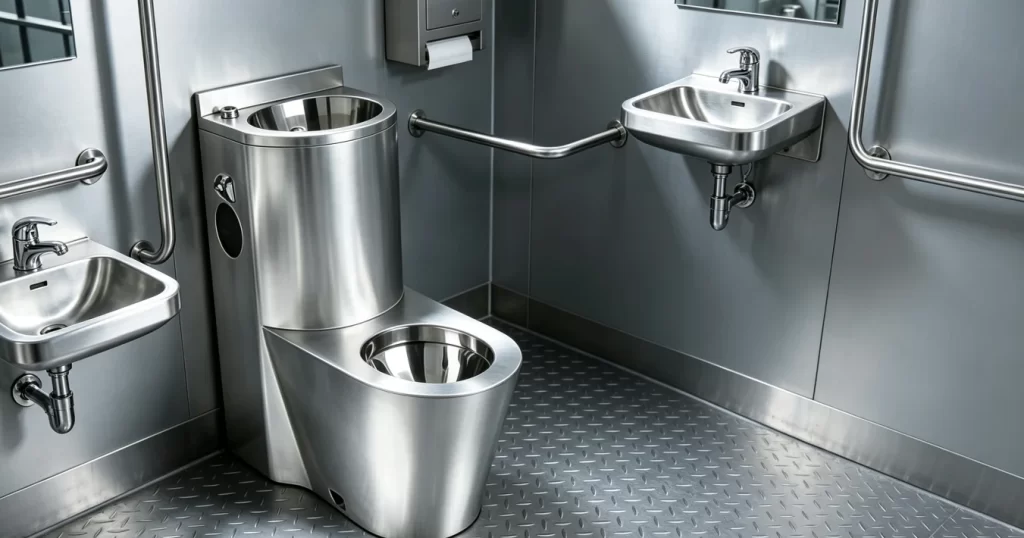
Where Anti-Ligature Stainless Steel Fixtures Are Required
Anti-ligature design principles apply across several institutional sectors where staff supervision is intermittent and safety risks run high:
- Correctional Facilities: Single-occupancy cells, holding areas, and booking cells need robust systems. The high incidence of vandalism and self-harm during the initial 48 hours of custody calls for steel fixtures that withstand severe impact and block suspension attempts.
- Mental Health Facilities & Psychiatric Wards: Patient restrooms, therapy suites, and common bathing areas must be suicide-resistant. Designers balance a therapeutic environment with physical safety, often applying colored powder coatings over heavy-duty stainless steel.
- Detention Centers & Municipal Holding Areas: Temporary holding cells need durable, multi-functional, low-maintenance equipment. These facilities often implement combo units to maximize floor space and cut maintenance needs.
FAQ
What is a ligature resistant fixture?
A ligature-resistant fixture is a plumbing device built with sloped surfaces, rounded edges, micro-perforated drains, and concealed fasteners. This design blocks the attachment of cords, ropes, or clothing, lowering the risk of self-harm in unsupervised environments.
Why specify anti-ligature fixtures for correctional restrooms?
Correctional restrooms present high risks for unsupervised self-harm and deliberate vandalism. Anti-ligature stainless steel fixtures remove potential suspension points, and the durable stainless steel construction stops inmates from breaking the fixtures to create weapons or cause flooding.
Specify Xinhe Anti-Ligature Stainless Steel Fixtures for Your Next Project
We provide custom CAD drawings and verified material certifications (SS304/316, SGS/CE) to support meticulous specification reviews for every deployment. Production holds reliable lead times, and every unit undergoes rigorous tensile failure and edge curvature inspection prior to global dispatch. Contact our engineering team to receive project-specific fixture drawings, material certifications, and anti-ligature compliance documentation for your facility.