Choosing the Right Mop Basin Sink Depth for Facility Maintenance
People who manage high-traffic facilities—airports, hospitals, schools, food service buildings, industrial plants, and public venues—understand that cleaning operations are not a back-of-house detail. They are part of the building’s daily operating system. Every shift moves moves water, soil, detergent, grit, and wastewater through the janitor’s room. Equipment must be specified for real-world use, not just floor-plan convenience.
When sourcing a commercial mop basin sink, material grade often takes center stage. Stainless steel type, gauge, and weld quality all matter. However, basin depth is a practical detail that is often overlooked.
A mop basin sink that is too shallow for the task can make bucket filling, mop rinsing, and wastewater disposal slower and messier. Water may splash outside the wash zone, cleaning chemicals may reach surrounding walls or floors, and janitorial staff may need extra time to clean the closet itself. A properly selected basin depth, combined with suitable drainage, splash protection, and durable construction, helps improve workflow and reduce avoidable maintenance problems.
Why Basin Depth Matters for Splash Control
The main function of a mop basin sink is to provide a dedicated place for dirty-water disposal, bucket filling, mop rinsing, and cleaning-tool washdown. In commercial facilities, these tasks often involve heavier buckets, larger mop heads, floor scrubber recovery tanks, and stronger cleaning chemicals than those used in light residential settings.
Depth helps because the side walls of the basin create a physical containment zone. A deeper basin, especially one paired with a backsplash or side splash guards, can reduce the amount of water that escapes when staff rinse mops, pour wastewater, or fill buckets quickly. It does not eliminate splashing by itself, because water pressure, faucet height, operator technique, bucket shape, and drain position all affect the outcome. Still, basin depth is one of the most visible and useful design variables.
For light commercial spaces, such as small offices or low-traffic retail rooms, a shallower basin may be sufficient when staff only handle small buckets and microfiber tools. In higher-use facilities, a deeper mop basin sink usually provides more practical working volume and better splash containment. A stainless steel utility mop sink for industrial use is especially relevant where durability, cleanability, splashback protection, and equipment compatibility are more important than minimum upfront cost.
A deeper wash zone can support several practical goals. It helps keep wastewater inside the sink, reduces the chance of dirty water reaching wall bases and floor joints, and gives staff more working room when handling larger cleaning tools. For facilities using concentrated detergents, degreasers, or floor-care chemicals, keeping liquid waste in a controlled basin is also part of good housekeeping and workplace safety practice.

Depth, Holding Capacity, and Drainage Performance
Basin depth affects how much wastewater the sink can temporarily hold before it drains. This is important because maintenance staff are not always disposing of clean water. They may be emptying buckets that contain soil, grit, winter salt, floor finish residue, or detergent foam.
A deeper basin gives workers more margin when pouring wastewater, especially if the drain flow is slower than the dumping rate. However, it is important not to overstate what depth can do. Drainage performance depends on the complete plumbing design:
- drain outlet size
- strainer design
- trap configuration
- pipe diameter
- slope, venting
- maintenance access
A deep basin does not automatically prevent blockages, and heavy solids should not be forced into the plumbing system without proper strainers or sediment-control practices.
The practical value of depth is that it provides capacity and reduces overflow risk during short, high-volume discharge events. For heavy-use janitorial rooms, the best specification is not simply “as deep as possible.” It is a balanced design that pairs adequate basin volume with the right drain assembly, removable strainer, and accessible plumbing for cleaning and maintenance.
Matching Basin Depth to Modern Janitorial Equipment
A mop basin sink rarely serves only one mop and one bucket. In modern facilities, janitorial rooms may support dual-bucket trolleys, heavy string mops, microfiber systems, wet/dry cleaning tools, chemical dilution stations, and walk-behind or ride-on floor scrubbers.
If the basin is too shallow or too narrow, emptying a recovery tank or rinsing a large mop head becomes awkward. Staff may need to pour slowly, reposition buckets repeatedly, or clean surrounding surfaces afterward. In contrast, a basin with adequate depth and internal width gives the cleaning team more room to work safely and efficiently.
Depth should also be considered together with structural quality. A deeper basin made from thin, poorly supported metal may flex, dent, or stress its seams under repeated use. A stronger commercial design should consider stainless steel grade, sheet thickness, weld quality, corner radius, reinforcement, mounting method, and accessory support. A commercial mop sinks material comparison can help buyers evaluate how stainless steel, composites, and lower-cost alternatives perform in demanding janitorial environments.
For stainless steel mop sinks, 304 stainless steel is commonly used for general commercial applications because it offers strong corrosion resistance and cleanability. In more aggressive environments, such as coastal locations, heavy chloride exposure, or harsh chemical use, buyers may need to evaluate 316 stainless steel or other project-specific materials. The correct choice depends on the chemical exposure, cleaning frequency, local code requirements, and expected service life.
Ergonomics: Depth Must Work With Mounting Height
Deeper is not automatically better. A mop basin sink must contain water, but it must also be usable by real workers during repeated daily tasks. If the front edge is too high, the basin is too deep, or the working posture requires excessive reaching, staff may need to bend, lift, or lean in ways that increase fatigue.
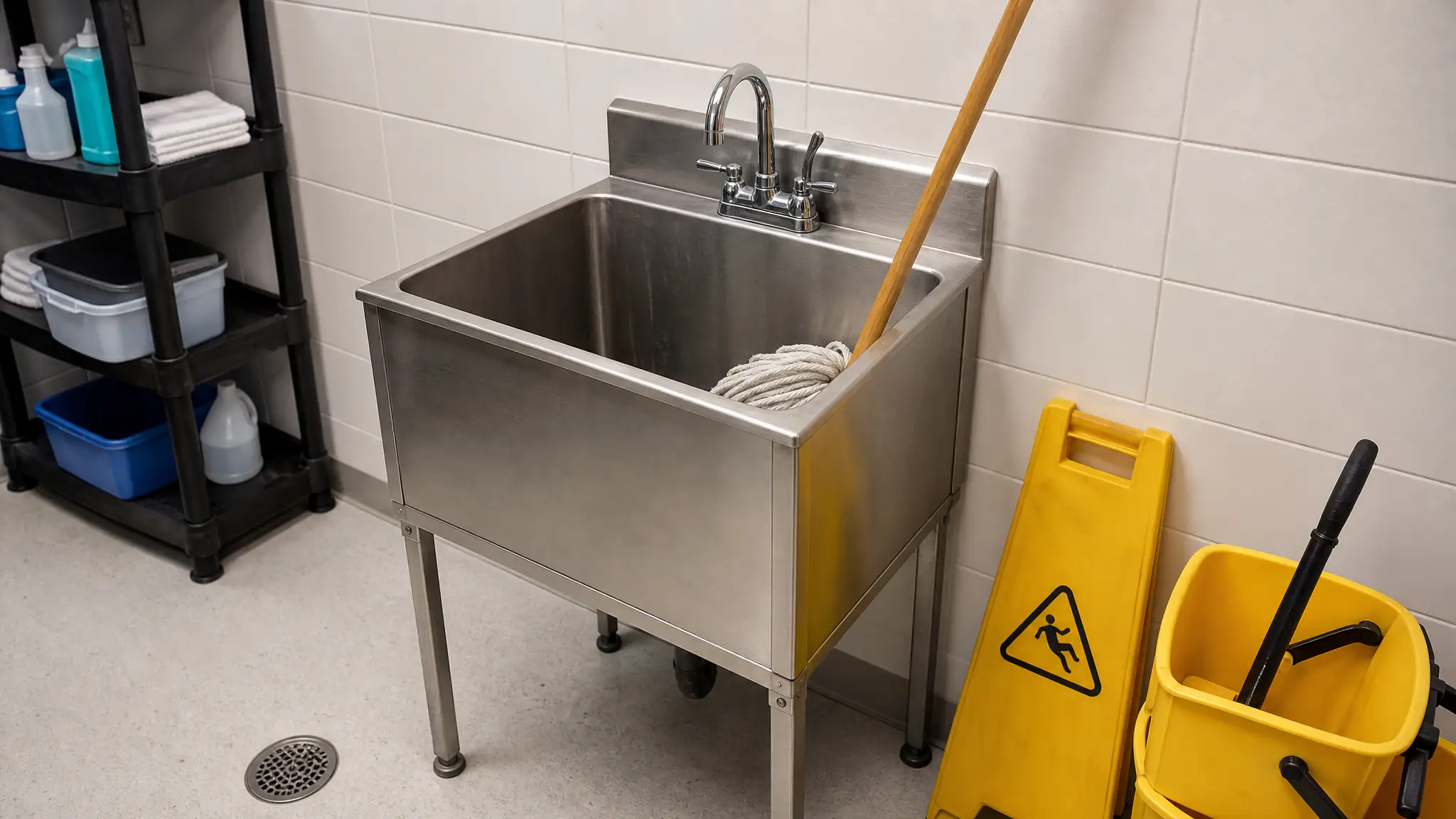
For floor-mounted mop basins, the basin sits directly on the floor or close to floor level. This setup is useful for heavy buckets because staff do not need to lift the bucket onto a high counter. The key ergonomic question is whether users can place, tilt, empty, and remove buckets without awkward lifting. Many facility planners evaluate basin depths in the 8-to-12-inch range for general janitorial use, but the final choice should be based on bucket size, equipment type, user height range, and the required splash protection.
Drop-front or low-front designs can be useful where staff need to roll in buckets or equipment. In these designs, the front apron is lower for access, while the side and rear walls remain higher for splash control. This can be a good compromise for facilities that need both easier loading and better containment.
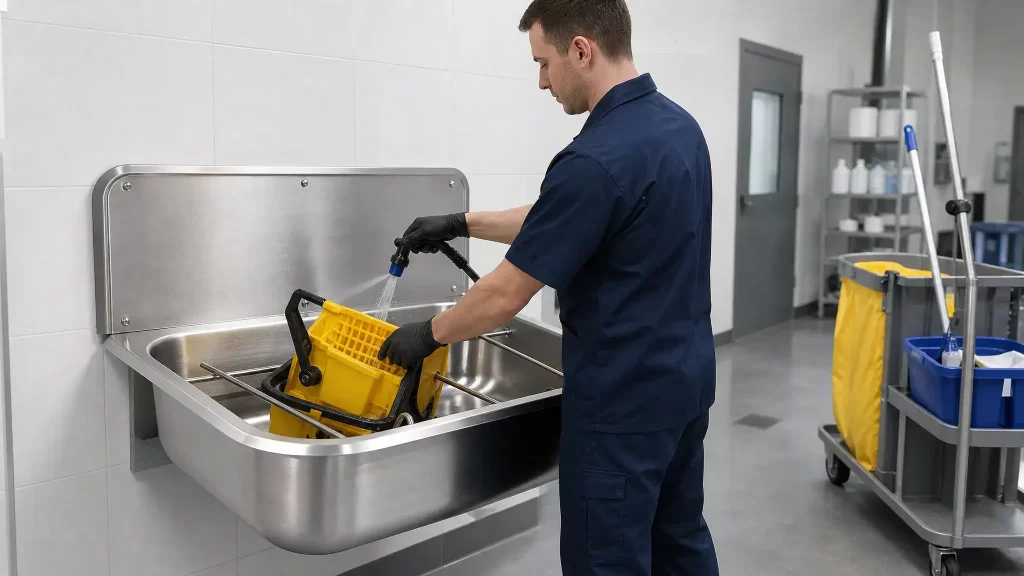
Wall-mounted mop sinks offer another advantage: installation height can be adjusted to the room layout and user needs. However, the internal depth and front lip height must be considered together. If the basin is installed too high or is too deep for the user group, workers may need to lean over the front edge to reach the drain or rinse tools. For wall-mounted units, project teams should review the finished floor height, rim height, basin depth, support structure, and expected load before finalizing the specification.
Compliance and Sanitary Design Considerations
Commercial mop sinks are often installed in environments where hygiene, code compliance, and cleanability matter. Food service, healthcare, hospitality, education, and public facilities may all have requirements for separating janitorial wastewater from food preparation, handwashing, and clean equipment areas.
In North America and other regulated markets, buyers should verify whether the selected product needs NSF/ANSI listing, local plumbing approval, backflow prevention, specific drain fittings, or other certification. The relevant requirement depends on the jurisdiction and the application. It is not enough to assume that a deep basin is automatically compliant. The product must match local health, plumbing, and building requirements.
Sanitary design features may include smooth, nonabsorbent surfaces, coved or radiused internal corners, corrosion-resistant materials, accessible drains, removable strainers, and splash protection around the wash zone. CDC vessel sanitation standards, for example, emphasize mop-cleaning facilities separated from food facilities, adequate deck drainage, cleanable surfaces, and proper storage for cleaning materials. While those standards apply to cruise vessels, the underlying design logic is useful for many commercial facilities: keep dirty cleaning operations separate, contained, drainable, and easy to clean.
For international buyers, the safest approach is to treat basin depth as one specification within a broader compliance checklist. A deep basin may improve usability, but certification, drainage, installation, wall protection, and maintenance access are equally important.
Regional and Project-Specific Requirements
Different projects may require different mop basin sink configurations. A compact restaurant in a dense urban area may prioritize space-saving wall-mounted equipment. A logistics warehouse may need a larger floor-mounted basin that can handle grit, mud, and frequent bucket dumping. A hotel may prioritize a clean appearance, easy wiping, and compatibility with housekeeping carts. A food processing area may need more robust drainage planning and strict separation from food-contact operations.
Regional conditions also matter. Facilities exposed to sand, dust, road salt, high humidity, or coastal air may need stronger corrosion resistance and easier cleaning access. Projects in markets with strict food service or public health inspections should verify approved materials, backflow protection, and installation details before purchase. In all cases, the best mop basin sink depth is the one that matches the cleaning task, the available room, the plumbing system, and the applicable code requirements.
Industry-Specific Depth Planning
Healthcare and clinical environments generally require janitorial fixtures that are easy to clean, corrosion-resistant, and separated from patient-care and clean-storage areas. Splash control is important, but claims about infection control should be handled carefully and supported by the facility’s own hygiene protocols. In these settings, a mop basin sink should be specified alongside wall protection, proper drainage, cleaning-material storage, and approved cleaning procedures.
Food and beverage facilities often deal with heavier soils, grease, detergents, and washdown routines. A larger basin can help contain wastewater and foam during cleaning tasks, but the drain system must be designed to handle the expected waste stream. Strainers, grease-control practices, and maintenance access may be as important as basin depth.
High-traffic public venues such as airports, malls, stadiums, and transit facilities usually need fast turnaround cleaning. In these locations, crews may empty buckets and scrubber tanks repeatedly throughout the day. A deeper, higher-capacity basin can reduce splashing and provide more working room, especially when paired with a heavy-duty grate, backsplash, and durable stainless steel construction.
Industrial facilities may need the most careful evaluation. Sand, metal particles, oil residue, dust, and chemical exposure can place heavy demands on the sink and plumbing system. For these applications, buyers should not choose depth alone. They should confirm the basin material, gauge, drain hardware, support frame, wall protection, and maintenance plan.
Depth Selection Matrix for Facility Planners
The following matrix provides practical planning guidance. These ranges should be treated as starting points rather than universal standards, because the final specification should be checked against local codes, equipment dimensions, and manufacturer data.
| Facility scale | Typical basin depth to evaluate | Compatible equipment | Why it works |
|---|---|---|---|
| Light commercial offices and small retail | 8 to 10 inches | Small mop buckets, microfiber flat mops | Saves space and supports basic cleaning tasks |
| Institutional buildings, schools, hotels, clinics | 10 to 12 inches | Dual-bucket trolleys, string mops, general janitorial tools | Balances splash control, capacity, and daily usability |
| Heavy commercial and industrial facilities | 12 inches or deeper where space and ergonomics allow | Large buckets, floor scrubber tanks, pressure-rinse tasks | Provides more containment volume for high-use cleaning rooms |
This matrix should not replace project-specific review. If the janitor’s room is small, a 12-inch-deep basin may not be practical. If staff use large scrubber tanks, an 8-inch basin may be too limited. The correct decision comes from matching basin depth with basin width, front lip height, drain capacity, backsplash height, and the actual equipment used by the cleaning team.
The Real ROI of Selecting the Right Dimensions
A commercial mop sink selection guide is useful because depth is only one part of the purchase decision. Buyers should also review material, gauge, installation type, faucet compatibility, backsplash options, grate design, drain hardware, and cleaning access.
The cost difference between a basic shallow basin and a better-specified commercial mop basin sink can be small compared with the long-term cost of poor drainage, repeated splash cleanup, damaged wall finishes, slippery floors, or premature replacement. However, ROI should be described realistically. A deeper basin does not guarantee lower maintenance costs by itself. It contributes to better performance when it is part of a well-designed janitorial room.
A strong specification should answer several questions before purchase.
- What size buckets will staff use?
- Will floor scrubber tanks be emptied into the sink?
- What chemicals will be handled?
- Is wall protection required around the basin?
- Does the drain need a removable strainer?
- Will the sink be floor-mounted, wall-mounted, or freestanding?
- Is the product certified or documented for the target market?
When those questions are answered early, the mop basin sink becomes a functional asset instead of a recurring source of cleanup problems.
Final Thoughts on Janitorial Planning
The janitor’s room supports the daily hygiene, safety, and professional appearance of your entire facility. It should never be treated as leftover space. To ensure long-term performance, consider these three pillars of sink selection:
- Operational Fit: Match basin depth to your specific equipment and cleaning volume.
- Safety & Ergonomics: Balance splash containment with proper mounting heights to protect staff.
- Technical Integrity: Prioritize material strength, drainage capacity, and local code compliance.
Strategic Selection for Every Environment
While compact basins work for light commercial use, high-traffic facilities require the containment of a deeper stainless steel mop basin sink. In industrial or food service settings, this depth must be paired with heavy-duty construction and a high-capacity drainage system.
Optimizing your janitorial layout starts with the right equipment. Xinhe combines 30+ years of fabrication experience with flexible customization to deliver mop sinks that fit your exact requirements. Let us help you refine your specs before your next bulk order—contact us today for expert support.