Home > Blog > Public Products >
How High Should an ADA Drinking Fountain Be in Public Projects
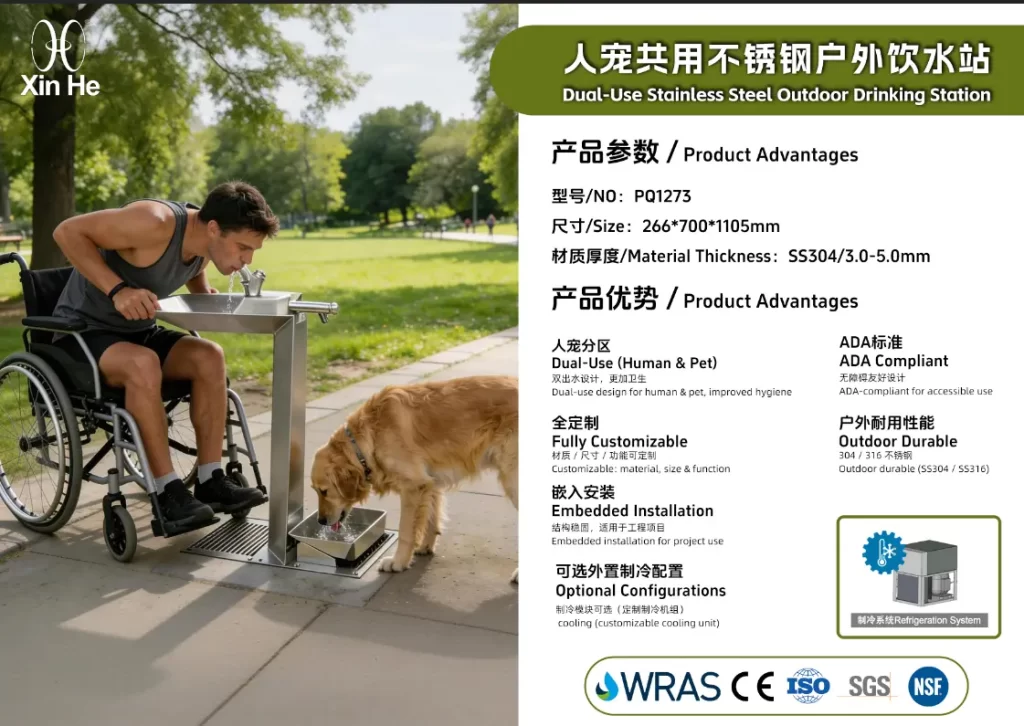
For most ADA public projects, the drinking fountain spout outlet should be no higher than 36 inches above the finished floor or ground. This ADA drinking fountain height helps wheelchair users reach the water stream safely and comfortably. However, height is only one part of the specification. Project buyers also need to evaluate clear floor space, knee clearance, spout location, installation type, and whether the unit will be used indoors, outdoors, or alongside a bottle filler.
Understanding these requirements upfront prevents costly re-installations and ensures your facility serves all users effectively.
Standard ADA Drinking Fountain Height
In ADA-style public projects, the key measurement is the spout outlet height, not the top of the basin or the back panel. For a wheelchair-accessible drinking fountain, the spout outlet must be 36 inches maximum above the finished floor or ground.
This specific height is designed to allow seated individuals to comfortably access the water flow without excessive reaching or straining.
Additionally, many public facilities require a “high-low” configuration. While the lower unit accommodates wheelchair users, the higher unit is designed for standing persons. The spout outlet for standing users is typically positioned between 38 and 43 inches high. When specifying dual units, it is critical to ensure the standing-height fountain does not obstruct the forward approach space required for the wheelchair-accessible unit.
Measuring the Height Correctly
A frequent oversight in facility construction is miscalculating where the measurement begins and ends. For project buyers, the safest approach is to confirm the exact spout outlet height on the technical drawing before production or bulk ordering.
- Measure from the Finished Floor: The measurement must start from the final ground surface. If you are installing an outdoor unit and plan to add a concrete pad or pavers later, that added thickness must be factored into the overall installation height.
- Measure to the Spout Outlet: Do not measure to the rim of the basin, the bubbler guard, or the top of the bottle filler. The standard height for an ADA drinking fountain strictly applies to the point where the water exits the spout.
Other Crucial ADA Dimensions
Height tells users whether they can reach the water, but other dimensions dictate whether they can safely interact with the fixture. Evaluating these metrics is just as vital as checking the spout height.
- Clear Floor Space: Users need room to navigate. Standard specifications generally require a 30-inch by 48-inch clear approach space directly in front of the unit.
- Knee and Toe Clearance: Knee clearance tells wheelchair users whether they can move close enough to drink. Accessible units typically require a minimum of 27 inches of vertical clearance underneath the basin.
- Operable Parts: Push buttons or activation bars must be operable with one hand, requiring no more than 5 pounds of force, which matters greatly for users with limited hand strength.
- Protruding Objects: In busy corridors, a wall-mounted unit cannot protrude into the walkway in a way that creates a hazard for visually impaired pedestrians.
Height Planning for Outdoor Public Fountains
For outdoor projects such as parks, campuses, sports areas, and transport stations, buyers should not only check the wheelchair-accessible fountain height but also confirm the final ground level, drainage, weather exposure, and material grade.
Outdoor environments present unique challenges. The ground may be sloped for drainage, which alters the effective height of the fountain depending on the user’s angle of approach. When planning an ADA compliant outdoor drinking fountain for public spaces, you must anchor the base on a level concrete pad that aligns perfectly with the adjacent pathways.
Material selection is also critical here. A stainless steel drinking fountain for public projects should generally be specified in 304 or 316 stainless steel. While 304 grade is excellent for general outdoor use, 316 grade offers superior corrosion resistance for coastal areas or facilities exposed to harsh industrial elements.
Wall-Mounted, Freestanding, or Bottle Fillers
Selecting the right configuration impacts how easily you can meet height requirements within your specific spatial constraints.
- Wall-Mounted Fountains: Ideal for indoor corridors, office buildings, and schools. A wall-mounted model saves floor space and allows installers to set the exact ADA compliant fountain height directly on the wall backing. However, the design must incorporate appropriate skirting or cane aprons to prevent it from becoming a protruding hazard.
- Freestanding Fountains: Best suited for outdoor walkways, parks, and plazas. Since the base height is fixed, contractors must ensure the ground surface is perfectly prepped so the spout remains at or below the 36-inch maximum.
- Bottle Filler Stations: Highly requested in airports, gyms, and modern campuses. When choosing a wall-mounted drinking fountain with bottle filler, buyers must ensure the bottle filler controls and sensors fall within the acceptable ADA reach range—often a maximum of 48 inches from the floor.
What to Confirm Before Bulk Ordering
Before placing a bulk order, project buyers should share the required dimensions, mounting methods, and site conditions with their manufacturing partner. This helps avoid a mismatch between the commercial drinking fountain specifications and the final site reality.
When evaluating a stainless steel drinking fountain manufacturer, ensure you clarify the following details:
| Procurement Checklist | Specific Details to Confirm |
|---|---|
| Spout Outlet Height | Confirm the design allows the spout to rest at 36″ max above the finished floor. |
| Mounting Mechanism | Specify if it requires in-wall carriers, surface mounting, or a freestanding floor bolt system. |
| Material Grade | Choose between 304 or 316 stainless steel based on indoor/outdoor environment. |
| Activation Type | Push-button, foot pedal, or touchless sensors (ensure compliance with operable force rules). |
| Additional Features | Chilled water compressors, filtration systems, or integrated pet bowls. |
Common Height Mistakes in Public Projects
Even with clear specifications, installation errors happen. Reviewing your outdoor drinking fountain installation planning can prevent these typical failures:
- Measuring from the Sub-floor: Contractors sometimes measure 36 inches from the unfinished concrete slab, only to add two inches of tile later, making the fountain non-compliant.
- Measuring to the Basin Rim: Setting the basin edge at 36 inches pushes the actual spout outlet higher, immediately failing accessibility checks.
- Placing Bottle Filler Controls Too High: While the bubbler might be at the correct height, placing the push-button for the bottle filler above 48 inches makes it inaccessible for many users.
- Overlooking Children’s Needs: In elementary schools or dedicated children’s areas, the required spout height is often lower (e.g., 30 inches). Using standard adult accessible dimensions in these specific zones is a frequent planning error.
FAQs
- What is the maximum ADA drinking fountain height?
For wheelchair-accessible units, the spout outlet is generally required to be 36 inches maximum above the finished floor or ground.
- Is the ADA height measured to the bowl or the spout?
It must be measured strictly to the spout outlet where the water stream begins, not to the top of the bowl, bubbler guard, or back panel.
- Can a drinking fountain with a bottle filler be ADA compliant?
Yes. However, the bubbler spout height, the bottle filler controls, the forward reach range, and the clear floor space must all be evaluated together to ensure full compliance.
- Do outdoor drinking fountains need ADA height planning?
Yes. If the outdoor project—such as a public park, stadium, or campus—requires accessible public use, the outdoor models must be planned around the same accessible height and approach space guidelines.
- What material is best for public drinking fountains?
Stainless steel is the industry standard for commercial projects because it is durable, hygienic, vandal-resistant, and suitable for heavy-traffic indoor or outdoor use.
Getting the ADA drinking fountain height right is a fundamental step in making public projects safer and more accessible. For schools, parks, corporate offices, hospitals, and transportation facilities, buyers must proactively confirm spout height, knee clearance, material grade, and installation type before ordering. Overlooking these details can lead to project delays and failed site inspections.
Xinhe Stainless supports international public hydration projects with durable stainless steel drinking fountains in wall-mounted, freestanding, indoor, outdoor, and customized configurations.
Get Project Specification Support
Share your project drawings or basic requirements with Xinhe to receive suitable ADA-style drinking fountain specifications tailored to your facility’s exact needs.