Kitchen Work Table Gauge Guide: 14 vs 16 vs 18 Selection
Walk into any commercial kitchen equipment showroom and you’ll find stainless steel work tables priced nearly the same until you check the gauge. One table reads 14 gauge. Another reads 18 gauge. The same footprint can carry a $200-plus price gap. Salespeople call both “commercial grade.” Both claims hold up, but the difference decides how the table performs once you load it.
Gauge measures steel thickness, and the numbering runs backward: a lower gauge means thicker steel. A 14-gauge tabletop measures about 2.0 mm. A 16-gauge top measures about 1.5 mm. An 18-gauge top measures about 1.2 mm. That 0.8 mm spread between the thinnest and thickest options changes load capacity, dent resistance, service life, and cost of ownership on a kitchen work table.
Gauge Comparison at a Glance
| Gauge | Thickness (mm) | Typical Load Capacity | Best Use Case |
|---|---|---|---|
| 14 | ~2.0 mm | 800–1,000 lbs | Butchery, high-volume bakery, receiving |
| 16 | ~1.5 mm | 600–800 lbs | General prep, cold-side work, most commercial kitchens |
| 18 | ~1.2 mm | 400–500 lbs | Light prep, catering setups, front-of-house stations |
These figures assume a standard 16-gauge tubular frame with cross-bracing. Frame gauge and tabletop gauge are separate choices, and the next sections cover them in detail. That spread decides whether your kitchen work table holds up under daily load, so read the comparison against your own station.
14-Gauge Tables
A 14-gauge tabletop at 2.0 mm is the thickest option in commercial kitchen equipment. It resists denting under point-load impact: a dropped mixer bowl, a full hotel pan slammed down, or continuous mallet work during butchery.
Where 14 gauge earns its cost:
- High-volume butchery and protein processing stations
- Receiving areas where full cases land on the table
- Bakeries running 60+ kg dough batches with heavy equipment parked in place
- Any station where staff use the table as an impromptu step
Where 14 gauge is overkill:
- Garde manger stations handling light salads and garnishes
- Pastry finishing lines with delicate tools
- Any operation under 50 covers per service
The premium for 14 gauge runs 15–25% above equivalent 16-gauge models. For most kitchens, that premium pays off only when the table faces sustained mechanical stress. Before you specify gauge purely on load numbers, read our stainless work table load capacity guide for buyers. Frame construction affects safe working load more than tabletop gauge alone.
A note on hat channels: Quality 14-gauge tables reinforce the underside of the tabletop with hat-channel bracing, a corrugated steel profile welded perpendicular to the table’s length. This distributes point loads and prevents oil-canning, the flexing and popping of flat sheet steel under load. If a supplier offers 14-gauge steel without hat channels, treat that as a specification gap and press them on it.
16-Gauge Tables
Sixteen gauge, 1.5 mm thick, is the workhorse of the commercial kitchen. It meets NSF/ANSI 2 structural requirements, handles a full shift of prep without flex, and costs less than 14-gauge alternatives. Most operators spec their first kitchen work table at 16 gauge, and that default serves most operations well.
Where 16 gauge is the right call:
- Full-service restaurants running 100–300 covers per service
- Hotel banquet prep kitchens
- Institutional foodservice (hospitals, universities, corporate dining)
- Any station with consistent moderate-to-heavy use without extreme impact loads
When 16 gauge is a marginal choice:
- Receiving and butchery (consider 14 gauge)
- Catering kitchens that keep sustained load under 200 lbs (18 gauge may suffice)
The same logic that drives gauge selection in tabletops applies to sinks. Our guide on why 16-gauge is also preferred for heavy-duty commercial sinks explains the choice through flex resistance and long-term surface integrity under constant wet loading.
For most operators specifying a new kitchen build or replacement tables, start with 16 gauge on a 16-gauge tubular frame. Upgrade from there based on specific use-case demands. Downgrade only when load requirements and budget both justify it.
18-Gauge Tables
Eighteen gauge at 1.2 mm is the thinnest tabletop widely sold in the commercial market, and buyers misspecify it more than any other gauge. Operators cause the misspecification. They pick 18-gauge tables for stations that demand more than the steel can give.
Where 18 gauge fits:
- Front-of-house bussing and expo stations
- Catering setups where tables deploy temporarily
- Back-bar prep stations with light cutting and plating
- Small café prep lines with minimal daily throughput
Where 18 gauge fails quickly:
- Any station with regular heavy-equipment placement (slicers, mixers, commercial blenders)
- Receiving areas
- Walk-in cooler prep tables with heavy product stacking
- High-traffic prep lines in full-service restaurants
An 18-gauge tabletop under sustained heavy use will oil-can within months. The surface flexes under moderate downward pressure, a signal that the steel is working at or near its elastic limit. Once deformation becomes permanent, the table loses both sanitation (water pools in the low spots) and structural safety.
The savings over 16 gauge are real but modest, 10–15% across a full buildout. That saving rarely justifies the risk of premature replacement.
Frame Gauge vs. Tabletop Gauge
Most buyers fixate on tabletop gauge and skip the frame. That mistake costs them. A 16-gauge tabletop on a 20-gauge frame will deflect and rack under load no matter how thick the top is. The two specifications work together.
Standard commercial spec:
- Tabletop: 16 gauge
- Legs and frame: 16-gauge square or round tube
- Undershelf: 18 gauge (acceptable for stored equipment, not for active work surface use)
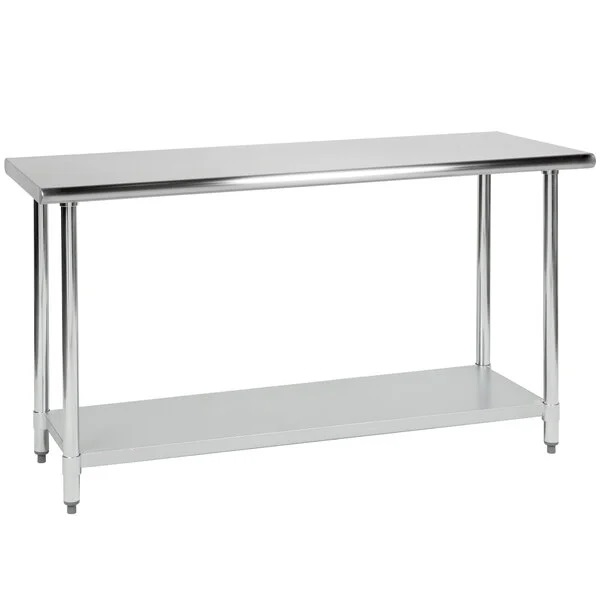
When you shop for a kitchen work table, match the frame gauge to the tabletop gauge before you weigh price. The Xinhe WT02-B Commercial Kitchen Work Table with Undershelf uses a 1.0 mm undershelf welded to the perimeter frame, a design that prioritizes rigidity at the base while keeping overall weight manageable. The welded connection matters: bolted undershelves introduce flex over time, especially in high-humidity kitchens where fastener corrosion accelerates.
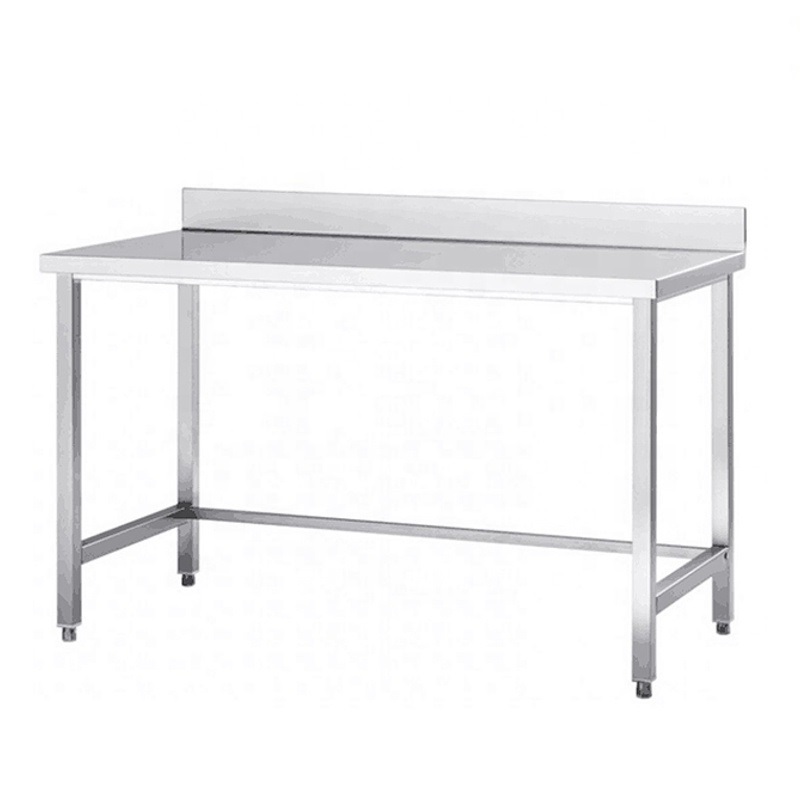
For operators who need adjustable storage, the Xinhe WT01 Stainless Steel Prep Table with Backsplash uses adjustable undershelf brackets, a practical trade-off between flexibility and rigidity.
304 vs. 430 Stainless Steel
Gauge tells you how thick the steel is. Grade tells you how it performs in a wet, salt-laden, acidic kitchen.
| Property | Type 304 | Type 430 |
|---|---|---|
| Chromium content | 18% | 16–18% |
| Nickel content | 8–10% | None |
| Corrosion resistance | Excellent | Moderate |
| Magnetic | No | Yes |
| Relative cost | Higher | Lower |
| Recommended for | All commercial kitchens | Dry storage, light-duty only |
Type 304 is the industry standard for commercial kitchen work surfaces. Its nickel content creates a stable austenitic structure that resists chloride corrosion, critical in kitchens where cleaning chemicals, brine, and acidic marinades hit the surface daily.
Type 430 is ferritic stainless. It performs acceptably in dry or low-moisture environments but corrodes faster under sustained wet conditions. Some budget-tier equipment uses 430 on non-contact surfaces (backs of equipment, lower frame members) while keeping 304 on the work surface, a legitimate cost play when the manufacturer discloses it clearly.
Field test: Hold a magnet to the tabletop. Type 304 shows little to no attraction; the magnet will not hold to the surface. Type 430 is magnetic. This quick check works when you buy used equipment or verify a supplier’s specification claim.
How to Verify Gauge Before You Buy
Suppliers misrepresent gauge two ways: marketing language (“heavy duty” for 18-gauge tables) or quoting nominal rather than actual thickness. Run three checks before you commit:
- Request the mill certificate or material spec sheet. A reputable supplier provides this on request. It lists actual measured thickness in millimeters, not just the gauge designation.
- Use a digital caliper on arrival. Measure the tabletop edge at three points: center and both ends. Acceptable tolerance for 16-gauge is 1.4–1.6 mm. Material outside that range signals substandard supply.
- Run the magnet test. This confirms 304 vs. 430 independent of the supplier’s stated specification. A non-magnetic result on the tabletop surface is a basic but meaningful quality signal.
These steps take under five minutes and prevent a six-month procurement mistake. Before you buy a kitchen work table, verify the gauge yourself rather than trust the listing photo.
Matching Gauge to Operation Type
| Operation | Recommended Gauge | Notes |
|---|---|---|
| Full-service restaurant prep | 16 gauge | Standard spec; covers most load scenarios |
| Butchery / protein station | 14 gauge | Impact resistance justifies cost premium |
| High-volume bakery | 14 or 16 gauge | Depends on equipment weight parked on table |
| Catering / event kitchen | 18 gauge | Acceptable for light, temporary use |
| Institutional foodservice | 16 gauge | NSF compliance, durability, replaceability |
| Front-of-house expo / bussing | 18 gauge | Low load, aesthetic considerations apply |
| Receiving / storage | 16 gauge minimum | Heavy case loads; 14 gauge for extreme volume |
Use this table to match your kitchen work table to its real workload, then confirm the frame spec before you order.
FAQs
Is 14-gauge stainless steel worth the extra cost for a restaurant prep table?
For most prep applications, no. Fourteen gauge pays off at butchery stations, receiving areas, and high-volume bakeries where sustained heavy impact or point loads are routine. For standard prep work, breaking down vegetables, portioning proteins, assembling dishes, 16 gauge handles the load and lasts a full equipment lifecycle without issue.
What does NSF certification mean for gauge requirements?
NSF/ANSI 2 sets food-zone surface standards covering finish, sealability, and structural integrity. It does not mandate a specific gauge. NSF-listed tables must still pass load and deflection testing, and in practice, 18-gauge tables fall short of listing for heavy-duty classifications. If your jurisdiction or insurer requires NSF-listed equipment, verify the classification level, not just the presence of an NSF mark.
Can I use an 18-gauge table in a commercial kitchen legally?
In most jurisdictions, yes, provided it carries the appropriate NSF listing and you use it within its rated load capacity. Fit decides the rest. An 18-gauge table used within spec in a light-duty application is a sound choice. The same table at a butchery station becomes a maintenance and safety liability, regardless of its certification status.
Final Thoughts
Gauge selection is not complicated, but it is consequential. Buy too light and you replace equipment or manage a warped surface within two years. Overbuy and you tie up capital in steel thickness your operation will never need.
The framework is straightforward: identify the heaviest sustained load the table will carry, confirm the frame specification matches the tabletop gauge, verify 304 steel on any surface that touches food or cleaning chemicals, and confirm gauge with a caliper before the equipment ships.
Spec your kitchen work table at 16-gauge 304 stainless on a 16-gauge frame. Change that baseline only when your specific use case demands it. Supplier marketing language should not drive the decision.