Stainless Steel Urinal Trough: The Buyer’s Guide for Commercial Projects
When sourcing restroom fixtures for high-traffic commercial projects, choosing the right stainless steel urinal trough ranks among the most consequential procurement decisions. Stadiums, schools, transit hubs, and factories all demand fixtures that combine durability, hygiene, and low lifetime cost. Stainless steel consistently outperforms alternative materials across these criteria. Xinhe, a manufacturer with over 30 years of experience supplying OEM fixtures, has documented what works in demanding commercial environments. This guide walks procurement teams through every key consideration.
What Is a Stainless Steel Urinal Trough
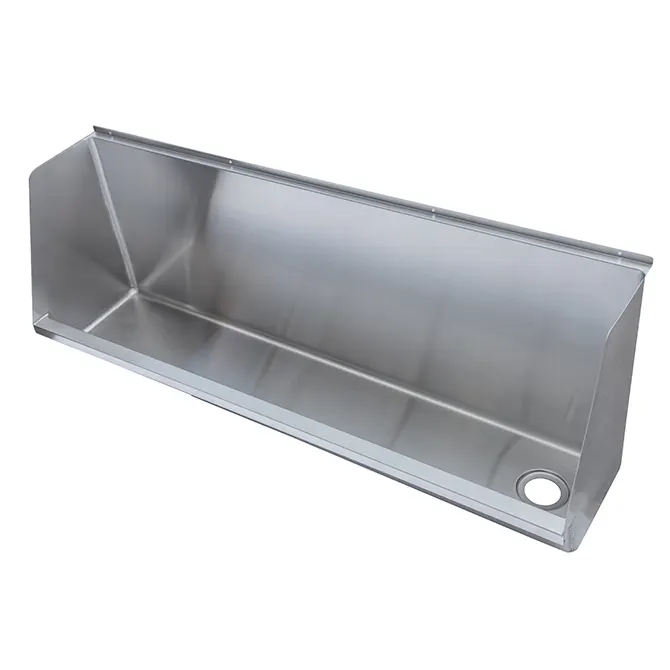
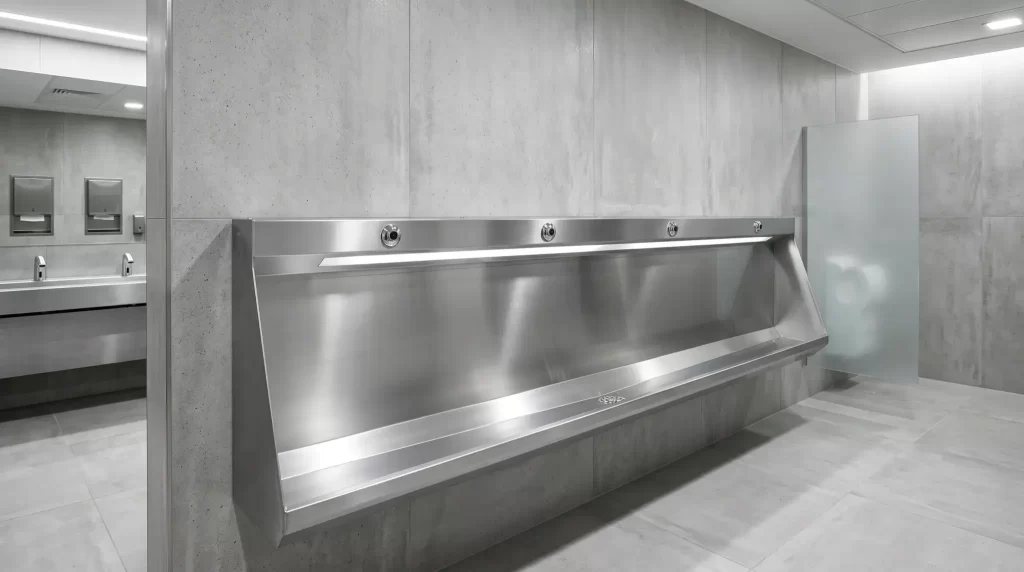
A urinal trough is a continuous, wall-mounted or floor-standing sanitary fixture designed for simultaneous use by multiple users in commercial restrooms. Unlike individual wall-hung urinals, a trough provides a shared basin that maximizes throughput in high-traffic environments while minimizing footprint and installation complexity.
Definition and Core Components
Every unit consists of three core components:
- Trough body: Fabricated from grade 304 or 316 stainless steel, forming the main basin and polished to a satin or mirror finish for corrosion resistance.
- Flushing valve: Available in manual, sensor-activated, or continuous flush configurations, delivering water across the entire basin length to rinse waste toward the drain.
- Drainage outlet: Usually positioned at one end or the center, connecting to the building’s waste system via a standard P-trap or S-trap.
Common Applications in Commercial Settings
Commercial trough urinals are standard in venues with peak-demand restroom usage. These include sports stadiums, concert arenas, schools and universities, highway rest stops, transit stations, military barracks, and industrial facilities. In each case, the fixture handles surges of users efficiently. A single 1.8-meter unit can serve three to four users simultaneously, cutting wait times compared to individual fixtures. For a deeper look at why these fixtures excel in demanding environments, learn why stainless steel urinal troughs excel in high-traffic spaces.
Why Stainless Steel Dominates Commercial Restrooms
Stainless steel dominates commercial restrooms for three reasons:
- Durability: It withstands impact, heavy use, and harsh cleaning chemicals without cracking or chipping.
- Hygiene: The non-porous surface resists bacterial growth and is easy to sanitize.
- Low maintenance: No grout lines, no glazing to wear, and minimal replacement over a 20+ year service life.
If your project serves high-traffic users and demands long service life, a stainless steel urinal trough is the clear default choice.
Stainless Steel vs. Ceramic vs. Plastic
Selecting the right material directly impacts the performance you can expect over decades of use. B2B buyers routinely compare stainless steel, ceramic, and plastic (HDPE), and the differences are significant.
Stainless Steel — Durability, Hygiene & Vandal Resistance
Stainless steel offers the best combination of impact resistance, hygiene, and vandal resistance. A vandal resistant trough made from 304 or 316 grade steel shrugs off kicks, scratches, and tampering. The non-porous surface prevents bacteria buildup, and welded seams eliminate crevices where grime accumulates. For high-risk public restrooms, stainless steel sets the industry benchmark.
Ceramic — Aesthetics vs. Fragility
Ceramic urinals look clean and modern, but they are inherently fragile. A single impact from a heavy object or deliberate vandalism can crack or shatter the basin, leading to costly emergency replacements. Ceramic also requires more careful cleaning to avoid damaging the glazed surface. In unsupervised or high-traffic public restrooms, ceramic presents a liability.
Plastic/HDPE — Budget Option with Limitations
Plastic or HDPE troughs offer the lowest upfront cost but degrade faster. They scratch easily, harbor bacteria in surface abrasions, and may discolor or warp under prolonged UV or heat exposure. For budget-constrained projects with light usage, HDPE may suffice, but it rarely delivers the lifecycle value of stainless steel.
| Factor | Stainless Steel | Ceramic | Plastic/HDPE |
|---|---|---|---|
| Durability | Excellent (20+ years) | Moderate (crack-prone) | Low to Moderate |
| Hygiene | Excellent (non-porous) | Good (glazed surface) | Fair (scratches trap bacteria) |
| Vandal Resistance | Excellent | Poor (shatters) | Fair |
| Maintenance Cost | Low | Medium | Medium-High |
| Initial Cost | Medium-High | Medium | Low |
| Best For | High-traffic, public, vandal-prone | Low-traffic, supervised | Budget, light-duty |
For most commercial and public projects, stainless steel delivers the lowest total cost despite a higher initial price.
Which Grade Should You Choose
Once you have chosen stainless steel, the next decision is grade. The two most common grades for trough fixtures are 304 stainless steel and 316 stainless steel, and the difference comes down to corrosion resistance.
304 Grade — The Standard Choice for Most Commercial Projects
The 304 grade is the workhorse of commercial restrooms. It contains approximately 18% chromium and 8% nickel, providing excellent corrosion resistance in typical indoor environments. For schools, offices, stadiums, and retail facilities, 304 delivers proven performance at a competitive price point. Most stock and standard OEM troughs are manufactured in this grade.
316 Grade — Superior Corrosion Resistance for Harsh Environments
The 316 grade adds 2% to 3% molybdenum to the alloy, dramatically improving resistance to chlorides and pitting corrosion. This makes 316 the preferred choice for coastal areas with salt air, swimming pool facilities with chlorine exposure, chemical plants, and marine environments. While 316 typically costs 20% to 30% more than 304, it prevents premature corrosion that could shorten service life in aggressive settings. Actual price differences fluctuate with raw material markets.
| Property | 304 Grade | 316 Grade |
|---|---|---|
| Composition | 18% Cr, 8% Ni | 16% Cr, 10% Ni, 2% Mo |
| Corrosion Resistance | Good (indoor/general) | Excellent (chloride/marine) |
| Price Premium | Baseline | +20–30% over 304 |
| Recommended Use | Schools, offices, stadiums | Coastal, marine, chemical plants |
When to Upgrade from 304 to 316
Choose 304 for standard indoor commercial restrooms with no exposure to salt or chemicals. Upgrade to 316 if your project is near a coastline, in a pool or spa facility, or in an industrial setting with chemical exposure. To explore both options in detail, customize your 304/316 trough specification.
Grade 304 covers the majority of commercial projects. Reserve 316 for corrosive or coastal environments where pitting resistance is mission-critical.
Sizing & Dimensions
Proper dimensions are critical for user comfort, code compliance, and space efficiency. Undersized troughs create bottlenecks; oversized units waste wall space and budget.
Standard Dimensions and Capacity Guidelines
Standard commercial trough urinals typically range from 600 mm to 1,800 mm in length, with depths of 240 to 350 mm and heights of 400 to 520 mm. A general rule: allow 500 to 600 mm of trough length per user. A 1,200 mm trough comfortably serves two to three users simultaneously, while a 1,800 mm unit accommodates three to four.
| Trough Length | Simultaneous Users | Typical Venue |
|---|---|---|
| 600 mm | 1 | Small office, single-occupancy |
| 900 mm | 1–2 | Restaurant, retail |
| 1,200 mm | 2–3 | School, office building |
| 1,500 mm | 3 | Transit station, factory |
| 1,800 mm | 3–4 | Stadium, arena, large venue |
Calculating Trough Length Based on Traffic & User Count
To size a trough, estimate peak hourly traffic and divide by the number of restroom breaks per hour. For a stadium section expecting 300 male users during a 15-minute halftime window, you need capacity for roughly 20 users per minute. Three 1,800 mm troughs serving four users each handle this surge with minimal queuing.
Custom Dimensions for Non-Standard Spaces
Many commercial projects feature non-standard wall configurations, including curved walls, narrow alcoves, or retrofit installations. Custom troughs can be fabricated to precise dimensions, including corner units and irregular lengths. Discuss your space constraints with the manufacturer early in the design phase.
Calculate peak traffic first, then select trough length at 500 to 600 mm per user. When in doubt, round up, as an oversized trough handles surges better than an undersized one.
Wall-Mounted vs. Floor-Standing
The installation method affects both structural requirements and long-term maintenance. B2B buyers choose between wall-mounted and floor-standing configurations based on wall structure, traffic level, and building codes.
Wall-Mounted — Space-Saving & Easy Cleaning
Wall-mounted urinal trough secures to the wall using heavy-duty brackets or concealed carriers. They free up floor space, simplify cleaning with no base to work around, and serve as the standard choice for most commercial restrooms. A heavy duty stainless steel fixture with wall mounting suits offices, schools, and retail environments with standard wall construction.
Floor-Standing — Maximum Stability for High-Traffic
Floor-standing troughs anchor to both the wall and floor, providing maximum rigidity for the most demanding venues. They resist shifting under heavy use and suit stadiums, transit hubs, and facilities where wall structure alone cannot support the load. Explore our CE-certified floor-standing urinal for public restrooms for compliant options.
Choosing Based on Wall Structure & Building Codes
Wall-mounted installation requires adequate backing, typically plywood or blocking behind the wall finish, or a masonry wall. Floor-standing models become necessary when walls are partition-only, such as drywall on metal studs without reinforcement. Always confirm local plumbing codes, which may dictate mounting height, clearance, and drainage requirements.
Choose wall-mounted for standard construction and easy maintenance. Choose floor-standing for high-traffic venues or weak wall structures.
Flushing Systems: Manual, Sensor & Waterless Options
The flushing system affects water consumption, hygiene, maintenance, and initial cost. Most installations use one of three systems.
Manual Flush — Reliable & Low-Cost
Manual flush valves with push-button or lever operation are the simplest and most cost-effective option. They have no electronic components to fail, making them ideal for facilities with limited maintenance staff. The trade-off is that users must manually flush, and water usage is not optimized.
Sensor-Activated — Hygiene & Water Efficiency
Sensor-activated infrared flush systems detect user presence and flush automatically after use. They improve hygiene with no touch required and optimize water consumption. Modern sensor-equipped urinals certified by the EPA WaterSense program use no more than 0.5 gallons per flush, representing a 50% reduction from the 1.0 gallon federal standard. Sensor systems are the preferred choice for modern commercial trough installations in airports, malls, and corporate facilities. They require a power source, either battery or hardwired, and periodic sensor calibration.
Waterless Systems — Sustainability & Compliance
Waterless troughs use a special cartridge or sealant liquid that allows waste to pass through while blocking odors. They eliminate water use entirely, supporting LEED certification and sustainability goals. However, cartridges require regular replacement every 3 to 6 months, and not all jurisdictions permit waterless systems. Always verify local plumbing codes before specifying.
Manual works for budget and simplicity. Sensor serves hygiene and water savings. Waterless supports sustainability, but verify code compliance first.
Cost Analysis
Understanding the true cost of a stainless steel urinal trough requires looking beyond the purchase order. Total cost of ownership includes initial purchase, installation, maintenance, water, and replacement over the fixture’s service life.
Upfront Cost Breakdown
The upfront cost includes the fixture itself, flushing hardware, mounting brackets, and installation labor. Standard 304-grade troughs with manual flush represent the most economical configuration. Sensor-equipped models add cost for electronic components, while 316-grade upgrades carry a premium for the enhanced alloy. Factory-direct pricing typically offers the best value for bulk orders.
Long-Term Savings: Maintenance, Replacement & Lifespan
Stainless steel troughs last 20+ years with minimal maintenance. There is no re-glazing, no crack repairs, and no frequent replacement needed. Ceramic urinals may need replacement every 7 to 15 years due to cracking or glaze wear. Over a 10-year period, the savings from avoided replacements and reduced maintenance often exceed the initial price difference.
Total Cost of Ownership Comparison
| Cost Factor (10-Year TCO) | Stainless Steel | Ceramic |
|---|---|---|
| Initial Purchase | Medium-High | Medium |
| Installation | Medium | Medium |
| Annual Maintenance | Low | Medium |
| Replacement Frequency | 20+ years | 7–15 years |
| 10-Year Total Cost | Lower | Higher |
Stainless steel carries a higher upfront cost but delivers the lowest 10-year TCO. Always calculate lifecycle cost, not just purchase price. For an accurate quote tailored to your project, contact Xinhe for a customized cost breakdown.
Certifications & Compliance: What to Look For
CE Certification for European Markets
CE marking is mandatory for sanitary fixtures sold in the European Economic Area. It confirms compliance with EU health, safety, and environmental protection directives. If your project or distribution channel touches Europe, CE certification is a hard requirement.
WaterMark & Other Regional Certifications
In Australia and New Zealand, WaterMark certification is required for plumbing products. In North America, look for UPC (IAPMO) or cUPC certifications. In the United States, stainless steel urinals should comply with ASME A112.19.3, which specifically covers stainless steel plumbing fixtures. Vitreous china urinals, by contrast, fall under ASME A112.19.2. In the Middle East, SASO (Saudi Arabia) and ESMA approvals may apply. Each certification verifies that the product meets specific standards for material safety, water efficiency, and structural integrity.
Why Compliance Matters for B2B Procurement
Non-compliant fixtures can be seized at customs, rejected by project inspectors, or fail warranty claims. For wholesale distributors and project contractors, sourcing certified products protects your business from liability and ensures smooth customs clearance. Always request certification documents before placing an order.
Match certifications to your target market. No certification means no import clearance. Always verify with physical certificate copies.
Customization Options: OEM/ODM for Commercial Projects
A custom stainless steel urinal trough tailored to your project’s dimensions, branding, and performance requirements can differentiate your offering in competitive markets.
What Can Be Customized?
Nearly every aspect can be customized through OEM ODM partnerships:
- Dimensions: Custom length, depth, and height for non-standard spaces
- Material grade: 304 or 316, or specialized alloys for extreme environments
- Flushing system: Manual, sensor, or continuous flush configurations
- Surface finish: Brushed or satin, mirror polish, or anti-fingerprint coating
- Branding: Laser-etched logo, custom packaging, and private-label documentation
The OEM/ODM Process Explained
The typical OEM/ODM process follows five steps:
- Requirement sharing and technical consultation
- CAD drawing and sample production
- Sample approval and testing
- Mass production
- Quality inspection and shipping
A well-established manufacturer completes this cycle in 4 to 8 weeks depending on complexity and order volume.
Minimum Order Quantities & Lead Times
MOQ for custom troughs varies depending on the level of customization. Standard products may have lower MOQs, sometimes starting at just 5 units. Lead times typically range from 25 to 45 days for production, plus shipping. Confirm MOQ and lead time before committing to ensure they align with your project timeline.
Customization adds value when standard products do not fit your space or brand requirements.
Conclusion
Choosing the right fixture for your commercial project comes down to five key decisions:
- Select stainless steel over ceramic or plastic for durability and lifecycle value.
- Choose 304 grade for standard environments and 316 for corrosive settings.
- Size the trough to peak traffic at 500 to 600 mm per user.
- Match installation type and flushing system to your venue’s needs.
- Partner with a certified, experienced supplier with proven OEM/ODM capability.
By evaluating total cost of ownership rather than just purchase price, and verifying certifications upfront, B2B procurement teams can source fixtures that deliver 20+ years of reliable service.
Ready to source durable stainless steel troughs for your next commercial project? Get a custom quote from Xinhe today.
FAQs
What is a urinal trough?
A urinal trough is a continuous sanitary basin designed for simultaneous use by multiple users in commercial restrooms. Unlike individual wall-hung urinals, a trough provides a shared, elongated basin that serves one to four users at once, making it ideal for high-traffic venues like stadiums, schools, and transit stations.
How long do stainless steel troughs last?
With proper maintenance, a stainless steel trough lasts 20+ years. Stainless steel does not crack, chip, or degrade like ceramic or plastic, and its non-porous surface resists corrosion and bacteria. Periodic cleaning with non-abrasive cleaners is all that is needed to maintain performance and appearance.
What size trough do I need?
Allow 500 to 600 mm of trough length per simultaneous user. A 1,200 mm trough serves two to three users; a 1,800 mm trough serves three to four. Calculate peak hourly traffic for your venue, then divide by the number of restroom break windows to determine total trough capacity needed.
Are stainless steel urinals better than ceramic?
For high-traffic and public restrooms, yes. Stainless steel is vandal-resistant, non-porous, and impact-proof. It will not crack or shatter like ceramic. It also requires less maintenance and has a longer service life. Ceramic may be preferable for low-traffic, design-focused environments where aesthetics outweigh durability.