Low-Flush Stainless Toilet for Detention Centers: Water-Saving Spec Guide
Water bills and municipal compliance fines now rank among the largest non-staffing operating costs in modern detention centers. A single high-volume cell block flushes tens of thousands of gallons per day, and older 3.5 GPF fixtures no longer pass most regional water-efficiency rules. Sourcing from a reliable stainless steel toilet manufacturer for detention project builds is the first step toward cutting these overhead costs.
A properly specified low-flush stainless toilet earns its place by cutting water use without losing the security, anti-vandal, and anti-ligature characteristics that correctional environments depend on. Facility planners, A&E firms, and project buyers will find below the low-flush technologies available today, the GPF and dual-flush options that fit different global regions, and the procurement details that matter when a fixture goes behind a secure cell door.
Why Water Conservation Matters Now
Upgrading to low-flush fixtures is rarely just an environmental initiative in the correctional sector; it is a fiscal necessity driven by operational realities. A 1,000-bed facility upgrading from older 3.5 GPF ceramic units to a modern 1.28 GPF water-saving stainless toilet saves approximately 2 million gallons of water annually.
Municipal water authorities globally are implementing stricter usage caps beyond pure utility costs. Detention centers exceeding these limits face severe financial penalties. Regulatory frameworks such as EPA WaterSense in North America, CalGreen in California, and strict WELS rated mandates in Oceania require commercial facilities to cut their water footprint. Selecting the right water-saving fixture is critical to avoiding compliance fines while reducing the maintenance frequency tied to constant flushing and pipe degradation.
Available Low-Flush Technologies
Specifying a low-flush fixture requires matching the evacuation technology to the specific environment of the cell block. Below is an overview of the primary flush mechanisms used in secure facilities today.
| Technology | Typical Flush Volume | Key Advantage | Operational Limitation |
|---|---|---|---|
| Single low-flush | 1.28 GPF (4.8 L) | Complies with EPA WaterSense; North American standard | Requires adequate waste line diameter for gravity flow |
| Dual flush | 3.0 / 4.5 L or 3.0 / 6.0 L | Preferred for European/Australian projects; high long-term savings | Slightly more complex valve mechanism |
| Pneumatic / electronic | Adjustable (0.5 – 1.28 GPF) | Top choice for anti-vandal needs; remote flush frequency control | Higher initial unit cost |
| Siphon-jet bowl | 1.28 – 1.6 GPF | Powerful evacuation; ideal for high-use cell blocks | Demands higher incoming water pressure |
| ADA-compliant silent flush | 1.28 GPF (4.8 L) | Meets accessibility standards; quiet operation lowers cell-block tension | Requires compatible carrier system for wall mount |
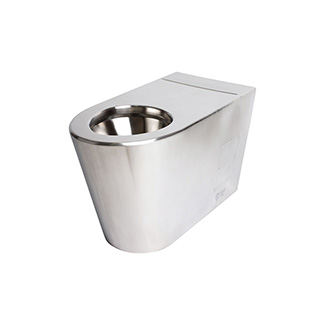
In multi-occupancy cells, facility managers increasingly specify an ADA-compliant water-saving stainless toilet with silent flush to address both conservation and accessibility mandates in one fixture. The PQ605 model from Xinhe pairs a 1.2mm thick 304-grade body with a 35° angled basin that evacuates waste on a single 1.28 GPF cycle. Its silent flush valve limits noise transfer between cells, which helps officers monitor activity during overnight hours, while the antimicrobial surface and seamless unibody construction cut the cleaning labor that multi-occupancy cells typically demand.
Matching GPF to Regional Compliance
Plumbing codes vary significantly by region, so the specifications for an acceptable stainless toilet must align with local water authority mandates.
North American Specifications
In the United States and Canada, procurement teams focus on the low flush correctional toilet standard of 1.28 GPF. Facilities specify an ASME A112.19.3 stainless toilet to ensure code compliance. Projects receiving state funding often mandate EPA WaterSense detention fixtures to guarantee both flow rate reductions and evacuation performance.
European Union & UK Directives
European procurement leans toward dual-flush technologies. A BS EN 997 compliant prison toilet typically uses a 3/6 L or 3/4.5 L valve configuration. A dual flush fixture offers the flexibility needed to meet strict EU water directives, providing a hygienic solution for secure facilities without wasting full-flush volumes on liquid waste.
Australia & New Zealand Standards
In Oceania, strict water efficiency labelling is mandatory. Any commercial or institutional build requires a WELS rated fixture to pass local approvals. Contractors primarily specify a 4.5/3 litre dual flush prison toilet to meet conservation requirements while securing sign-off for correctional plumbing fixtures Australia wide.
Middle East Water Initiatives
Gulf states face extreme municipal water limits, requiring efficient systems that withstand high incoming water pressure. A specialized water-efficient prison toilet supplier usually provides custom fixtures that operate on low GPF while resisting scaling from hard water conditions.
Southeast Asia & ASEAN Requirements
For projects across the Philippines, Indonesia, and Malaysia, high humidity and coastal conditions demand corrosion resistance. Buyers sourcing an OEM stainless WC often specify 1.28 GPF systems built from 316-grade steel to prevent salt-air degradation.
Procurement teams handling cross-region projects often align these flush ratings with how secure facility plumbing should be specified from day one, so that GPF, valve type, and rough-in dimensions are locked before fabrication starts.
Operational Levers for Water Savings
Achieving maximum water efficiency requires looking beyond the bowl’s baseline GPF rating. Modern detention facilities use secondary operational levers to prevent intentional water waste, a common issue in high-security environments.
Programmable Flush Limits
Inmates often trigger continuous flushes to cause flooding or dispose of contraband. Integrating electronic controllers lets facility managers set lockout times (e.g., maximum of two flushes per hour). This prevents malicious water dumping, ensuring the fixture performs exactly as modeled in the budget.
Sensor and Time-Delay Actuation
Pneumatic push-buttons with time-delay functions prevent rapid, consecutive flushing. Proximity sensors ensure the fixture flushes only when necessary, removing the physical button entirely and further minimizing ligature risks.
Leak Detection and Prevention
Traditional porcelain toilets are prone to hairline cracks that cause silent, continuous leaks. A fully welded stainless steel toilet for detention project installations eliminates these micro-leaks. The unibody construction ensures water leaves the bowl only during an active flush cycle.
Cost Modeling and Payback
Project buyers often need to justify the initial capital expenditure of stainless steel fixtures. Buyers calculate the payback period of a low-flush fixture by combining utility savings with reduced maintenance overhead.
| Metric | Legacy 3.5 GPF Ceramic | Modern 1.28 GPF Stainless Toilet |
|---|---|---|
| Flush Volume | ~13.2 Liters | ~4.8 Liters |
| Est. Annual Water Use (500 beds, 12 flushes/day) | ~28,800 m³ | ~10,500 m³ |
| Estimated Water Savings | Baseline | ~18,300 m³ saved annually |
| Replacement Frequency | High (cracking, vandalism) | Significantly lower (25+ year lifespan) |
The true ROI for a facility goes beyond utility bills. By eliminating shattered porcelain, facilities save on emergency plumbing call-outs and reduce security risks to staff. When evaluating a bulk supplier, calculating this combined reduction in OPEX usually reveals a payback period of under three years.
Procurement Checklist
To ensure all operational and compliance bases are covered, A&E firms and contractors should integrate the following criteria into their bidding documents.
Many of these checklist items overlap with space planning for jail toilets, since teams must decide flush type and rough-in location before pouring the cell shell.
- Flush Volume: Confirm GPF or dual-flush mode (1.28 GPF / 3-4.5 L / 4.5-6 L).
- Regional Certification: Ensure compliance with EPA WaterSense, WELS, BS EN 997, or Gulf municipal standards.
- Valve Type: Specify pneumatic, electronic sensor, push-button, or remote programmable actuators.
- Material Grade: Select between 304 or 316 stainless steel (316 is highly recommended for coastal or high-humidity projects).
- Material Thickness: Demand a minimum gauge of ≥1.2 mm generally, with ≥1.5 mm on critical load-bearing surfaces.
- Security Features: Clearly outline anti-ligature and anti-vandal requirements.
- Mounting Configuration: Determine wall-hung, floor-mounted, or wall-drainage setups.
- Accessibility: Confirm ADA-compliant seat height and grab-bar clearance when the project falls under U.S. accessibility jurisdiction.
Working with an experienced manufacturer like Xinhe ensures the fabrication team strictly follows these specifications during production.
FAQ
Is 1.28 GPF enough flushing power for a high-use detention cell?
Yes, provided the fixture uses a siphon-jet design. Modern 1.28 GPF models use water velocity rather than sheer volume. When matched with the correct incoming line pressure, a 1.28 GPF flush clears waste and toilet paper without requiring double-flushing.
What is the lowest GPF a stainless toilet can reliably operate at?
Operators can dial some electronic systems down to 0.5 GPF for liquid waste, but 1.28 GPF is generally the lowest recommended volume for solid waste evacuation in secure facilities. Going below this threshold in a primary ligature-resistant water closet risks drain line carry issues, potentially leading to blockages deep within the facility’s plumbing infrastructure.
Can existing detention centers retrofit to low-flush stainless toilets without replacing rough-in plumbing?
In many cases, yes. A custom manufacturer can engineer replacement fixtures that match existing wall or floor templates. Facility managers must verify that older, oversized cast-iron drain lines have sufficient slope to carry waste using lower water volumes to prevent settling.
Are dual-flush stainless toilets accepted for U.S. correctional projects?
While dual-flush systems are the standard in Europe and Australia, U.S. projects typically favor a single 1.28 GPF flush to meet EPA WaterSense criteria and simplify maintenance. Dual-flush options are gaining traction in progressive U.S. facilities aiming for LEED certification or strict state-level water mandates.
Conclusion
Specifying a low-flush stainless toilet for a detention project is no longer optional. Water authorities, sustainability mandates, and operating budgets all push in the same direction. Current technology lets facilities cut flush volume sharply without giving up the security, durability, and anti-ligature performance that correctional environments demand. Project teams sourcing should align GPF, flush valve type, material grade, and rough-in dimensions before fabrication begins.
Need a region-specific spec sheet, GPF options, or a quotation from a factory direct prison toilet manufacturer for an upcoming project? Share your project brief to Xinhe, and our engineering team will return a configured proposal tailored to your secure facility’s exact requirements.