Why a Professional Workbench with Drawers is the Secret to an Efficient Commercial Space
People spend thousands of dollars on high-end ranges or CNC machines, but then they try to save a few pennies on the tables where the actual work happens. It’s a classic mistake. If your table wobbles when you’re deboning a chicken or assembling a gearbox, your entire workflow is compromised.
The humble stainless steel prep table is often treated as an afterthought, but in reality, it’s the center of the universe. When you upgrade to a workbench with drawers, you aren’t just buying furniture; you’re buying back time. In a high-pressure environment, movement is your enemy. Every step you take to find a clean whisk or a specialized wrench is a second wasted. By integrating storage directly into your primary surface, you turn a static piece of metal into a command center.
The Physics of “Commercial Grade”
In the world of commercial kitchen equipment, everything looks the same on a website. It’s all silver, it’s all shiny, and it all claims to be “heavy-duty.” But once you get it in the room, the differences become glaring. The most important metric you’ll ever look at is the “gauge.”
We’ve met some managers buy 18-gauge tables because they were $50 cheaper. Two months later, those tables have a permanent “bow” in the middle because someone sat a heavy mixer on them. If you’re doing real work, you need a 14-gauge or at least a 16-gauge top. A 14-gauge stainless steel workbench feels like a tank. It doesn’t “ping” or vibrate when you’re pounding meat or hammering a joint. It has a high load-bearing capacity that gives you peace of mind. If you’re bolting a vice to the corner, you want that 14-gauge thickness so the bolts don’t just rip through the sheet metal.
304 vs. 430 Stainless
This is where things get technical, and it’s where most people make a mistake that ruins their equipment within a year. There are two main flavors of stainless steel in this industry: 304 and 430.
- 304 Stainless Steel Table: This is the gold standard. It contains a higher percentage of nickel and chromium. Why does that matter? Because it makes the steel virtually immune to rust in wet environments. If you’re in a kitchen where you’re constantly splashing water, vinegar, or citrus juices, you need 304. It costs more, but it’s a one-time purchase.
- 430 Stainless Steel Table: This is a more “economical” option. It’s magnetic and it’s great for dry environments—think of it for a garage workbench with storage where you’re mostly dealing with tools and dry parts. But if you put a 430 table in a damp dish room, you’ll see “tea staining” (those little orange rust spots) faster than you can say “health inspection.”
Trust us, if you’re in the food industry, go with 304. The extra cost is basically an insurance policy against having to buy a new table in 18 months.
The Philosophy of the Drawer
A flat table is a surface; a workbench with drawers is a system. We are huge believer in the “mise en place” philosophy—not just for ingredients, but for your entire life.
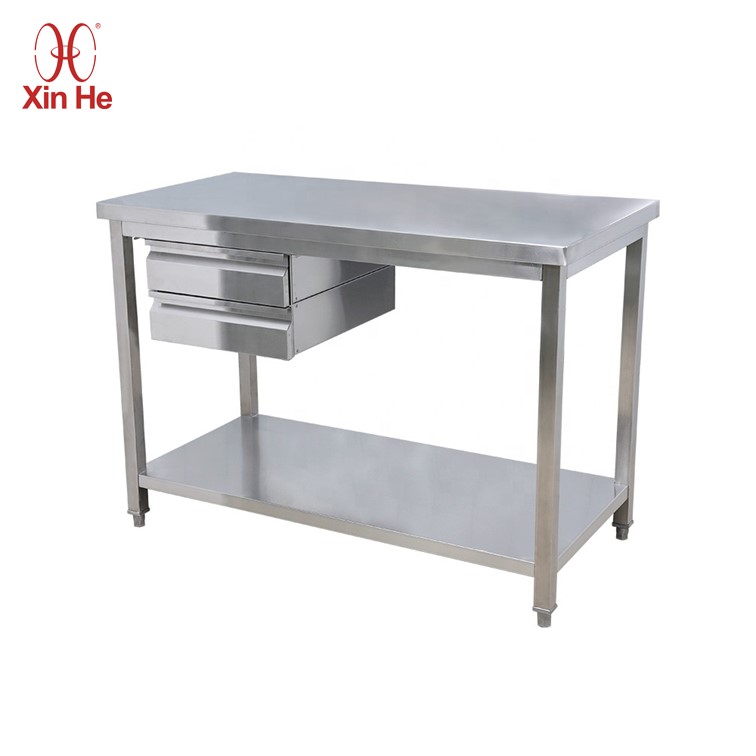
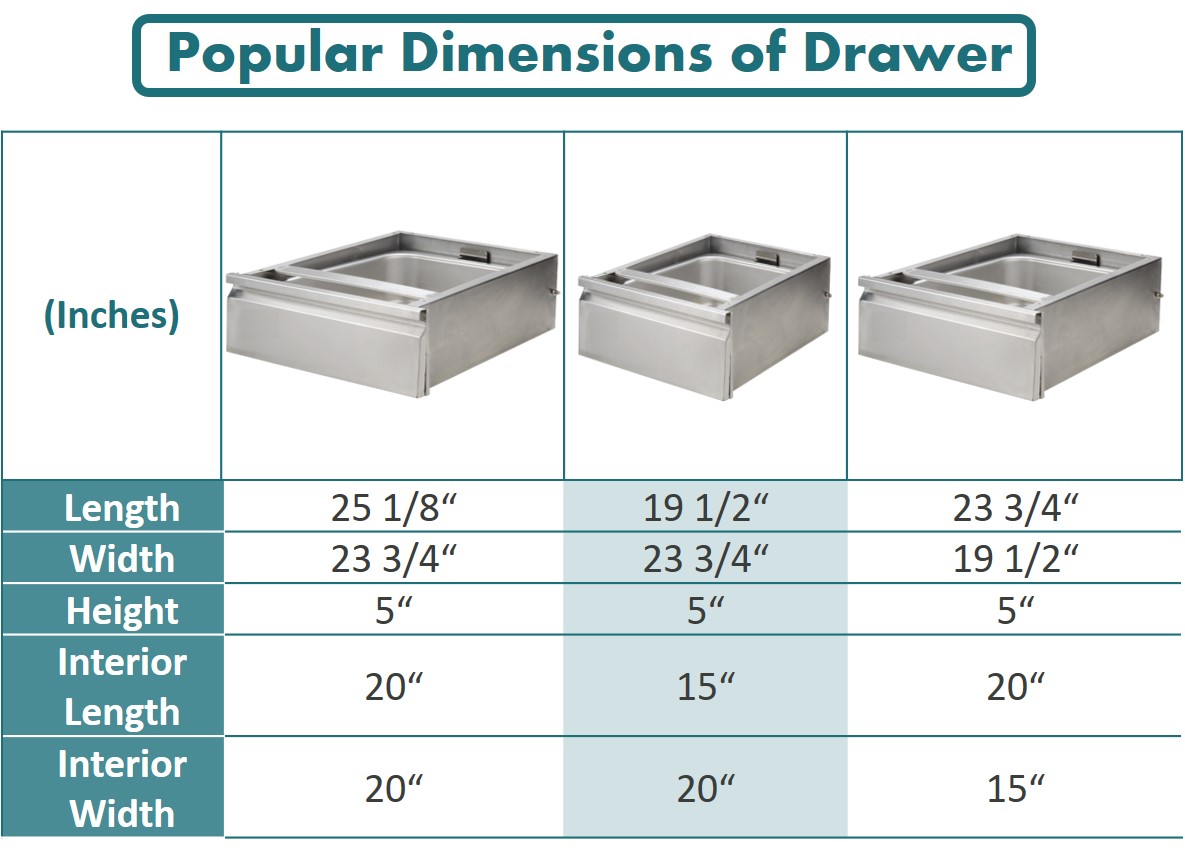
When you have built-in workbench drawers, you create a home for the things that usually clutter up your top surface. In a kitchen, that’s your digital scales, your thermometers, and your tasting spoons. In a workshop, it’s your calipers, your sharpies, and your safety glasses. When these things have a drawer, they don’t get lost under a pile of prep or covered in grease.
We often suggest a connected components layout: a mix of drawers for small items and workbench shelves (undershelves) for the big stuff. If you’re wondering how this affects your setup’s longevity, it’s worth checking what is the life expectancy of a stainless steel table with wheels to ensure your mobility doesn’t compromise the drawer tracks’ alignment over time.
Ergonomics
Most people overlook the standard workbench height, which usually hovers around 35 to 36 inches. This is designed for the “average” person, but in a real commercial setting, no one is average. You’re standing for eight, ten, maybe twelve hours a day. If that table is two inches too low, you’re going to be hunched over, and by the end of the week, your lower back will be on fire.
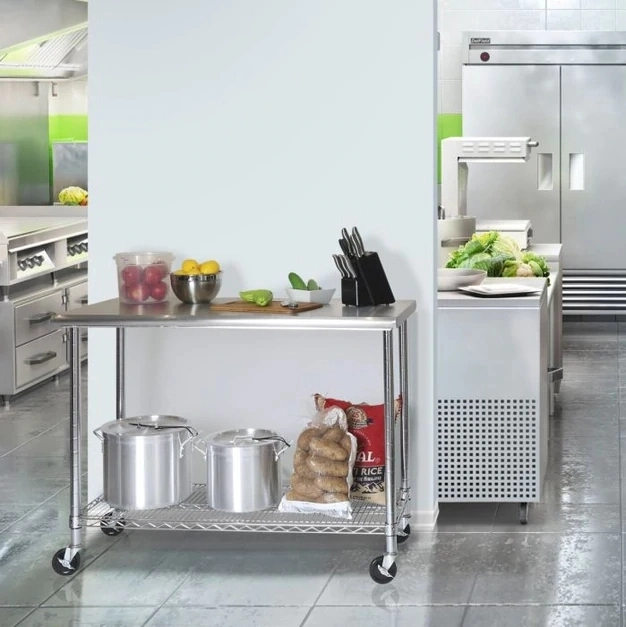
Look for tables with adjustable bullet feet. They allow you to level the table on those notoriously uneven commercial floors, but they also give you about an inch or two of vertical wiggle room. If you need something even more dynamic, a workbench with wheels is a lifesaver. Being able to roll a heavy workstation out of the way to mop the floor or to reconfigure your line for a big catering event is a luxury you won’t want to live without once you’ve had it. Just make sure the casters are high-quality—cheap wheels will lock up the second a bit of grit gets in the bearings.
Beyond the Kitchen
It’s interesting how often restaurant equipment finds its way into high-end workshops. We know a guy who runs a precision bike shop, and his entire floor is lined with stainless steel tables. He uses them because he’s constantly dealing with degreasers and hydraulic fluids that would rot a wooden bench in weeks.
For a garage workbench with storage, stainless steel is actually a very smart play. It’s easy to clean, it reflects light (which helps you see what you’re doing), and it doesn’t soak up oil. If you’re working on a dirty engine block, you can just spray the whole table down with a degreaser and wipe it clean. Try doing that with a plywood top.
Maintenance: The “Do’s and Don’ts”
People think stainless steel is “set it and forget it,” but that’s not quite true. If you want your workbench with drawers to look like a mirror for ten years, you have to treat it right.
- Stop using bleach: Chlorine is the enemy. It breaks down the protective chromium oxide layer on the steel. Use a specialized stainless cleaner or just mild soap and water.
- Wipe with the grain: If you look closely, the steel has a “direction.” Always wipe that way to avoid streaks and microscopic scratches.
- Don’t use steel wool: If you scrub a stainless table with a carbon steel wool pad, you’ll actually leave tiny bits of iron embedded in the surface. Those bits will rust, making it look like your table is failing when it’s actually just the residue from the pad. Use a green Scotch-Brite pad instead.
Conclusion
A durable workbench with drawers isn’t just a purchase; it’s an investment in your sanity and your efficiency. Its robust construction ensures it won’t let you down in the middle of a rush, and the integrated storage keeps your workspace from turning into a disaster zone. By picking the right gauge and the right grade of steel, you’re setting yourself up for years of trouble-free work.
If you’re tired of working on surfaces that shake and storage that’s always out of reach, it’s time to level up. Get a quote from Xinhe today. We know the difference between “shiny” and “sturdy,” and they can help you spec out a table that actually fits your workflow.
FAQs
1. Do steel tables scratch easily?
Yes, it’s going to get fine scratches over time—that’s called “patina.” Most commercial kitchen equipment has a brushed finish specifically to help hide these marks. If you’re worried about it, always use a cutting board. Don’t go hacking away directly on the metal.
2. What’s the actual difference between a workbench and a standard prep table?
It mostly comes down to “beefiness.” A standard prep table is a simple, lightweight surface for making sandwiches or tossing salads. A stainless steel workbench is usually built with a thicker gauge and often includes extra features like workbench drawers or a reinforced frame. It’s meant for the heavy lifting.
3. Is 304 steel really worth the extra money?
If there is even a hint of moisture or salt in your environment, yes. If you’re using it as a packing station in a dry warehouse, you can get away with 430. But for 90% of commercial applications, the 304 is the better long-term investment.
4. Can I add more drawers later?
It depends on the model. Some high-end brands allow you to bolt on additional workbench drawers later, but it’s almost always cheaper and more stable to buy the configuration you want from the start. Retrofitting can be a pain and often leads to a “franken-table” that isn’t as sturdy.
5. Are these tables okay for heavy machinery?
As long as you check the load-bearing capacity and choose a 14-gauge top, absolutely. I’ve seen these tables hold industrial mixers and small lathes without a problem. Just make sure the weight is distributed evenly across the legs.