Commercial Stainless Table Engineering: Why Quality is Your Best Investment
Whether you are a bulk wholesaler in Dubai, a project contractor for a New York hotel chain, or a heavy-duty importer in Sydney, you understand that the stainless table is more than just furniture—it is the backbone of your “uptime.” In high-traffic facilities, you aren’t just buying a surface; you are investing in a workstation built to be scrubbed, slammed, soaked, and stressed for 18 hours a day, 365 days a year. At this scale, the “cheapest” price is almost always the most expensive mistake you can make.
As a manufacturer, we see the entire lifecycle of these products, from the raw steel coil to the final shipping container. We know exactly why one table can endure three decades of abuse while another pits and rusts within three months. This guide is designed to give you the cold, hard engineering facts behind the stainless table and explain why it remains the undisputed king of the commercial workspace.
1. Beyond the Surface: Durability and Longevity in Hostile Environments
When we talk about a commercial stainless steel table, we are talking about a piece of equipment that serves as the literal foundation of a workflow. In a high-volume kitchen or a pharmaceutical lab, the environment is fundamentally hostile. It is acidic, it is humid, and it is physically punishing.
The Myth of “Stainless”
Stainless steel relies on a chromium-oxide “passive layer” to heal itself. If you buy a low-quality heavy duty stainless steel table with poor nickel content, that layer fails. For the B2B buyer, understanding why restaurants use stainless steel tables comes down to this structural and chemical stability.
For the B2B buyer, longevity isn’t just about the metal not snapping; it’s about the structural integrity of the welds and the gauge of the top. In our factory, we focus on the “bend test.” A cheap table will “oil-can”—that annoying popping sound when you press down on the center. A high-quality industrial table from a reputable manufacturer like Xinhe uses reinforced hat channels. These are U-shaped supports welded underneath the tabletop that distribute weight and eliminate the flex.
Why Gauge is Your Most Important Metric
If you are importing containers of equipment, you need to know that a 14-gauge stainless kitchen table is roughly 25% thicker than a 16-gauge one. For a prep station where staff are using heavy mallets or industrial mixers, 14-gauge is the only choice that prevents denting. Dents aren’t just ugly; they create microscopic valleys where liquid pools, eventually leading to “pitting corrosion.”
2. The Hygiene Standard: Why Non-Porous Wins Every Time
In the B2B sector, specifically for hospital projects and food service, hygiene isn’t a “nice-to-have”—it’s a legal liability. The primary reason a commercial stainless steel table is the global standard is its non-porous nature.
The Science of Easy Maintenance
“Are stainless tables easy to clean and maintain?” This is the most common question from junior procurement officers. The answer lies in the “RA” (Roughness Average) value of the finish. A #4 brushed finish is standard because it balances aesthetics with sanitization.
Unlike wood, which has a grain that acts as a skyscraper for bacteria, or plastic, which develops deep scratches that harbor salmonella, a stainless prep table can be wiped down with a 10% bleach solution or heavy-duty degreasers without losing its luster. For high-traffic environments, this means faster turnover between shifts and lower labor costs for cleaning.
Key Hygienic Features to Look For:
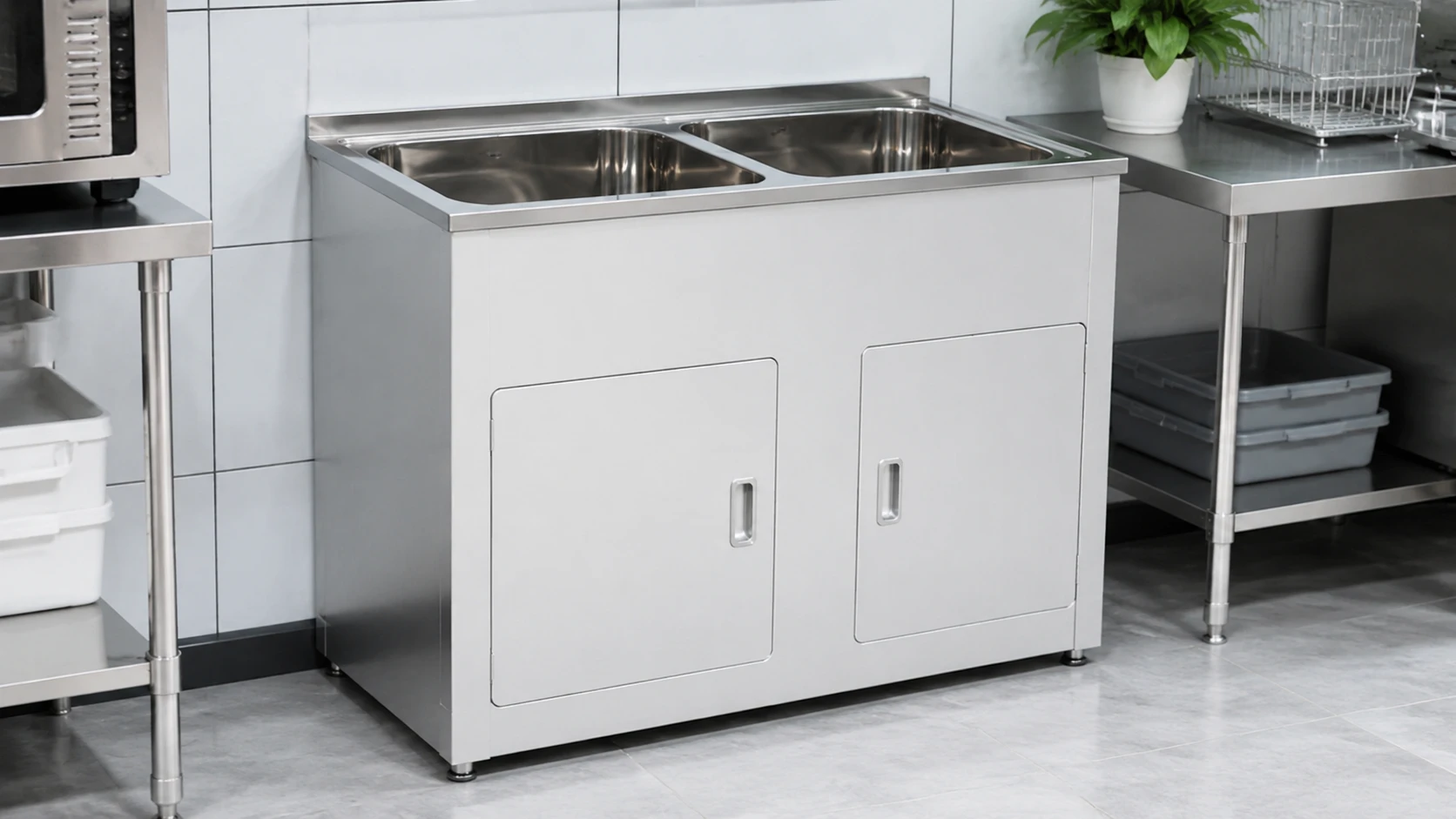
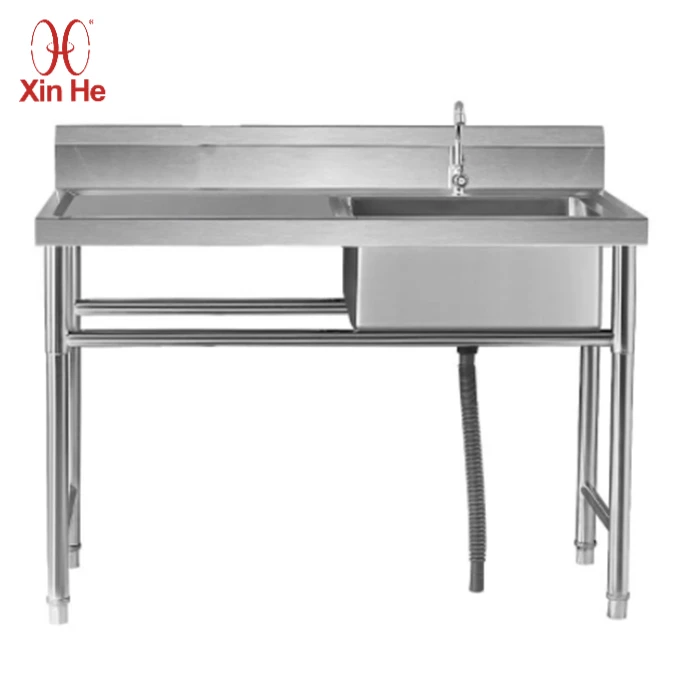
- Coved Corners: In a stainless table with sink, look for “coved” or rounded internal corners. Dirt loves 90-degree angles. If the sink bowl is pressed with a radius, it can be wiped clean in one motion.
- Marine Edges: A high-end restaurant table often features a marine edge—a slightly raised “drip guard” around the perimeter. This prevents raw meat juices or chemical spills from running onto the floor, keeping the entire facility safer and cleaner.
3. Maximizing ROI through Workspace Efficiency
A table is a dead asset if it doesn’t improve the speed of the person standing at it. As a manufacturer, we don’t just sell “rectangles with legs”; we sell workflow solutions. When a contractor asks for a commercial work table vs prep table, we start asking about the “triangle of movement.”
Organization and Customization
The ROI increases exponentially when you add storage solutions.
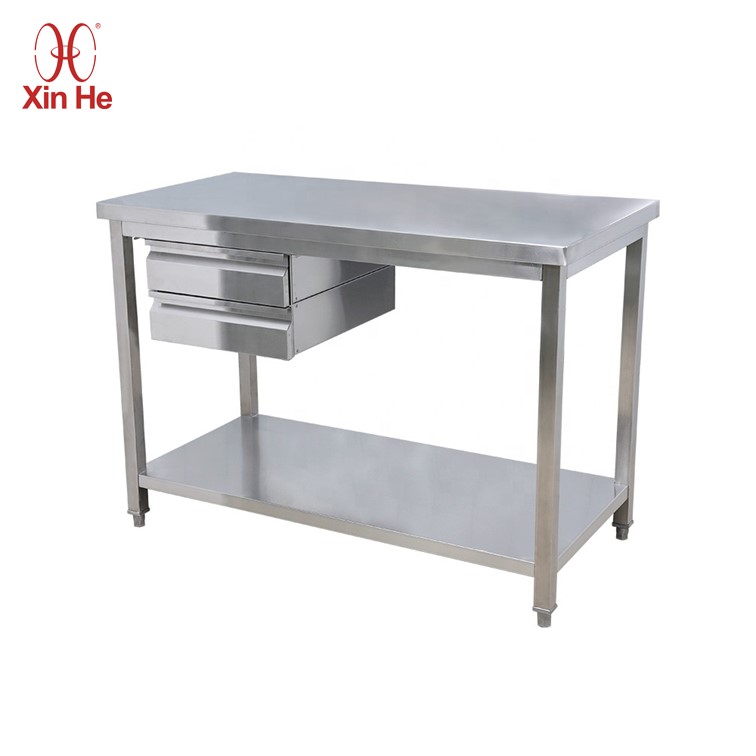
- Undershelves: Most commercial tables made from steel come with an adjustable undershelf. For a wholesaler, offering a table with a “high-shelf” or a “double-deck” allows the end-user to store three times the equipment in the same footprint.
- Mobility (Casters): Adding heavy-duty casters turns a stationary unit into a mobile prep station. To ensure safety, we always recommend checking the life expectancy of a stainless steel table with wheels to match the weight capacity with the right caster grade.
The Role of the Island
A kitchen work table island is the most efficient configuration for a collaborative team. By removing the backsplash and making the table accessible from 360 degrees, you eliminate the “bottleneck” effect. In a B2B project context, specifying islands rather than wall-mounted tables can often reduce the total number of units needed, saving the client money while increasing throughput.
4. Technical Comparison: Making the Right Selection
For the importer or trade buyer, you need to be able to explain the “Why” to your customers. Use this breakdown to justify the price point of premium equipment.
| Table Type | Primary Use Case | Critical Feature |
|---|---|---|
| Prep Table | High-intensity food prep | Built-in cutting boards or poly-tops. |
| Work Table | General assembly, packing, labs | 14-gauge steel with reinforced bracing. |
| Kitchen Island | Collaborative, central hub | 360-degree access; no backsplash. |

Where to Buy and What to Ask
If you are wondering where to buy quality stainless tables online, the market is flooded. However, for B2B bulk orders, going through a platform like WebstaurantStore or Amazon is fine for a one-off, but for projects, you need a direct relationship with a factory.
When vetting a supplier like Xinhe, ask for their salt spray test results. Ask about the “Type” of stainless. The 304 and 316 stainless steel table debate is a classic:
- 304 Stainless: The workhorse. Best for 99% of indoor commercial applications.
- 316 Stainless: The “Marine Grade.” If your project is a beachside resort or a laboratory using harsh chlorides, 304 will fail. 316 is more expensive but is the only thing that won’t rust in high-salinity air.
Visual & Technical Checkbox for Buyers:
- Material: Is it 304 for general use or 316 for coastal/chemical use?
- Gauge: Is the top thick enough (14 or 16 gauge) to prevent “oil-canning”?
- Legs: Are the legs also stainless, or are they galvanized? (Stainless legs last longer in wet environments).
- Feet: Are the bullet feet adjustable to level the table on uneven floors?
- Certification: Does it meet NSF (National Sanitation Foundation) standards for your region?
By focusing on these metrics, you aren’t just buying a table—you are securing the operational future of your commercial space.
Conclusion: Investing in Infrastructure
At the end of the day, a stainless table is an investment in your facility’s infrastructure. If you are a project contractor, your reputation is tied to the longevity of the equipment you install. At Xinhe, we understand that our success is built on the durability of the products we ship to your docks—whether it’s a standard unit or a complex custom stainless steel work table with drawers designed for high-efficiency pharmacy labs.
Choosing high-quality stainless steel—engineered with the right gauge, the right grade (304 vs 316), and the right reinforcements—ensures that the workspace remains a productive, hygienic, and safe environment for decades.
If you are ready to upgrade your facility or need a bulk quote for an upcoming project, don’t settle for “catalog” descriptions. Consult with experts who understand the metallurgy and the workflow. Get a free consultation with our experts today and ensure your next project is built on a foundation of quality.
FAQs
Do steel tables scratch easily?
Yes. Any metal-on-metal contact will scratch the surface. However, a heavy duty stainless steel table with a #4 finish hides these scratches well. More importantly, these scratches are superficial; they do not compromise the “passive layer” that prevents rust.
How much weight can a commercial stainless steel table typically support?
A standard 16-gauge table for a restaurant (60 inches long) can typically hold 500–800 lbs if the weight is distributed. If you are placing a 400-lb dough mixer in the exact center, you must specify a table with center-leg support or a thicker 14-gauge top.
What is the difference between a worktable and a prep table?
Terminology varies, but generally, a stainless steel worktable is a flat surface for equipment or assembly. A stainless prep table often includes a backsplash to protect the wall and may have a sink or integrated storage for knives and tools.