Corner Work Table vs Straight Table: Which One Actually Earns Its Floor Space
Picking layout equipment is a tug-of-war. You want to squeeze every usable inch out of the floor, but you also need the line to move fast. And in a busy commercial kitchen, the trouble almost always shows up in the same spot: where two walls meet. That awkward 90-degree junction is where prep zones stall and dishwashing stations get clumsy.
So when you’re laying out a wall-side prep area or tying two stations together, the question comes up fast: do you spend more on a corner work table, or stick with a plain straight one? Honestly, it depends less on the table and more on how your kitchen handles dead corners, wall edges, and bodies moving through tight space.
Quick Answer: When a Corner Table Wins
Need a fast read before you order? A corner work table is the smarter buy when you’ve got empty corner footage to reclaim, when you want one continuous L-shaped flow between two stations, or when you need splash protection running along two walls at once.
A straight table makes more sense for long, open prep lines, for center-floor island setups, and for any kitchen where you’ll be shoving equipment around on a regular basis.
| Go with a corner work table when… | Stick with a straight table when… |
|---|---|
| Your wall corners sit empty and wasted | The prep line runs long, open, and dead straight |
| You want an unbroken L-shaped workflow | The table gets moved or regrouped often |
| Staff are squeezed into tight wall zones | Two or more cooks work opposite sides of a long table |
| You need splash protection on two meeting walls | The unit works mainly as a central island |
| The build needs custom sizing to fit the architecture | Off-the-shelf sizes already drop right into the plan |
What a Corner Work Table Actually Is
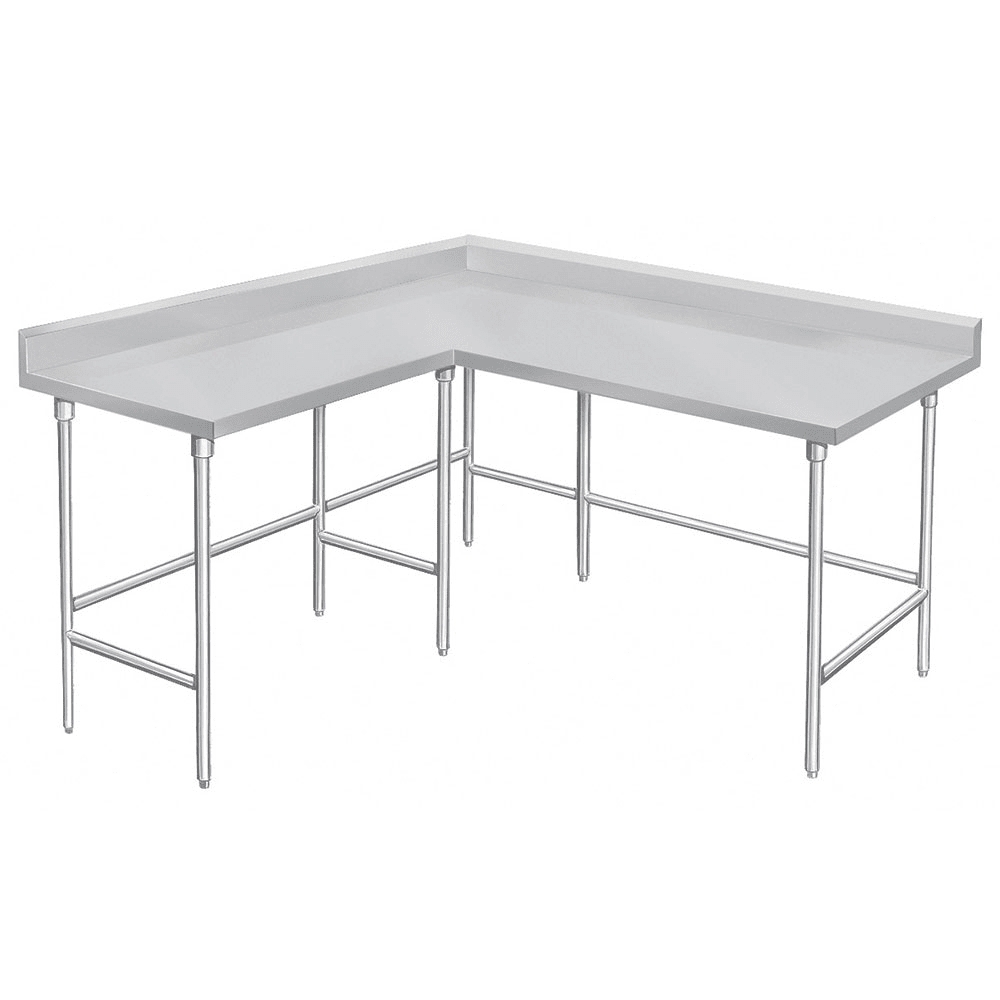
In a foodservice setting, a corner work table is a stainless steel surface built to drop into a 90-degree corner, or to act as a bridge linking two perpendicular runs of equipment. The difference from a regular rectangular table parked against one wall is simple: this one digs into the depth of the corner and turns wasted space into a working station.
You’ll see these in the places where space is tight and inspectors are strict — restaurant kitchens, hotel catering operations, institutional canteens, food processing plants. Depending on the job, the table gets built as an L-shape stainless steel corner work table with backsplash that hugs both walls, or as a compact square unit with a lower shelf for heavy smallwares. Either way, it gives you a stable surface for blending, slicing, and sorting without eating up the middle of the room.
Where the Corner Table Beats the Straight One
A linear table loses this fight in a few specific spots. To see why, look at three things: foot traffic, ergonomics, and what’s actually built into your walls.
Tight corners in restaurant kitchens
In a cramped restaurant kitchen, floor space translates directly into service speed. Force a standard rectangular table into a corner and you’ll create a hollow, unreachable pocket behind it — the kind of gap that collects dropped tongs and hidden grime. A dedicated restaurant kitchen corner table sits right in the junction instead, opening up surface area exactly where a cook needs to pivot. One person can plate or sort ingredients there without stealing any central floor.
L-shaped prep lines
Kitchen efficiency comes down to steps. Every trip a line cook makes from the wash zone to prep, or from prep to the cook line, costs seconds that add up over a shift. A straight setup can force that walk back and forth. Drop in an L shape stainless steel work table and the turn becomes natural — the cook stands in the inside angle and reaches two surfaces just by twisting at the waist. Less fatigue, more plates out the door per hour.
Backsplash protection on two walls
Sanitation is where corner placement quietly pays off. Splashes, flour dust, and food scraps love to slip behind a table where you can’t reach, and that’s how mold and code violations start. A corner work table with backsplash seals off both meeting walls at once. Near a dish sink or a raw protein station, that matters — a continuous run of custom corner work table with backsplash gives you a hygienic prep surface you can hose and wipe in seconds.
Storage in the corner you weren’t using
Storage runs short in most kitchens, especially for the bulky stuff — stockpots, mixing bowls, bulk ingredient bins. Wire racks are a pain to wedge into a corner next to a prep station. A heavy-duty stainless steel corner table with storage solves it by tucking an undershelf right under the work surface. Go with a compact corner table with lower shelf and you’ve turned a dead corner into an organized commercial kitchen storage table that keeps clutter off the active path.
Custom project layouts
Big jobs rarely come with tidy walls. A multi-floor hotel kitchen or an industrial food processing plant is full of columns, plumbing drops, and electrical conduit that break up any straight line. Catalog tables can’t fix that. This is where a custom stainless steel work table earns its keep — a good stainless steel work table manufacturer can change the length, depth, and cutouts so a corner unit wraps cleanly around whatever’s in the way, keeping the layout tight and code-compliant.
Where the Straight Table Still Wins
None of this makes corner units a blanket replacement. The straight stainless steel work table is still the backbone of open layouts and high-volume assembly lines, and there are real reasons for that.
If your workflow depends on a center island where prep cooks face each other and build dishes together, you need a straight table. Full stop. Corner units are stuck against perimeter walls by design — they can’t work as a double-sided island. Straight tables also win on flexibility. Menu changes, new production lines, seasonal swaps — bolt on some casters, roll the table away, regroup it however you want.
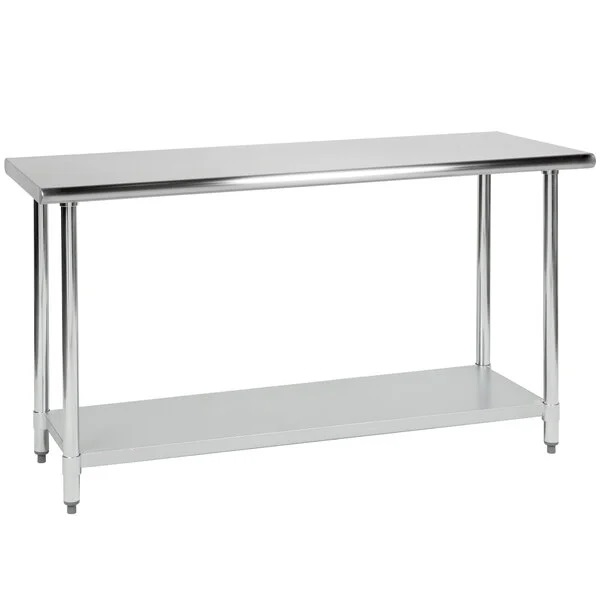
And for big budget-driven builds that need a wall of identical workstations, ordering a straight prep table with undershelf in standard lengths is just cheaper. These units run off the line in volume with barely any tooling changes, which is exactly what you want for long, plain prep walls where no special corner engineering is involved.
The Buying Factors That Actually Matter
When you’re staring at blueprints for a new build or reworking an old layout, weigh these before you lock the equipment list:
| Buying factor | Corner work table | Straight table |
|---|---|---|
| Best placement | Architectural corners, L-shaped zones, wall junctions | Open center floors, long walls, linear prep lines |
| Space use | High — reclaims dead corner area | High on straight runs, poor in corners |
| Worker access | Built for single-worker pivot work | Built for cooks working opposite sides |
| Wall & splatter protection | Excellent — covers two walls with dual backsplash | Standard — covers one straight wall section |
| Mobility | Low — usually fixed or built in for an exact fit | High — takes casters easily for modular layouts |
| Procurement cost | Higher, thanks to custom engineering | Lower, with stock sizes ready to ship |
Here’s how I’d think about it. If your cooks burn time walking across an open floor to move things between two perpendicular walls, the higher upfront cost of a corner unit pays itself back fast — fewer steps, fewer collisions, fewer accidents. But if your floor plan has to flex with the seasons, the standard linear option will serve you longer. Neither answer is universal, and anyone who tells you otherwise is selling something.
What to Check Before You Order a Corner Table
Corner units demand more precision than a row of straight tables. They interface directly with existing walls and adjacent commercial kitchen equipment, so a small measuring slip turns into expensive field rework. Run through this list first:
- Verify the corner angle. Don’t trust the wall to be a true 90 degrees. Drywall flaws, uneven tile, and a settled foundation all throw corners out of square. Put a digital protractor on it before fabrication starts.
- Match the table depth. The corner unit’s depth should line up with the sinks and straight tables sitting against it — common 600mm or 700mm depths — so you don’t end up with a protruding edge someone catches a hip on.
- Align the backsplash height. The integrated stainless steel backsplash needs to match the height and thickness of neighboring equipment, or you’ll leave gaps where moisture creeps behind the wall lining.
- Check the under-table clearances. Low plumbing lines, floor drains, and outlets can all clash with an undershelf or a drawer.
- Spec the material grade. For hard daily use, ask for 304 stainless steel on the top — it holds up to organic acids, harsh sanitizers, and the inevitable banging around.
- Decide on the build format. A fully welded unit gives you maximum rigidity and load capacity. A knockdown unit ships flat and squeezes through narrow doorways, elevators, and tight halls during install. Pick based on your site, not your preference.
Picking the Right Corner Design
Matching the model to your real problem — splashing, storage shortage, or both — is what makes the table worth the money. There are two main configurations to choose from:
| Model type | Best for | What it does well |
|---|---|---|
| L-Shape corner work table with backsplash | Wall-side prep lines, wet dishwashing areas, heavy fluid prep | Seamless turn, strong dual-wall splash guard, big surface |
| Corner table with storage | Tight restaurant corners, small bakery prep, dry-goods packing | Space-saving footprint, deep lower shelf, fast tool access |
For a large facility, the smart move is to run both designs along the perimeter and drop straight tables down the center. That mix tends to give the cleanest flow.
So Is a Corner Work Table Better
Not better in some absolute sense. But it’s far better at solving a particular set of problems. If your kitchen has empty wall corners begging to be used, needs an unbroken L-shaped prep line, or demands airtight hygiene along two walls, the corner unit is the right call. If you mostly need long open prep runs and the freedom to rearrange, straight tables win.
On a real project — a hotel, a canteen, a processing plant — you rarely commit to one style anyway. The best layouts blend high-volume straight tables with custom-built corner units, and let each do the job it’s actually good at.
As a trusted partner, Xinhe runs full OEM and ODM customization to help contractors and project buyers tune their layouts to the building they’ve actually got. Browse the full commercial kitchen equipment range, or reach to request a custom project quote with your specs in hand.
FAQ
Is a corner work table only for small kitchens?
No. It saves space in a cramped prep room, sure, but it’s just as useful in a large industrial kitchen. In big facilities it creates smooth transitions between perpendicular prep zones, closing gaps and keeping traffic flowing along long perimeter walls.
Can a corner table replace a straight prep table entirely?
No — they work as a pair. A corner unit is made for wall placement and corner junctions. It can’t serve as a central island where cooks need all four sides. A solid layout uses straight tables down the center and corner tables along the walls.
Should I get an integrated backsplash?
If the table sits flush against the wall — especially near dish zones, veg prep, or the cook line — yes. The backsplash stops water, grease, and scraps from slipping behind the table, protects the wall from moisture, and makes deep cleaning a lot faster.
Knockdown or fully welded — what’s the difference?
A knockdown table ships flat. That cuts shipping volume and cost, and it’s far easier to carry through tight doorways and halls. A fully welded table arrives ready to use, rigid, and rated for heavier loads — the better pick for the toughest industrial work.
What should I send before asking for a custom quote?
Give the exact dimensions of your corner walls, the table depth and working height you need, whether you want a backsplash, and your preferred shelf setup. A rough blueprint or a quick layout sketch helps the manufacturer nail the fit.